The oldest footprints of the dinosaur lineage have been found, dating back about a quarter-billion years.
The age of these prints reveals they were made in the immediate aftermath of the worst mass extinction in history — the devastating Permian-Triassic event, which eliminated as much as 95 percent of the planet's species. As such, these findings suggest the roughly 160-million-year-long Age of Dinosaurs not only ended in disaster, but might have begun because of one as well.
"The Permian-Triassic was a time of global devastation, but also a time of great opportunity, because new groups had the space and freedom to evolve in the post-apocalyptic world," said researcher Stephen Brusatte, a paleontologist at the American Museum of Natural History in New York.
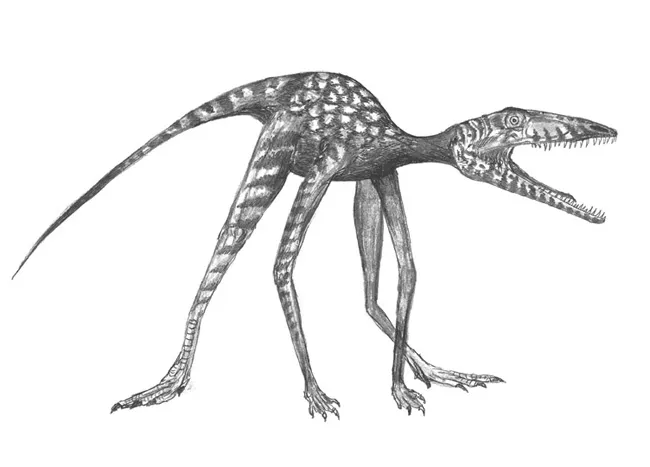
Scientists uncovered the roughly 250-million-year-old footprints in the Holy Cross Mountains of central Poland. They came from a housecat-sized creature with feet only about three-quarters of an inch (2 cm) long. The animal walked on all four legs, and possessed much longer hindlimbs than forelimbs, given how its footprints apparently overstep the handprints.
The different lengths of the creature's toes and the way they were angled suggest it was an ancestor of the dinosaur lineage known as a dinosauromorph.
"We have identified the oldest fossils of the dinosaur lineage," said researcher Grzegorz Niedzwiedzki, a paleontologist at the University of Warsaw in Poland.
The prints were made on the floodplain of a large meandering river, far inland from the coast, which captured many other different kinds of tracks as well, including those of amphibians, lizards, and predatory relatives of crocodiles known as rauisuchians. However, the dinosauromorph only made 2 percent to 3 percent of the prints found in these rocks, suggesting it was a rare part of its environment.
"Dinosauromorphs, therefore, did not immediately blossom once they originated," Brusatte said. "They remained rare and small for a long time before becoming ecologically dominant."
The fact this dinosauromorph moved on four legs is at odds with past evidence suggesting that early dinosaurs all walked on two legs, a key trait that scientists had conjectured helped them dominate the world by moving faster than other reptiles.
"As these Polish footprints tell us, the earliest dinosauromorphs were still quadrupedal, and it took some time for bipedality to evolve," Brusatte said. "No longer is there a simple story that dinosaurs were bipedal and this made them successful."
These findings reveal that dinosauromorphs emerged just 1 million or 2 million years or so after the Permian-Triassic mass extinction — some 5 million to 9 million years earlier than before thought.
"This tells us something quite radical and unexpected," Brusatte told LiveScience. "It was previously thought that the rise of dinosaurs was something that happened 10 million to 20 million years later, and was unconnected with the extinction. But, it seems like the extinction played a critical role in opening ecological niches for new groups like the dinosaur lineage to conquer."
The scientists detailed their findings online Oct. 6 in the Proceedings of the Royal Society B.

