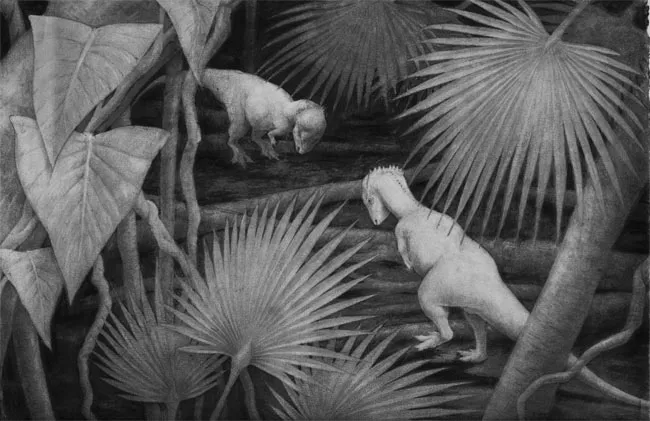
Dog-Sized Dinosaur Had Thick, Head-Butting Skull
Get the world’s most fascinating discoveries delivered straight to your inbox.
You are now subscribed
Your newsletter sign-up was successful
Want to add more newsletters?
Delivered Daily
Daily Newsletter
Sign up for the latest discoveries, groundbreaking research and fascinating breakthroughs that impact you and the wider world direct to your inbox.
Once a week
Life's Little Mysteries
Feed your curiosity with an exclusive mystery every week, solved with science and delivered direct to your inbox before it's seen anywhere else.
Once a week
How It Works
Sign up to our free science & technology newsletter for your weekly fix of fascinating articles, quick quizzes, amazing images, and more
Delivered daily
Space.com Newsletter
Breaking space news, the latest updates on rocket launches, skywatching events and more!
Once a month
Watch This Space
Sign up to our monthly entertainment newsletter to keep up with all our coverage of the latest sci-fi and space movies, tv shows, games and books.
Once a week
Night Sky This Week
Discover this week's must-see night sky events, moon phases, and stunning astrophotos. Sign up for our skywatching newsletter and explore the universe with us!
Join the club
Get full access to premium articles, exclusive features and a growing list of member rewards.
A dog-sized dinosaur may have roamed what is now Big Bend, Texas, some 70 million to 80 million years ago, ramming other paleo-beasts with a bony lump on its head.
The ancient Texan, now called Texacephale langstoni, represents a new genus of pachycephalosaur, a group of bipedal, thick-skulled dinosaurs.
Paleontologists discovered two specimens of the skull top, called a dome, from the dinosaur, in a horned dinosaur bone bed. The new species is about one of a dozen with a bony lump on its skull top, which the researchers suggest likely was used to butt heads in a manner similar to modern-day musk oxen and cape buffalo.
Darren Tanke of the Royal Tyrrell Museum in Canada spotted the first dome of the dinosaur's head while on a working holiday in January 2008.
"While I was wandering around the horned dinosaur bone bed, I happened to look down and there was this odd-shaped rock sitting on the ground," Tanke told LiveScience. "I just instinctually picked it up and when I turned it over I could see the impression of the brain case on the underside."
The dome is about the size of a peach, Tanke said.
The finding will help scientists piece together a more complete picture of species that lived in the Big Bend region, where such fossils are rare and tend to be poorly preserved, said Nicholas Longrich of Yale University, and lead author of the paper describing the dinosaur published in the April issue of the journal Cretaceous Research.
Get the world’s most fascinating discoveries delivered straight to your inbox.
In addition, the dinosaur seems to firm up an idea about ethnicity of sorts in dinosaurs. The discovery of the new species lends further weight to the idea, which has gained popularity in recent years, that dinosaurs found in Canada and the northern United States were distinct from their southern neighbors.
"Instead of roaming across the North American continent, we see pockets of different dinosaurs that are pretty isolated from one another," Longrich said. "Every time we get good fossils from Texas, they end up looking very different from those to the north."
The team hopes to find a complete skull of the species as well as to find more related dinosaur fossils from the Texas site.
Jeanna Bryner is managing editor of Scientific American. Previously she was editor in chief of Live Science and, prior to that, an editor at Scholastic's Science World magazine. Bryner has an English degree from Salisbury University, a master's degree in biogeochemistry and environmental sciences from the University of Maryland and a graduate science journalism degree from New York University. She has worked as a biologist in Florida, where she monitored wetlands and did field surveys for endangered species, including the gorgeous Florida Scrub Jay. She also received an ocean sciences journalism fellowship from the Woods Hole Oceanographic Institution. She is a firm believer that science is for everyone and that just about everything can be viewed through the lens of science.