















Colorful Strategy: Why Lizard Tails Change with Age
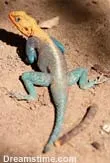
The rainbow-splashed tails of lizards fade with age, a costume change that is a consequence of different feeding behaviors in juveniles versus adults, new research suggests.
Juvenile lizards actively search for food, exposing themselves frequently to danger from lurking predators. By flashing an eye-catching tail, the lizards can deflect attacks to this appendage, which can re-grow if severed. Later in life when the lizard switches to less active food finding, the dazzling decoy becomes unnecessary.
The scientists, led by Dror Hawlena of Ben-Gurion University of the Negev in Beer-Sheva, Israel, monitored blue-tailed lizards during their typical one-year life spans. At hatching, the baby lizards all wore bright-blue tails, and by three weeks of age, 85 percent had lost the tail coloration and also their striped body patterns.
The lizard's main predator at the study site was a carnivorous bird, the great grey shrike, which hunts from perches and has excellent color vision.
To survive an ambush the juvenile lizards in the study used two tail displays—a fast, delicate vibration and a slower undulation—more frequently than when they matured. Since juveniles are so active there is a greater probability of encountering predators, and they are less likely to spot the unexpected enemy. So the tail displays can be lifesavers.
At about three weeks old, the lizards became less active and relied on the safer sit-and-wait method of finding food. While stationary, the adults are more likely to spot a predator in time to escape.
"The ultimate experiment to explore our hypothesis further would be to manipulate tail color and to examine survival consequences when lizards use either of the two foraging modes," the authors stated in their research paper, published in the November/December issue of the journal Behavioral Ecology.
Get the world’s most fascinating discoveries delivered straight to your inbox.
Researchers said that while they can't directly apply the results to other species, it could hold true for other lizards that experience the color change.
- Three Lizards, Three Behaviors
- Snakes, Frogs and Lizards: The Best of Your Images
- Fickle Female Fish Force Males to be Flashy
- Images: World's Ugliest Animals
Jeanna Bryner is managing editor of Scientific American. Previously she was editor in chief of Live Science and, prior to that, an editor at Scholastic's Science World magazine. Bryner has an English degree from Salisbury University, a master's degree in biogeochemistry and environmental sciences from the University of Maryland and a graduate science journalism degree from New York University. She has worked as a biologist in Florida, where she monitored wetlands and did field surveys for endangered species, including the gorgeous Florida Scrub Jay. She also received an ocean sciences journalism fellowship from the Woods Hole Oceanographic Institution. She is a firm believer that science is for everyone and that just about everything can be viewed through the lens of science.