 Live Science Plus


You are now subscribed
Your newsletter sign-up was successful
Want to add more newsletters?

Delivered Daily
Daily Newsletter
Sign up for the latest discoveries, groundbreaking research and fascinating breakthroughs that impact you and the wider world direct to your inbox.

Once a week
Life's Little Mysteries
Feed your curiosity with an exclusive mystery every week, solved with science and delivered direct to your inbox before it's seen anywhere else.

Once a week
How It Works
Sign up to our free science & technology newsletter for your weekly fix of fascinating articles, quick quizzes, amazing images, and more

Delivered daily
Space.com Newsletter
Breaking space news, the latest updates on rocket launches, skywatching events and more!

Once a month
Watch This Space
Sign up to our monthly entertainment newsletter to keep up with all our coverage of the latest sci-fi and space movies, tv shows, games and books.

Once a week
Night Sky This Week
Discover this week's must-see night sky events, moon phases, and stunning astrophotos. Sign up for our skywatching newsletter and explore the universe with us!
Join the club
Get full access to premium articles, exclusive features and a growing list of member rewards.
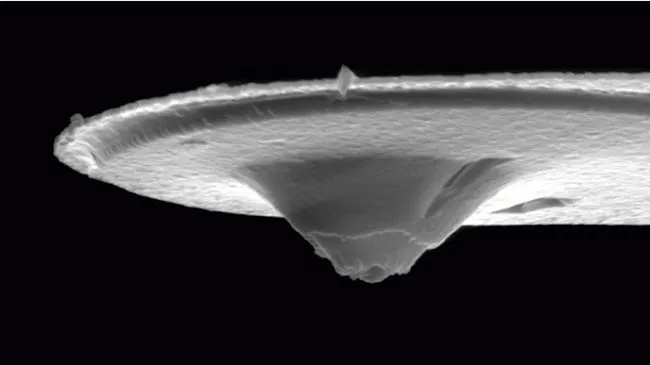
Researchers have created the world's smallest fountain pen with a tip so tiny it can draw lines a hundred times thinner than a red blood cell.
Called the "nanonfountain probe," it can paint lines as thin as 40 nanometers and has its own reservoir to hold various types of inks, including pigments for painting patterns and organic materials for designing sensors.
The new pen can be attached to the atomic-force microscope, which allows scientists to see nanoscale environments as well as draw on them. Possible uses for such a tiny pen, or an array of several of them, include crafting miniscule protein arrays and complex semiconductors.
Because scientists built the pen using standard microfabrication techniques and materials, it will be possible to mass-produce the tips.
The pen was developed by researchers at the National Science Foundation Nanoscale Science and Engineering Center for Integrated Nanopatterning and Detection Technologies. The research was published earlier this year in the journal Small and was publicly announced this week.
- The World's Smallest Robot
- The World's Smallest Motor
- The World's Smallest Refrigerator
- Bragging Rights: The Smallest Fish Ever
Small Stuff

Micromachines
Microscopic Art
