















Ancient Mayan Marketplace Discovered

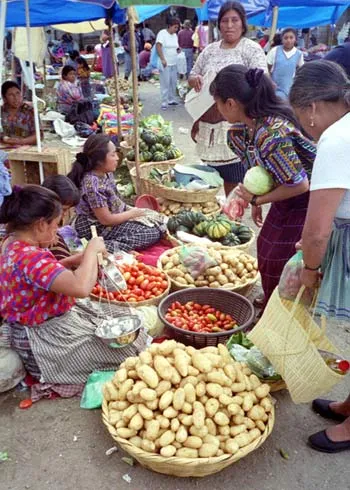
Chemical residues found in soil from Mexico’s Yucatan peninsula indicate that ancient Mayans traded food in marketplaces, a practice long considered unlikely by archaeologists.
From examining the sites of ancient Mayan cities, archaeologists have long recognized that the cities were home to more people than the local agricultural capacities could have supported, said Shepherd University archaeologist Bruce Dahlin, who led the new study of the Yucatan soil.
So for years, archaeologists looked for evidence of advanced farming practices that could have ramped up agricultural capacities beyond what archaeologists can observe, thus sustaining the populations. The idea that Mayans might have imported food and other goods wasn't taken seriously because most archaeologists thought that the Maya elite had a system whereby underlings were paid for loyalty by goods passed down the social ladder.
Still, large, open areas found in settlements of the Classic era (about A.D. 300 to 900) seemed to look like possible marketplaces, but archaeologists could find no strong indications of the areas' purpose. This is where the chemical residues came in handy.
Dahlin brought in environmental scientist Richard Terry of Brigham Young University and his team to analyze surface soil samples from Chunchucmil in the western Yucatan for indications that food had once been there. These indications come in the form of phosphorus, left in the soil by decomposed food.
"All food materials contain phosphorus, and a common denominator of all humans is that they bring food to places where they live," Terry said. "Over time, the organic matter is ground into the soil and rots, but the phosphorus holds to the soil particles even in a tropical rain forest that gets a meter or two of rain every year."
Terry and his team found concentrations of phosphorous up to 40 times higher in these open areas than those in ancient patios and streets. The pattern of phosphorous residue matched that found in the last remaining modern market that runs atop soil (all other modern markets have been paved).
Get the world’s most fascinating discoveries delivered straight to your inbox.
The matching patterns indicate that the Mayans did in fact have a market economy, and studies from other sites may reveal just how far that economy may have spread.
The team's results are detailed in the journal Latin American Antiquity.
- Top 10 Ancient Capitals
- Images: The Seven Ancient Wonders of the World
- History's Most Overlooked Mysteries

Andrea Thompson is an associate editor at Scientific American, where she covers sustainability, energy and the environment. Prior to that, she was a senior writer covering climate science at Climate Central and a reporter and editor at Live Science, where she primarily covered Earth science and the environment. She holds a graduate degree in science health and environmental reporting from New York University, as well as a bachelor of science and and masters of science in atmospheric chemistry from the Georgia Institute of Technology.