 Live Science Plus


You are now subscribed
Your newsletter sign-up was successful
Want to add more newsletters?

Delivered Daily
Daily Newsletter
Sign up for the latest discoveries, groundbreaking research and fascinating breakthroughs that impact you and the wider world direct to your inbox.

Once a week
Life's Little Mysteries
Feed your curiosity with an exclusive mystery every week, solved with science and delivered direct to your inbox before it's seen anywhere else.

Once a week
How It Works
Sign up to our free science & technology newsletter for your weekly fix of fascinating articles, quick quizzes, amazing images, and more

Delivered daily
Space.com Newsletter
Breaking space news, the latest updates on rocket launches, skywatching events and more!

Once a month
Watch This Space
Sign up to our monthly entertainment newsletter to keep up with all our coverage of the latest sci-fi and space movies, tv shows, games and books.

Once a week
Night Sky This Week
Discover this week's must-see night sky events, moon phases, and stunning astrophotos. Sign up for our skywatching newsletter and explore the universe with us!
Join the club
Get full access to premium articles, exclusive features and a growing list of member rewards.
Adhesive bandages might become a thing of the past, thanks to researchers at the Massachusetts Institute of Technology and Hong Kong University who have developed a simple biodegradable liquid that can stop bleeding in rodents within seconds.
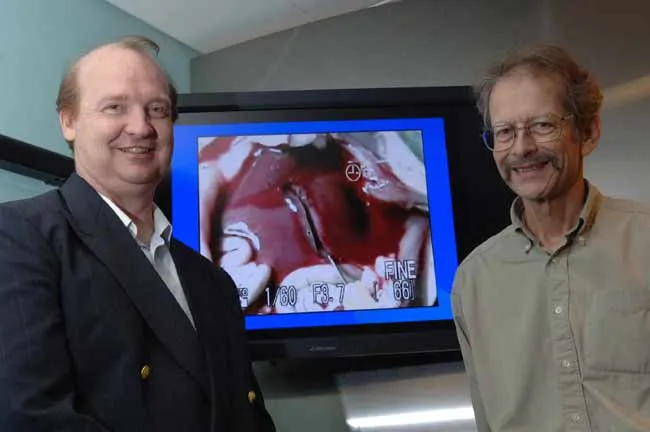
When the liquid, composed of protein fragments called peptides, is applied to an open wound, the peptides self-assemble into a gel that seals the wound and stops bleeding [image].
"We have found a way to stop bleeding, in less than 15 seconds, that could revolutionize bleeding control," said Rutledge Ellis-Behnke, an MIT researcher and lead author of the study, which appears today in the online edition of the journal Nanomedicine.
Eventually, the gel breaks down into amino acids, the building blocks of proteins, that can be used by surrounding cells for tissue repair.
The researchers used a similar liquid to allow brain cells to regrow and partially restore sight in hamsters earlier this year.
For this study, they applied the clear liquid to open wounds in brain, liver, skin, spinal cord and intestinal tissue in hamsters and rats.
"In almost every one of the cases, we were able to immediately stop the bleeding," Ellis-Behnke said.
The material could provide a quick method for controlling bleeding during surgeries without causing other damage, according to Ellis-Behnke.
"The time to perform an operation could potentially be reduced by up to 50 percent," he said.

