Migrating Moths Are Good Navigators
Get the world’s most fascinating discoveries delivered straight to your inbox.
You are now subscribed
Your newsletter sign-up was successful
Want to add more newsletters?
Delivered Daily
Daily Newsletter
Sign up for the latest discoveries, groundbreaking research and fascinating breakthroughs that impact you and the wider world direct to your inbox.
Once a week
Life's Little Mysteries
Feed your curiosity with an exclusive mystery every week, solved with science and delivered direct to your inbox before it's seen anywhere else.
Once a week
How It Works
Sign up to our free science & technology newsletter for your weekly fix of fascinating articles, quick quizzes, amazing images, and more
Delivered daily
Space.com Newsletter
Breaking space news, the latest updates on rocket launches, skywatching events and more!
Once a month
Watch This Space
Sign up to our monthly entertainment newsletter to keep up with all our coverage of the latest sci-fi and space movies, tv shows, games and books.
Once a week
Night Sky This Week
Discover this week's must-see night sky events, moon phases, and stunning astrophotos. Sign up for our skywatching newsletter and explore the universe with us!
Join the club
Get full access to premium articles, exclusive features and a growing list of member rewards.
To most of us, moths are nothing more than strange homebodies that can't leave a light bulb alone. But every year, millions of moths hop aboard wind currents and flutter hundreds of miles southward to suitable mating lands. The migrating moths are not totally at the mercy of the wind — they are equipped with compasses, a new study suggests.
"There has been speculation for many years about whether insects that rely on the wind for their migrations can have any control over the direction in which they migrate," said lead researcher Jason Chapman of Rothamsted Research in England.
Without flight control, the furry insects could land in unsuitable spots and die.
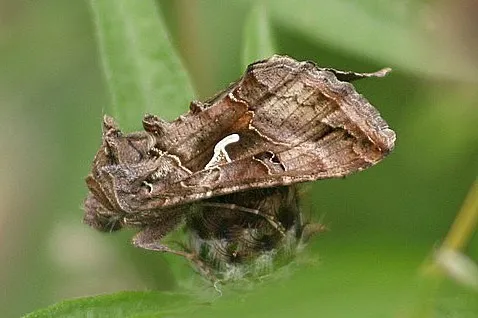
Using a radar-beam technique, Chapman and his colleagues monitored about 200 million silver Y moths (Autographa gamma), a plant-feeder that migrates at night, flying southward over the U.K.
Results, detailed online today in the journal Current Biology, show most of the moths took wing only on nights with south winds. Once airborne, the moths expedited their commute by flying in a roughly downwind direction while concentrating at altitudes with the fastest winds.
The moths also compensated when the wind direction was way off target.
"When the wind is not exactly aligned with their preferred direction, they take this into account and head off in a direction that will partially compensate for this wind drift," Chapman told LiveScience. "However, how they do this remains a mystery, as they somehow have to detect the wind direction while flying hundreds of meters above the ground and in very low light levels."
Get the world’s most fascinating discoveries delivered straight to your inbox.
Chapman suspects the moths use a geomagnetic compass to stay on track, similar to the type found in migratory birds.
Study funding came from the Biotechnology and Biological Sciences Research Council and the Volkswagen Foundation.
- Video: Mimicking Moths
- Top 10 Animal Senses That Humans Don't Have
- Images: Backyard Bugs
Jeanna Bryner is managing editor of Scientific American. Previously she was editor in chief of Live Science and, prior to that, an editor at Scholastic's Science World magazine. Bryner has an English degree from Salisbury University, a master's degree in biogeochemistry and environmental sciences from the University of Maryland and a graduate science journalism degree from New York University. She has worked as a biologist in Florida, where she monitored wetlands and did field surveys for endangered species, including the gorgeous Florida Scrub Jay. She also received an ocean sciences journalism fellowship from the Woods Hole Oceanographic Institution. She is a firm believer that science is for everyone and that just about everything can be viewed through the lens of science.