















Testosterone Swings Can Make Bad Avian Dads

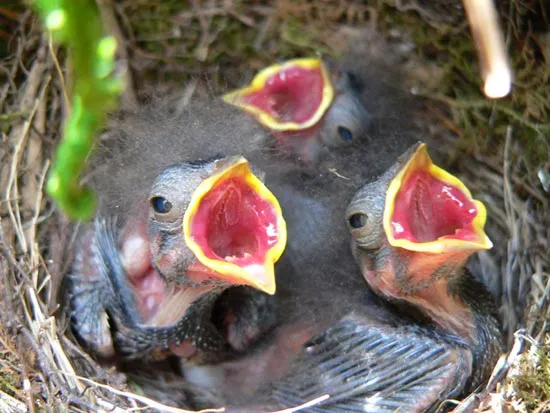
The ability to ramp up testosterone levels drives certain male sparrows to mate, but also makes them bad dads, a new study suggests.
Researchers had thought that the total amount of testosterone might determine the mating habits and aggressive tendencies of male dark-eyed juncos, a type of sparrow. But the new study, detailed in the December issue of the journal American Naturalist, of juncos in the wild showed that the speed with which testosterone levels can rise and fall also plays an important role in determining whether dad stayed around to help care for the kids.
Male juncos were captured at times while they were in and around nests, and their testosterone levels were measured. Those whose levels were more stable were more likely to invest more time and energy in parenting, while those with higher levels were more likely to go from mate to mate and display more aggressive behavior.
"This study is one of the first to show for a songbird living in the field under natural conditions that individual variation in the hormone testosterone maps onto variation in aggression and parental behavior," said study leader Ellen Ketterson of Indiana University Bloomington.
This relationship between hormone level and behavior poses what scientists call an evolutionary trade-off. Males have only a certain amount of time and energy to invest in attracting mates and then helping to parent their offspring. Certain circumstances may favor the love 'em and leave 'em approach to maximize mating numbers, while at other times, the junco may benefit by being a stay-at-home dad.
"The results are exciting because they show us how animals that make different choices might differ from each other on a physiological level," said study team member Joel McGlothlin of the University of Virginia. "On an evolutionary level, they suggest that there may often be more than one right choice, depending on the circumstances."
The different circumstances driving the different parenting behaviors may often be variations in the birds' environment.
Get the world’s most fascinating discoveries delivered straight to your inbox.
"Variation in behavior may persist because the environment varies," Ketterson said. "In cold, wet years, or years when lots of predators are attacking young in the nest, good fathers may be more successful at leaving offspring. When food is plentiful and predators are few, males that focus on mating may be more successful. The balance between the two is probably dynamic."
- Video: Extraordinary Birds
- 10 Amazing Things You Didn't Know about Animals
- Images: Rare and Exotic Birds

Andrea Thompson is an associate editor at Scientific American, where she covers sustainability, energy and the environment. Prior to that, she was a senior writer covering climate science at Climate Central and a reporter and editor at Live Science, where she primarily covered Earth science and the environment. She holds a graduate degree in science health and environmental reporting from New York University, as well as a bachelor of science and and masters of science in atmospheric chemistry from the Georgia Institute of Technology.