 Live Science Plus






Underground Peep Show Reveals Artifacts of Life
You are now subscribed
Your newsletter sign-up was successful
Want to add more newsletters?

Delivered Daily
Daily Newsletter
Sign up for the latest discoveries, groundbreaking research and fascinating breakthroughs that impact you and the wider world direct to your inbox.

Once a week
Life's Little Mysteries
Feed your curiosity with an exclusive mystery every week, solved with science and delivered direct to your inbox before it's seen anywhere else.

Once a week
How It Works
Sign up to our free science & technology newsletter for your weekly fix of fascinating articles, quick quizzes, amazing images, and more
Delivered daily
Space.com Newsletter
Breaking space news, the latest updates on rocket launches, skywatching events and more!
Once a month
Watch This Space
Sign up to our monthly entertainment newsletter to keep up with all our coverage of the latest sci-fi and space movies, tv shows, games and books.
Once a week
Night Sky This Week
Discover this week's must-see night sky events, moon phases, and stunning astrophotos. Sign up for our skywatching newsletter and explore the universe with us!
Join the club
Get full access to premium articles, exclusive features and a growing list of member rewards.
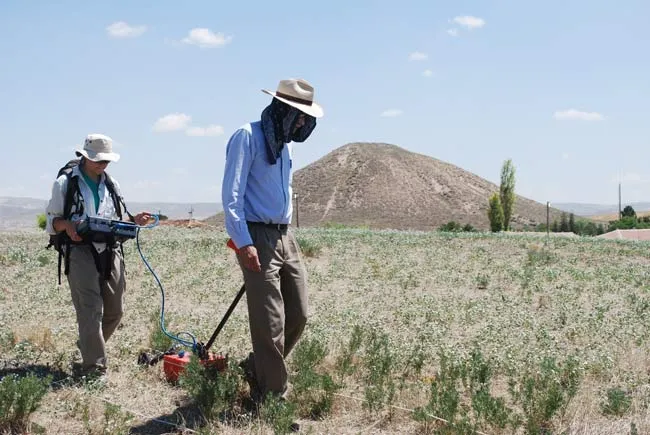
Walking along the scrubby countryside of central Turkey, Compton Tucker — bandana draped over his head and under his straw hat — looks like he's hauling a pushmower back to a tool shed.
But the boxy equipment that he's dragging isn't cutting down weeds, it's actually a kind of radar that can see underground. Like a beachcomber with a metal detector, Tucker and colleagues walk up to 10 miles (16 kilometers) a day, seven days a week, across sweltering ancient Turkish archaeological grounds in search of bone fragments, pottery and tombs.
In the past, NASA radar has been used on satellites and spacecrafts to detect ice deposits and to explore deep canyons on the moon's surface. On Earth, GPR has been used to survey Civil War cemeteries and battlefields.The radar works by bouncing pulses of microwave energy off buried objects to create a subterranean snapshot.
"We don't want to be limited by our eyes, so we use electromagnetic spectrum radar to look beneath the surface," Tucker said.
Researchers spent three weeks at the site compiling information about human settlement, artifacts and agriculture, using tools that traditional archaeologists usually don't have access to.
Archaeology is hard work, not to mention expensive, so an entire site is rarely excavated, said Philip Mink II, an archaeologist from the University of Kentucky, who was not involved with the mission.
"GPR and other geophysical techniques allow us to collect data on parts of the site we might otherwise not be able to investigate," Mink said. "These investigations may locate archaeological features such as houses, tombs, burials, trash and storage pits, and ceramic firing areas that can be targeted for excavation given the limited money and time field archaeologists often face."
A refined search will prevent trampling of burial sites, as well as dissuade the scourge of the archaeologist — looters.
"One of the reasons we do the work, and are very passionate about it, is that we feel like what we're doing is fighting against looters and plunderers who would find the more valuable things, trash everything else, and send them to Switzerland where anyone can buy them," Tucker said.
"The context of how these objects were buried is completely lost, and instead they just become some sort of trophy on someone's mantle," Tucker added.
Both Tucker and Nigro anticipate the techniques developed by the mission will be applicable to many other culturally sensitive archaeological sites, such as the Hasanlu site in Iran and Tikal in Guatemala.
- History's Most Overlooked Mysteries
- The 7 Most Mysterious Archaeological Finds on Earth
- Image Gallery: The Seven Ancient Wonders of the World
This article was provided by OurAmazingPlanet, a sister site to LiveScience.

