














Water Plays Surprising Role in Climate Change
This Behind the Scenes article was provided to LiveScience in partnership with the National Science Foundation.
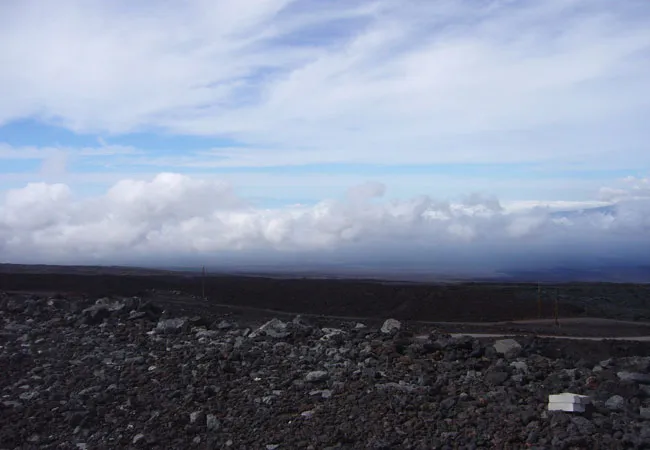
With its sea turtles and surf shops, the Big Island of Hawaii resembles a tropical, watery world. Yet for climate scientists, it's the ideal place to study low-humidity air and the processes that dehydrate the atmosphere. From the sprawling dome of Mauna Loa — 11,000 feet above Hawaii's coconut-fringed beaches — climate scientists David Noone and Joe Galewsky can track water vapor that's traveled as far as the equator and the pole. They're the first to try to measure vapor's chemical signature in real-time in order to understand the processes controlling the global water cycle. "There's no other place you could take these measurements," says Galewsky, an assistant professor at the University of New Mexico. "An instrument here in the middle of the Pacific can tell us information about the whole Northern Hemisphere," he says. Looming above the layers of local weather, Mauna Loa's expansive summit experiences air last moistened hundreds of kilometers away. "From this high perch you can see the actual boundary between the clouds below and the clear [low humidity] skies above. It’s inspiring; you can see what you’re measuring," says Noone, an assistant professor at the University of Colorado at Boulder and a fellow of the Cooperative Institute for Research in Environmental Sciences.
Charles Keeling, pioneer
Mauna Loa's unique height and isolation are the very reasons the mountain was selected for the first continuous carbon dioxide measurements 50 years ago. Pioneered by Charles Keeling, the measurements show global concentrations of CO2 on the rise, and at an ever-quickening pace. The original instrument still resides in a small building next door to the main station of the Mauna Loa Observatory. "I like to think we’re following in Keeling’s footsteps," says Noone. In fact, through their National Science Foundation-funded field work, Noone and Galewksy are monitoring an equally important greenhouse gas. Like CO2, water vapor also traps and radiates heat back towards the planet. Understanding the processes that control atmospheric humidity, they say, will be critical to projecting the degree of future global warming. "There's no question CO2 is driving changes in our planet's climate," explains Noone, "But a lot of the changes we are seeing are due to changes in the water cycle, and to the amount of water vapor in the air."
Atmospheric isotopes in real-time
To track the moisture converging on Mauna Loa, the scientists study unique clues created by oxygen and hydrogen isotopes — variations of the elements that are weighed down by extra neutrons. Water molecules with heavy atoms preferentially condense. The scientists use this fact to determine whether cloud formation and precipitation have affected the air, as well as to identify the path along which it traveled. In this way, they create maps of water’s journey through the atmosphere. But with the idea of measuring atmospheric isotopes in real-time still new, the scientists leave nothing to experimental chance. They use every instrument available to them to measure the concentration of heavy oxygen and hydrogen: three autonomous, laser-based analyzers, two satellites, a series of hand-held flasks, and home-built, dry ice-cooled, water traps rigged from surgical tubing and fish tank parts. "I have visions of jabbing myself in the hand [with a glass trap] and lying unconscious in the middle of the Saddle Road on Mauna Loa," jokes Galewsky, who like Noone is a climate modeler and spends most of his time in front of a computer, not in the field. In contrast with the new analyzers, the trap and flask samples must be physically run and timed to coincide with infrequent satellite overpasses. Unluckily for the scientists, this means taking samples at 2:00 a.m., when temperatures on Mauna Loa's dried lava fields dip near freezing. For two hours in the middle of the night, the traps must be bathed in a smoking cocktail of dry ice that's continually fed. There's no mistaking the allure of the real-time analyzers, which hum steadily from a shelf in the station building, collecting data every few seconds.
Measuring the response to climate change
Get the world’s most fascinating discoveries delivered straight to your inbox.
Back on the continent, Noone and Galewsky will work with colleagues at NASA's Jet Propulsion Laboratory to compare measurements from the ground-based instruments against what the Tropospheric Emission Spectrometer on NASA’s Aura satellite "sees." This "ground-truthing" will help them use the remote observations to track water vapor on a global scale and diagnose large changes in the water cycle as the planet warms. The new real-time analyzers offer the scientists another opportunity: the ability to make extensive measurements of atmospheric humidity at key locations like Mauna Loa. Noone and Galewsky believe such measurements could eventually develop into long-term monitoring efforts for water vapor, similar to the global CO2-monitoring program inspired by Keeling's early work. "The advantage of measuring isotopes in water vapor," says Noone, "is that the measurements can help us understand the response of the water cycle to climate change, and not just the forcing, which CO2 measurements provide."
Noone and Galewsky suggest that beyond their initial field trial at Mauna Loa, establishing a new and on-going global vapor-tracking network would help climate scientists to monitor the ways in which planetary warming due to emissions of CO2 unfolds. They would be able to measure how human activities and other influences on climate change the role of atmospheric water in weather and climate.
Editor's Note: This research was supported by the National Science Foundation (NSF), the federal agency charged with funding basic research and education across all fields of science and engineering. See the Behind the Scenes Archive.