















Climates North and South of Equator Said Linked

Earth's equator is sometimes viewed as a bit of a virtual wall that separates the climates of the northern and southern hemispheres.
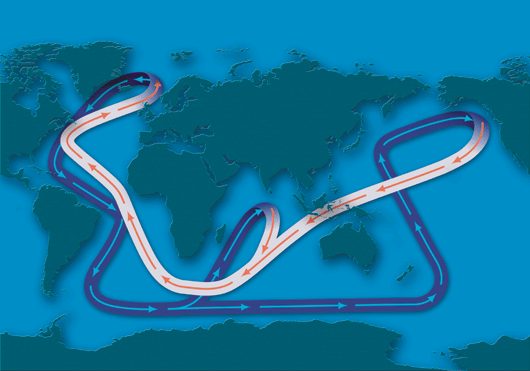
Ocean currents, the main driver of climate, tend to confine themselves to one side or the other. When waters from North and South meet at the equator, they combine lazily and create an utter lack of wind known as the doldrums.
But a new study finds the climates in each half of the planet are linked by the oceans over the long run. Ocean circulation in the Southern Hemisphere has in the past adapted to sudden changes in the north, say researchers from Universitat Autonoma de Barcelona in Spain and the Cardiff University in the UK.
Several times in history, when the temperature increased in the Northern Hemisphere, the Southern Hemisphere has entered a cooling period, which creates a decrease in the amount of deep water transported to the Atlantic Ocean from the south. When the climate cooled in the North Atlantic, the Southern Hemisphere entered a warmer period, causing water to be transported northwards.
The study is detailed in the April 1 issue of the journal Science.
Computer models had predicted the link. But this is the first time actual weather records have revealed it to be true.
The climates of Europe and North America are greatly influenced by the Gulf Stream, which carries warm water from the Gulf of Mexico north along the Florida coast, east across the Atlantic and south along the west coast of Europe. The warm water tends to moderate local climates.
Get the world’s most fascinating discoveries delivered straight to your inbox.
The strength of the Gulf Stream's current is governed by how much salt is in the southbound water. If salinity decreases, the current weakens.
Previously, other scientists had modeled a possible effect of global warming: Melting of the Greenland ice sheet would add fresh water to the Atlantic and weaken the Gulf Stream. That would create a cooler, dryer climate in Europe and North America.
But the Atlantic might already be adapting to global warming in the same way as it adapted to climate changes in the past, say the authors of the new study. Southern Hemisphere waters are less salty than those in the northern hemisphere, and this freshwater in the south sinks to the ocean floor and is transported to the rest of the Atlantic, reducing the salinity of the North Atlantic Ocean and the strength of the gulf stream. Lately there has been a decrease in the amount of freshwater sinking to the floor of the South Atlantic Ocean.
"Although we don't know where global warming will take us, this could be a sign that the oceans are already adapting to the changes," said study team member Rainer Zahn.
