













Art from Space: Phytoplankton Bloom

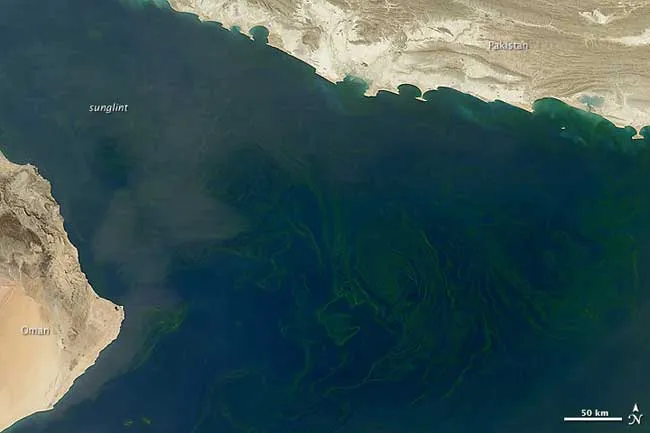
Blooms of phytoplankton are often visible by satellites, and a new image released by NASA shows a particularly artful bloom in the Arabian Sea.
The image, taken Feb. 18, was released today. It reveals the phytoplankton drawn into thin green ribbons by turbulent eddies in the sea. Phytoplankton are tiny plantlike organisms that use chlorophyll and other pigments to absorb sunlight for photosynthesis, and when they grow in large numbers, they change the way the ocean surface reflects sunlight.
The bloom in the new images stretches from the shores of Pakistan to the coast of Oman.
The phytoplankton blooms in the northern Arabian Sea are strongly influenced by the seasonal wind shifts (the monsoon) that dominate the area’s climate, NASA scientists explained. Because the Arabian Sea is landlocked to the north, it is less influenced by large-scale ocean circulation and more strongly influenced by the monsoon winds.
Large blooms of phytoplankton occur in the summer, when strong southwesterly winds blow from the ocean toward land, mixing the water. Blooms also happen in the winter, however, when northeast winds blow offshore.
In the past few years, a team of oceanographers studying the Arabian Sea has noticed that kinds of phytoplankton present during the Northeast (winter) monsoon seem to be changing. Among the changes is the increasingly frequent and widespread appearance of a dinoflagellate species called Noctiluca miliaris. Prior to the late 1990s, this type of phytoplankton showed up only sporadically during summer blooms, usually in conjunction with the upwelling of low-oxygen waters.
According to the researchers, the unusual abundance of this organism in winter blooms may be a sign that the waters of the Arabian Sea are becoming more eutrophic—overly fertile and oxygen-depleted.
Get the world’s most fascinating discoveries delivered straight to your inbox.
It generally isn’t possible to identify phytoplankton species through satellite observations alone, and many other kinds of phytoplankton occur in the area. However, the scientists’ description of the interloper—“N. miliaris tends to aggregate at the surface to form large, slimy green patches”— is certainly consistent with the bloom shown in this image.
The washed out appearance at the upper left of the image is due to sunglint, which is the mirror–like reflection of sunlight off the water. Some of the brightness may be caused by blowing dust. Pakistan’s coastal waters are tinged blue as well as green. The color may result from numerous influences, including phytoplankton and sediment.
- 101 Amazing Earth Facts
