A monster of a reptile, a 30-foot-long crocodile ancestor, once navigated the lagoons of the Tataouine region of southern Tunisia 130 million years ago.
Found on the fringes of the Sahara — near an area that served as Star Wars' Tatooine, and inspired its name — fossils suggest Machimosaurus rex was the largest marine crocodile ever found and represents a new species of teleosaurid — a type of extinct crocodylomorph, or a group that includes crocodiles and their ancestors.
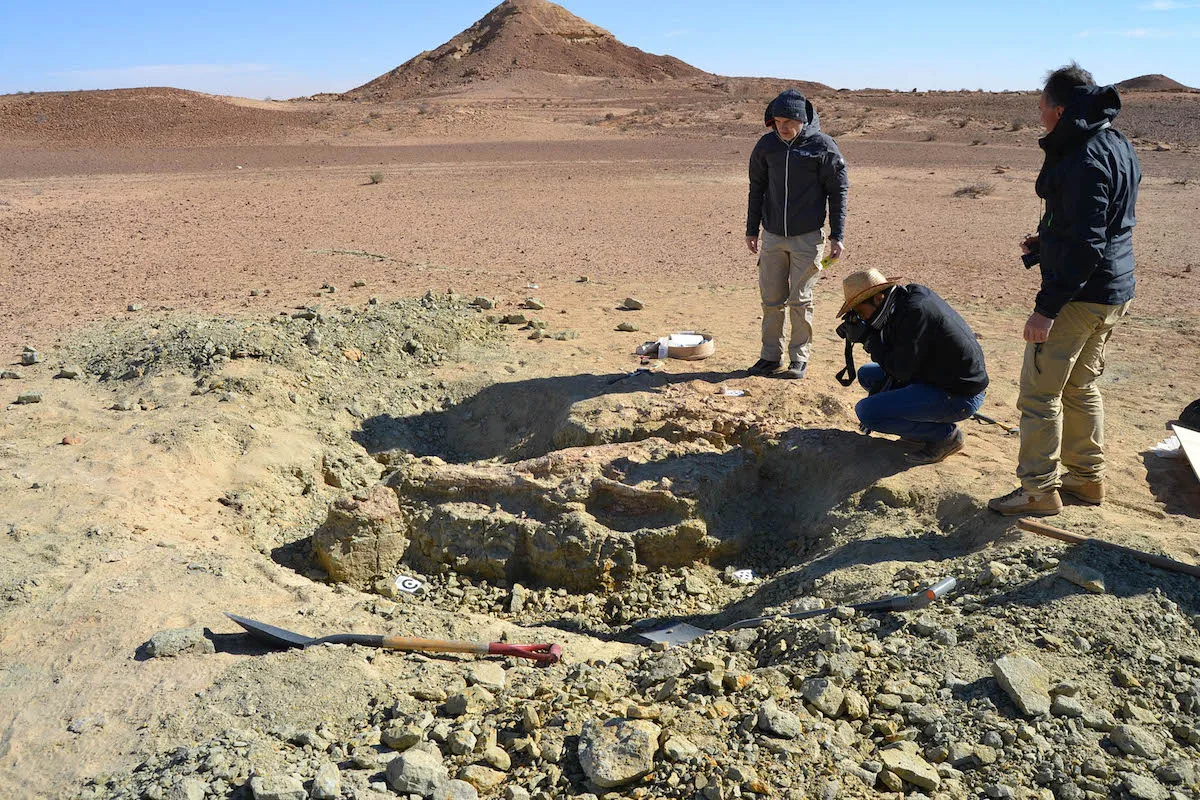
In December 2014, a multinational paleontological team was two days away from the end of an expedition when they came upon what appeared to be a jumble of crushed, isolated bones. Further excavation revealed something much greater. [See Images of the Extinct Monster Crocodile Ancestor]
"At one point, when one eye of the crocodile was completely exposed, we realized there was an entire, giant skull just under our feet," said excavation team member Andrea Cau, a doctoral student at the Biological, Geological and Environmental Department of Alma Mater Studiorum in Bologna University, in an email interview with Live Science. In the hours that followed, they became certain they were laying eyes on a previously unknown species.
The crocodile ancestor M. rex would have been fearsome-looking, swimming through the salty lagoons of prehistoric Tunisia.
M. rex was found lying on its stomach with its head tilted toward the right side of its body. The skeleton consists of most of the skull with three teeth in place and seven others unattached and scattered around the snout. Part of the back, near the head, and the ribcage were also present. These remains were surrounded by an abundance of fossils from fish, invertebrates (such as gastropods and bivalves) and other evidence of a salty water environment. Fossils from a large turtle were also collected in association with M. rex, but the placement of these suggests they were deposited at a later time.
The study's authors believe M. rex was likely an ambush predator with the teeth of a generalized hunter and a bite strong enough to crush through turtle shell.
"In analogy with modern crocs that usually attack zebras and wildebeests, it is plausible that M. rex was also able to kill mid-sized dinosaurs," Cau said. This massive reptile could walk on land but probably spent most of its time in the sea or lagoons.
Sign up for the Live Science daily newsletter now
Get the world’s most fascinating discoveries delivered straight to your inbox.
Geologic data collected by the team in this area since 2009 show that M. rex lived in the early Cretaceous period. This makes it the most recent representative of the teleosaurids, which were previously believed to have gone extinct at the end of the Jurassic period (ending nearly 150 million years ago). It was thought teleosaurids had disappeared as part of a global mass extinction event that occurred at the boundary of the Jurassic and Cretaceous periods. The authors of this study say that M. rex adds to evidence disproving this mass extinction, suggesting instead that what occurred was a series of local extinction events.
The study is published in the Jan. 10 issue of the journal Cretaceous Research.
Editor's Note: This article was updated to clarify that Star Wars' Tatooine was named after Tataouine.