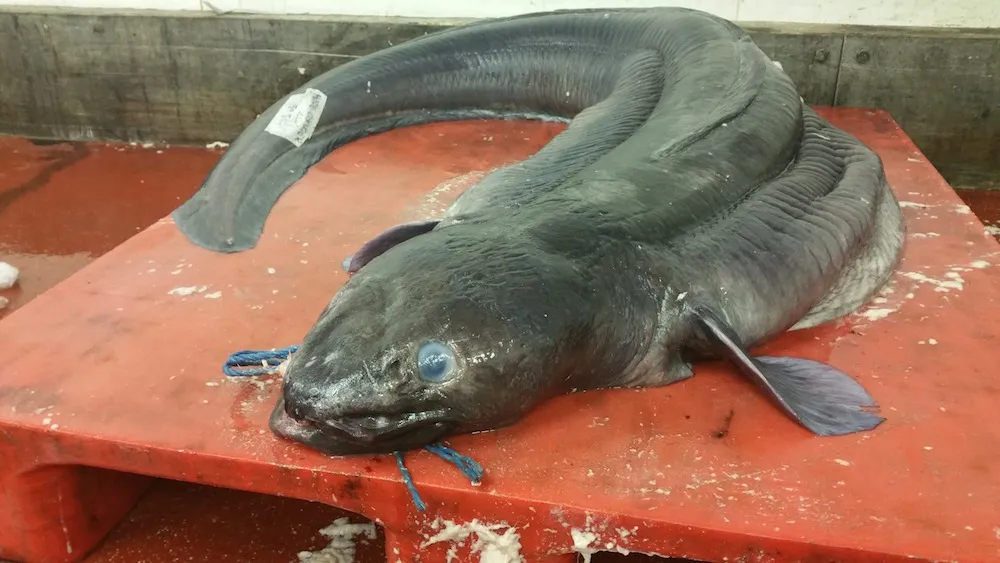
A silvery-gray conger eel had already gone limp by the time fishermen found it on their trawler, but its shocking length of 7 feet (2.1 meters) still caught them off guard, according to the British company that found the huge eel.
Fishermen mistakenly snagged the blue-eyed eel yesterday (May 14) off the southwestern coast of the United Kingdom. At the time, they were trawling the area (i.e., dragging nets to catch fish) on an inshore trawler named Hope. The conger eel got stuck in the nets, and was already dead by the time the fishermen hauled it aboard, according to the company, Plymouth Fisheries.
"I was stunned because it was so huge," Scott Govier, a commercial fisherman with Plymouth Fisheries, told the U.K. tabloid the Daily Express. "It was already dead when we pulled it up, else we would have thrown him back in and let him live."
In fact, the eel narrowly missed setting a U.K. record. Once gutted, it weighed 131 lbs. (59 kilograms), just shy of the 133.25-lb. (60.44 kg) record for a rod-caught conger eel.
Before it was gutted, the eel likely weighed between 155 and 160 lbs. (70 kg to 73 kg), Plymouth Fisheries said.
The newfound conger eel (right) is long, but not too much longer than other conger eels (for example, left) that fishermen have caught off the coast of the United Kingdom.
(Image credit: London International Club of Spearfishing)
"Conger does not have a great deal of commercial value today, as prices have dropped. But this was an impressive fish, and a catch to make any angler's day," Pete Bromley, manager of Plymouth Fisheries, said in a statement.Typically, conger eels are inexpensive, but the massive catch brought in about 40 British pounds (about $63) when it was sold at an auction in Plymouth, the company said.
Sign up for the Live Science daily newsletter now
Get the world’s most fascinating discoveries delivered straight to your inbox.
"Conger move to very deep water and die after spawning, so like all large congers caught off the Southwest Approaches [the waters off the U.K.'s southwestern coast], this fish is likely to be an unspawned female," he added.
Conger eels are typically found hiding among the Southwest's many wrecks, or on reefs and rocky ground, "but they do venture out to open ground in search of food, usually during neap tides or slack water," Bromley said. However, "despite their size and power, they are not very strong swimmers," he added.
A photo the company posted on Twitter initially made the fish look much longer than 7 feet, but two additional photos — including one comparing the conger eel to a man holding another eel, and another of the fish on a pallet — later provided a better perspective.
"The chap standing next to it is around 5 foot, 7 inches [1.7 m] tall, and we estimated the conger eel to be around 7 feet in length," Bromley said. "Our second photo showing it lying on a pallet also makes this clear, as this pallet is only 1 meter by 1.2 meters [3.2 feet by 3.9 feet] in size."
Laura is the managing editor at Live Science. She also runs the archaeology section and the Life's Little Mysteries series. Her work has appeared in The New York Times, Scholastic, Popular Science and Spectrum, a site on autism research. She has won multiple awards from the Society of Professional Journalists and the Washington Newspaper Publishers Association for her reporting at a weekly newspaper near Seattle. Laura holds a bachelor's degree in English literature and psychology from Washington University in St. Louis and a master's degree in science writing from NYU.