Solar radiation, freezing rain, dense fog: The next-generation F-35 Joint Strike Fighter warplane can withstand all that and more, according to U.S. Air Force officials.
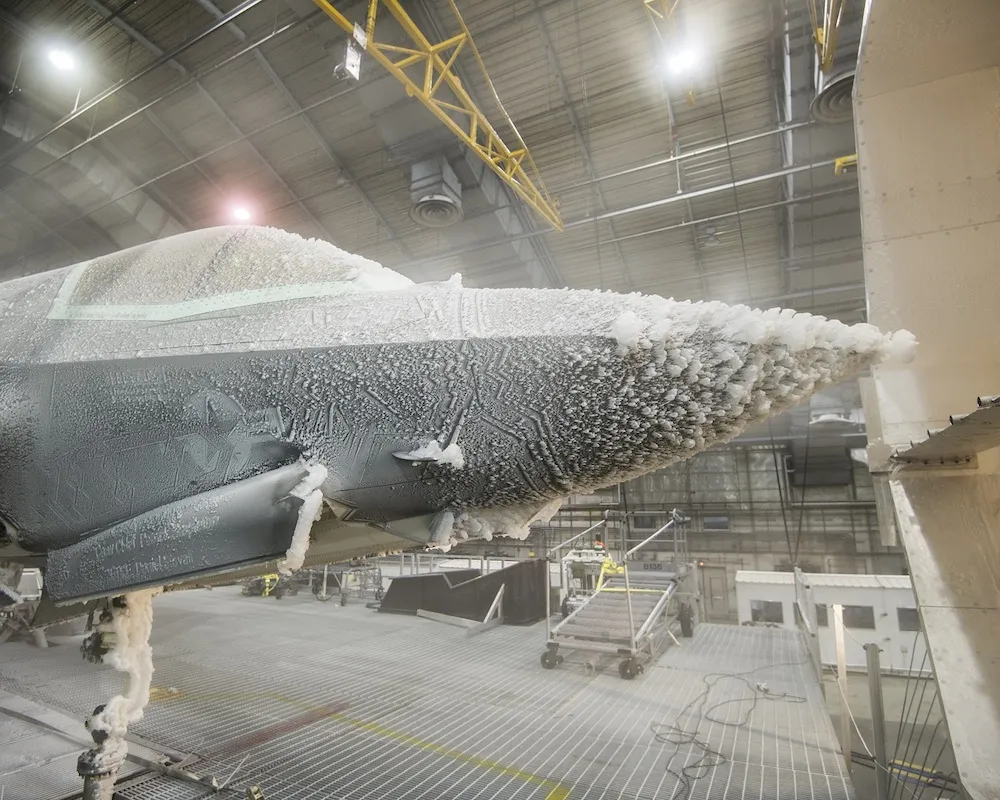
For the past five months, technicians at the McKinley Climatic Laboratory,at Eglin Air Force Base in Florida, have put the fighter jet through a series of rigorous tests to see how well it holds up to the stresses of extreme weather. The warplane endured a range of simulated conditions, including high winds, solar radiation, fog, humidity, ice, snow and freezing rain.
"While we are testing in the world's largest climatic testing chamber, we're pushing the F-35 to its environmental limits — ranging from 120 degrees Fahrenheit [48.8 degrees Celsius] to negative 40 degrees, and every possible weather condition in between," Billie Flynn, an F-35 test pilot who performed extreme cold testing on the aircraft, said in a statement. [Supersonic! The 10 Fastest Military Airplanes]
Developed by Lockheed Martin, the F-35 Lightning II is marketed as an all-weather stealth aircraft. It's expected to be used by 13 countries around the world, according to Air Force officials. That means it'll need to fly in extreme heat (over the outback of Australia) as well as in frigid cold (over the Arctic Circle above Canada and Norway).
The F-35 was hit with icy winds during a recent round of testing.
(Image credit: Michael D. Jackson, F-35 Integrated Test Force)
Recently released photographs from the McKinley Climatic Laboratory show the F-35 undergoing a range of tests. In several photos, the jet sits before a so-called "icing cloud test calibration fixture." This tool is used to measure how and where ice accumulates on an F-35 subjected to freezing winds. Another photo shows the jet sitting beneath what appears to be a huge array of heat lamps.
In a round of recent climactic tests, Lockheed Martin's F-35B braved extreme temperatures and solar radiation.
(Image credit: Michael D. Jackson, F-35 Integrated Test Force)
"We've designed an environment here at the chamber where we can simulate virtually any weather condition — all while flying the jet at full power in either conventional or vertical takeoff mode," said Dwayne Bell, technical chief at the McKinley Climatic Laboratory.
The climatic tests are just one of many rounds of testing the F-35 will have to complete before it can be deployed by any national military. In November 2014, the Navy variant of the jet, the F-35C, was tested aboard an aircraft carrier off the coast of San Diego. The plane successfully completed a series of modified landings and takeoffs at sea.
Sign up for the Live Science daily newsletter now
Get the world’s most fascinating discoveries delivered straight to your inbox.
In August 2013, the F-35B — the variant of the jet designed to take off on a short runway and land vertically — completed its first successful vertical landing at nightaboard an aircraft carrier. The first versions of the F-35 are expected to take to the skies in mid-2015, according to a statement from Lockheed Martin.