It's quick and easy to access Live Science Plus, simply enter your email below. We'll send you a confirmation and sign you up for our daily newsletter, keeping you up to date with the latest science news.
Blackbeard, the world's most famous pirate, lost his flagship in 1718 when the ship ran aground on a sandbar in North Carolina. But in 1996, the wreck of the Queen Anne's Revenge was rediscovered, and archaeologists began excaviting the ship.
Since then, the excavation project has revealed that the ship contained many medical instruments of the day, hinting that Blackbeard put great effort into keeping his crew healthy. [Full story: Blackbeard's Booty: Pirate Ship Yields Medical Supplies]
Here is a look at the instruments found aboard the ship.
This image shows a mortar and pestle, made of cast brass, which would have been used to prepare medicine. Photo credit: North Carolina Department of Cultural Resources
These nesting weights go one inside the other allowing them to be carried compactly. They also would have been used to help prepare medicine. Two sets like this one were found on Blackbeard's ship. Photo credit: North Carolina Department of Cultural Resources
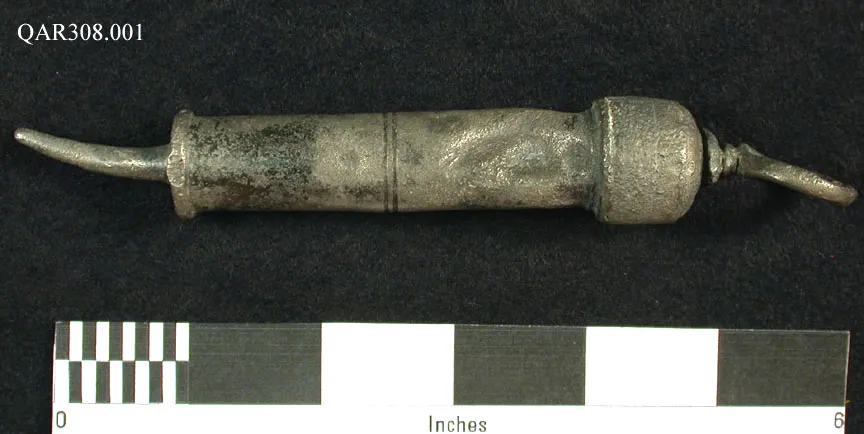
This urethral syringe was used to treat syphilis, a sexually transmitted disease that can be fatal. Chemical analysis shows that it contained mercury, which was commonly used to treat people with syphilis during the early 18th century. Although mercury may alleviate some of the symptoms taking too much of it can be fatal. Photo credit: North Carolina Department of Cultural Resources
This image shows the remains of a clyster pump that was found on Blackbeard's ship. The remains of two pumps were found on the wreck. These devices would have been used to pump fluid into the rectum, allowing the body to quickly absorb it. Photo credit: North Carolina Department of Cultural Resources
Sign up for the Live Science daily newsletter now
Get the world’s most fascinating discoveries delivered straight to your inbox.
A fragment of a small jar or basin that would have held medicinal material. Photo credit: North Carolina Department of Cultural Resources
This silver needle may have been used for surgery. Photo credit: North Carolina Department of Cultural Resources
This image shows an x-ray of a pair of scissors that were found attached to part of the wreck site. These scissors could also have been used in surgery. Photo credit: North Carolina Department of Cultural Resources
The excavation and study of the Queen Anne's Revenge is an ongoing project. This image shows work being carried out on the artifacts. Photo credit: North Carolina Department of Cultural Resources
Owen Jarus is a regular contributor to Live Science who writes about archaeology and humans' past. He has also written for The Independent (UK), The Canadian Press (CP) and The Associated Press (AP), among others. Owen has a bachelor of arts degree from the University of Toronto and a journalism degree from Ryerson University.

 Live Science Plus