 Live Science Plus





You are now subscribed
Your newsletter sign-up was successful
Want to add more newsletters?

Delivered Daily
Daily Newsletter
Sign up for the latest discoveries, groundbreaking research and fascinating breakthroughs that impact you and the wider world direct to your inbox.

Once a week
Life's Little Mysteries
Feed your curiosity with an exclusive mystery every week, solved with science and delivered direct to your inbox before it's seen anywhere else.

Once a week
How It Works
Sign up to our free science & technology newsletter for your weekly fix of fascinating articles, quick quizzes, amazing images, and more

Delivered daily
Space.com Newsletter
Breaking space news, the latest updates on rocket launches, skywatching events and more!

Once a month
Watch This Space
Sign up to our monthly entertainment newsletter to keep up with all our coverage of the latest sci-fi and space movies, tv shows, games and books.

Once a week
Night Sky This Week
Discover this week's must-see night sky events, moon phases, and stunning astrophotos. Sign up for our skywatching newsletter and explore the universe with us!
Join the club
Get full access to premium articles, exclusive features and a growing list of member rewards.
Army ants have been spotted attacking and eating a huge worm and even a snake, suggesting to researchers that their cooperative hunting strategy initially evolved just for such a surprising purpose.
Animal behaviorist Sean O'Donnell was having afternoon coffee when a giant earthworm exploded out of the leaf litter covering the jungle floor in an Ecuadorian nature preserve. The worm, later measured at nearly 16 inches long, was pursued by a column of hundreds of raiding army ants that quickly paralyzed or killed it.
O'Donnell and colleagues have now suggested a new theory on the origin of cooperative hunting behavior in army ants, which are among the most socially complex animals known. The researchers said the behavior may have started as a way to take down larger prey.
Different lifestyle
"Cheliomyrmex may be telling us that cooperative hunting of large prey is an evolutionary predecessor of going after smaller prey," said O'Donnell, of the University of Washington. "Typically, army ants follow a lifestyle of attacking other social insect colonies. But Cheliomyrmex is not following this lifestyle."
The ants are brick red in color and are considered medium or large-sized compared to most common ant species found in the United States.
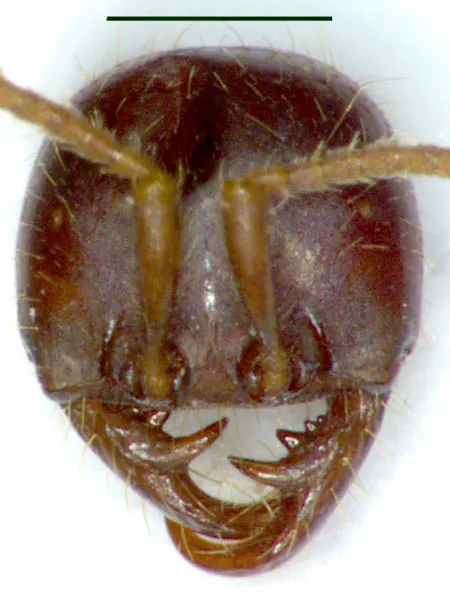
What makes Cheliomyrmex such a fearsome predator is that its workers have claw-shaped jaws that are armed with long, spine-like teeth. These teeth may help Cheliomyrmex workers attach themselves to their prey's skin during attack.
O'Donnell, who was bitten and stung when he collected Cheliomyrmex specimens, said the ants' stings were particularly painful and itchy, comparable to the stings of fire ants found in the United States. He and his colleagues believe the venom in a Cheliomyrmex sting is toxic and possibly paralytic, considering how quickly the giant earthworm became immobile after being attacked.
Rare ant
Based on the observation of the ants feeding on the snake, the researchers said the species is the only known New World army ant to remove and consume vertebrate flesh.
Raiding parties of other New World army ants occasionally sting and kill small vertebrates such as lizards, snakes and birds, but usually do not consume them. Other New World army ants prey heavily on insects and other invertebrates.
O'Donnell said Cheliomyrmex is related to Old World driver ants in Africa, which also have large-toothed jaws and feed on large-bodied prey. The ancestor of Cheliomyrmex may have split from Old World army ants as long as 105 million years ago, at around the time when Africa and South America separated during the breakup of the giant continent Gondwana.
Cheliomyrmex lives mainly underground in New World tropical rainforests. Although previously identified, little was known about its behavior or prey until these two chance encounters at the Tiputini Biodiversity Station, an ecological preserve in eastern Ecuador.
This research is detailed in the current issue of the journal Biotropica.
- Secret Weapons of Small Creatures
- Ants Ambush Prey from Foxholes
- Amazing Ants 'Fly' When They Fall
- Hope for Eradicating Red Fire Ants
Image Gallery

Invasive Species

