














This Research in Action article was provided to LiveScience in partnership with the National Science Foundation.
A University of Colorado Boulder research team has moved closer to what some call the Holy Grail of a sustainable hydrogen economy — splitting water with sunlight.
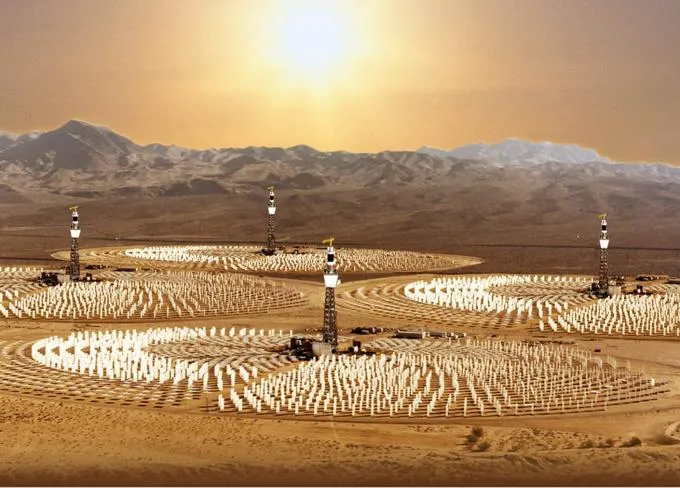
The CU-Boulder team has devised a solar-thermal system designed to use a vast array of ground mirrors to concentrate sunlight onto a single point atop a central tower up to several hundred feet tall. The tower would gather heat to roughly 2,500 degrees Fahrenheit (1,350 Celsius) and then deliver it into a reactor containing chemical compounds known as metal oxides.
As the metal oxide compound heats up, it releases oxygen atoms, changing its material composition and causing the newly formed compound to seek out new oxygen atoms. The team showed that adding steam to the system would cause oxygen from the water molecules to adhere to the metal oxide surface, freeing up hydrogen molecules for collection as hydrogen gas. To get the steam, the concentrated sunlight beamed to the tower would heat the water to boiling. [Hydrogen: Future of Fuels Finally Drives Up | Video]
Conventional theory holds that producing hydrogen through the metal oxide process requires 1) heating the reactor to a high temperature to remove oxygen 2) then cooling it to a low temperature before 3) injecting steam to re-oxidize the compound and release hydrogen gas for collection. The innovation here is that no swing in temperature is required. The whole process can be undertaken at the same temperature, and can be driven by turning a steam valve on or off.
With the new method, the amount of hydrogen produced to power fuel cells or for storage is entirely dependent on the amount of metal oxide (a combination of iron, cobalt, aluminum and oxygen), and how much steam is introduced into the system.
The researchers envision building reactor tubes roughly a foot in diameter and several feet long, filling them with the metal oxide material and stacking them on top of each other. A working system to produce a significant amount of hydrogen gas would require a number of the tall towers, each with its own reactor, to gather concentrated sunlight from several acres of mirrors surrounding each tower.
Get the world’s most fascinating discoveries delivered straight to your inbox.
A paper on the National Science Foundation-funded research was published in the August 2 issue of Science.
Editor's Note: Any opinions, findings, and conclusions or recommendations expressed in this material are those of the author and do not necessarily reflect the views of the National Science Foundation. See the Research in Action archive.