 Live Science Plus



'Cat's Paw Nebula' Bursting with New Star Growth
You are now subscribed
Your newsletter sign-up was successful
Want to add more newsletters?

Delivered Daily
Daily Newsletter
Sign up for the latest discoveries, groundbreaking research and fascinating breakthroughs that impact you and the wider world direct to your inbox.

Once a week
Life's Little Mysteries
Feed your curiosity with an exclusive mystery every week, solved with science and delivered direct to your inbox before it's seen anywhere else.

Once a week
How It Works
Sign up to our free science & technology newsletter for your weekly fix of fascinating articles, quick quizzes, amazing images, and more
Delivered daily
Space.com Newsletter
Breaking space news, the latest updates on rocket launches, skywatching events and more!
Once a month
Watch This Space
Sign up to our monthly entertainment newsletter to keep up with all our coverage of the latest sci-fi and space movies, tv shows, games and books.
Once a week
Night Sky This Week
Discover this week's must-see night sky events, moon phases, and stunning astrophotos. Sign up for our skywatching newsletter and explore the universe with us!
Join the club
Get full access to premium articles, exclusive features and a growing list of member rewards.
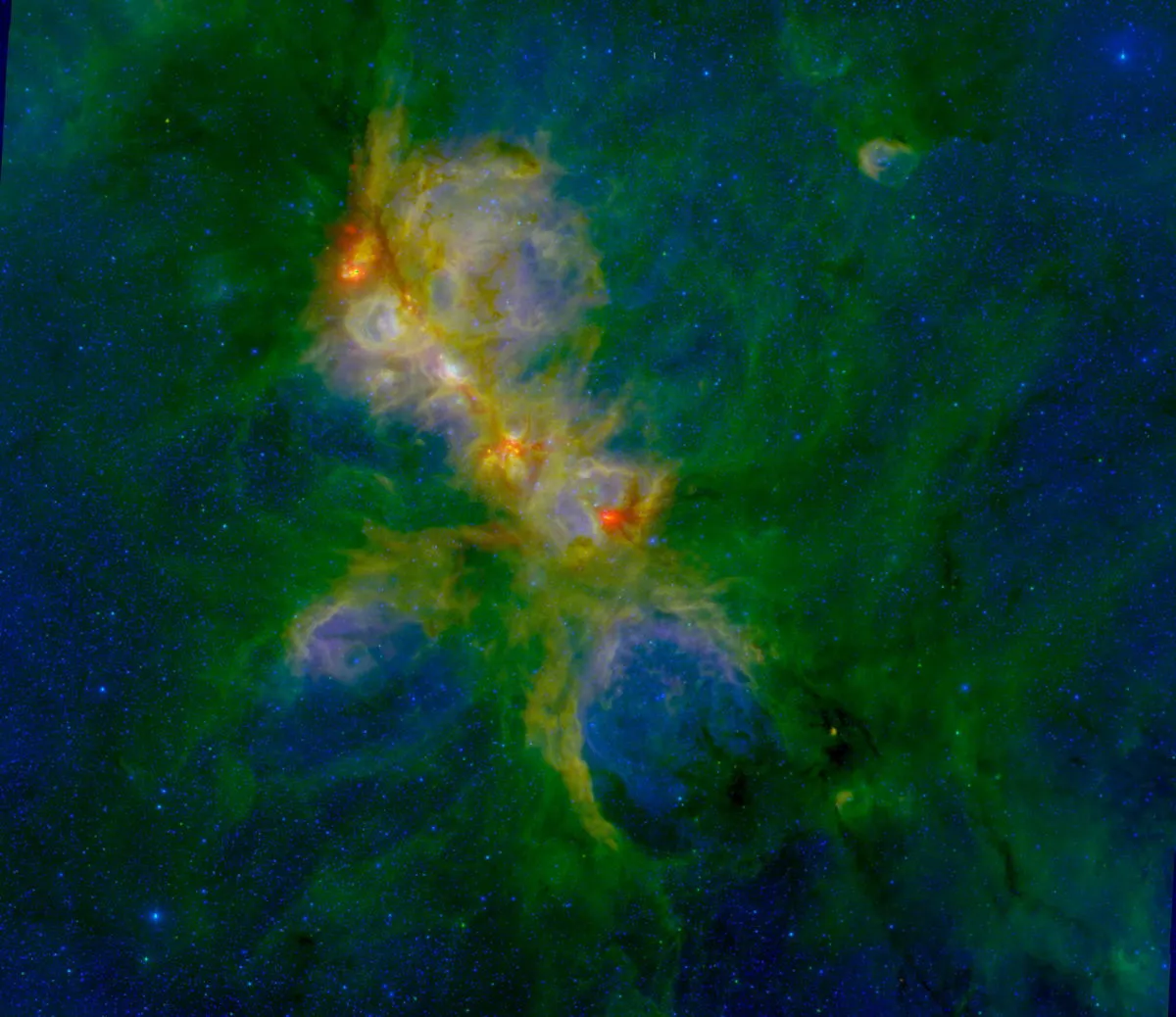
INDIANAPOLIS — A nebula that shines about 5,500 light-years from Earth could be going through a "baby boom," according to a new study.
NGC 6334 (the Cat's Paw Nebula) might be one of the most productive star-forming regions in the Milky Way. The nebula is home to tens of thousands of newly formed stars and plays host to about 200,000 suns' worth of star-creating material.
"NGC 6334 is forming stars at a more rapid pace than Orion — so rapidly that it appears to be undergoing what might be called a burst of star formation," the study's lead author Sarah Willis of the Harvard-Smithsonian Center for Astrophysics (CfA) and Iowa State University said in a statement. "It might resemble a 'mini-starburst,' similar to a scaled-down version of the spectacular bursts sometimes seen in other galaxies."
More than 2,000 of the stars in the nebula are very young and are still trapped inside the "dusty cocoons" that birthed them, scientists said. Willis presented the new findings here today (June 5) at the 222nd meeting of the American Astronomical Society.
Astronomers have observed distant, bright starbursting galaxies before, but because the Cat's Paw Nebula is a region within the Milky Way, scientists can get a better sense of why starburst regions might form and what they look like closer-up.
"Because NGC 6334 is nearby, astronomers can probe it in much greater detail, even down to counting the numbers of individual stars of various types and ages," CfA officials wrote.
Astronomers are still trying to investigate the origin of the starburst. Some researchers think that a blast from a supernova explosion or galactic collisions could create starbursts; however, neither of those explanations appear to explain the Cat's Paw Nebula's recent activity.
Scientists expect that the starburst will last for a relatively short amount of time in cosmic terms. In total, NGC 6334's burst will probably endure for only a few million years.
"We’re lucky, not only because it’s nearby but also because we’re catching it while the starburst is happening," Willis said.
This story was provided by SPACE.com, a sister site to LiveScience. Follow Miriam Kramer @mirikramer and Google+. Follow us @Spacedotcom, Facebook and Google+. Original article on SPACE.com.

