
 Live Science Plus



Images: The Artistry of Nature - Snowflakes Up Close

A stellar dendrite.

A stellar dendrite. Stellar means star-like, and the word dendrite comes from the Greek work for tree. The name perfectly marries the six-pointed, branching shape of this most iconic type of snow crystal.
This and the following images were captured by Caltech physicist Kenneth Libbrecht, using a specially designed snowflake photomicroscope.
Another stellar dendrite.
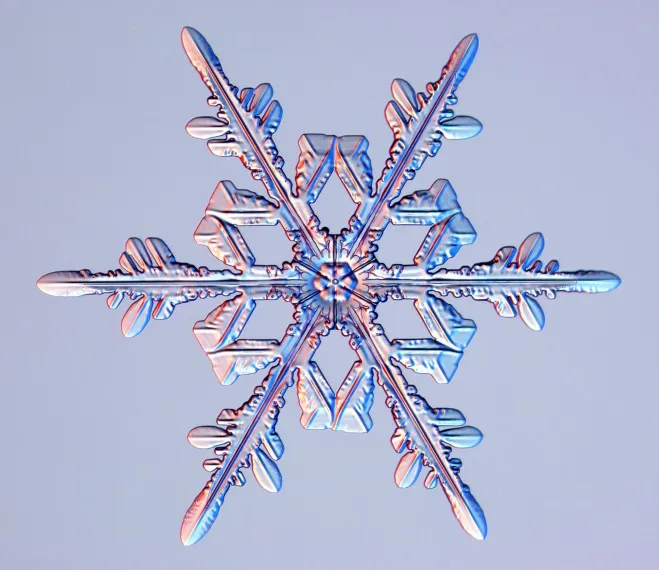
These types of snowflakes are actually very rare, Libbrecht said. "Perhaps one in a million."
What the?

Yes, that is a snowflake, or, more accurately a snow crystal the more technical name for snowflakes. There are roughly 35 different types. This type of snow crystal is known as a hollow column. Typically these crystals have openings on each end, but in this case the ice has trapped air bubbles inside.

A stellar plate

These snowflakes are characterized by six broad arms, and often have elaborate markings etched onto their surface. They are fairly common, Libbrecht says.
A fernlike stellar dendrite

These are the largest of the snow crystals, so named for the delicate, fern-like branches that protrude from the crystal's six main arms. Libbrecht writes on his website that stellar dendrites often make for the best skiing.
Faux snow

Under a microscope, human-made snow just doesn't measure up. It may be great for ski resorts, but in general, humans have had a hard time recreating in the laboratory what happens naturally in the skies.
A bullet rosette

Snow crystals may offer an astounding array of shapes, they are rarely perfectly symmetrical, Libbrecht says.
Get the world’s most fascinating discoveries delivered straight to your inbox.
