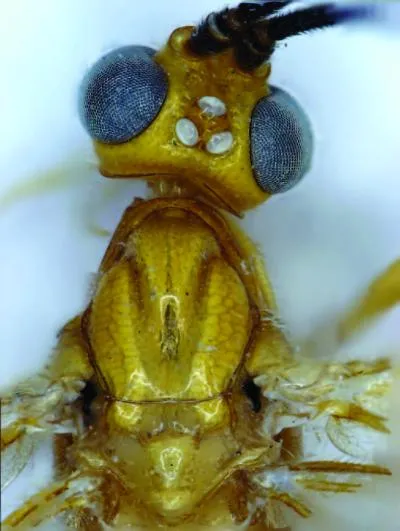
A new species of parasitic wasp with a lethal lifestyle is taking its name from assassin Beatrix Kiddo, the heroine played by Uma Thurman in Quentin Tarantino's "Kill Bill" films.
While the winged creature isn't exactly a master of the "Five Point Palm Exploding Heart Technique" — a technique that involves striking five pressure points, resulting in (you guessed it) an exploding heart — it does shares the yellow-and-black color of Kiddo's jumpsuit. Even more, the wasp has its own deadly repertoire of assassinlike moves.
Found in Thailand, the wasp has been formally named Cystomastacoides kiddo. The newly described species belongs to a family of parasitoid wasps, known as Braconidae, which turn the bodies of other insects into living incubators for their babies.
This picture shows, Cystomastacoides nicolepeelerae, named after the lead author's favorite novelist Nicole Peeler.
(Image credit: Buntika Butcher and Donald L. J. Quicke)
A Braconidae wasp typically implants its eggs inside of a host insect. As the larvae grow, they eat the host from the inside out, if not killing it, rendering the host immobile or sterile, researchers say. [The 10 Most Diabolical and Disgusting Parasites]
Parasitic wasps are known for their morbidly clever ways. For instance, recent research found that one species of parasitic wasp, Ampulex compressa, has larvae that secrete antimicrobial substances to keep their host, a cockroach, from spoiling. In another study, detailed in 2011 in the journal Biology Letters, scientists found Dinocampus coccinellae wasps use ladybugs as incubators because the zombie ladybugs keep predators away from the wasps' vulnerable larva.
In the new study, scientists identified two more new species of wasps in the Cystomastacoides genus, but in Papua New Guinea. One, Cystomastacoides asotaphaga, was discovered victimizing a moth caterpillar of the species Asota plana. The other, Cystomastacoidesnicolepeelerae, was named for fantasy author Nicole Peeler, a favorite novelist of Donald Quicke, a researcher at Imperial College London who led the study.
The scientists say their findings expand the range of this parasitic wasp genus, which had previously only been known from a single species, Cystomastacoides coxalis, found only in mainland China.
Sign up for the Live Science daily newsletter now
Get the world’s most fascinating discoveries delivered straight to your inbox.
Just last year, scientists identified at least 177 distinct species of parasitic wasps in the Orthocentrinae subfamily from Guatemala, Honduras, Nicaragua and the Amazon rain forests of Ecuador.
The new species from Thailand and Papua New Guinea were described today (March 19) in the Journal of Hymenoptera Research.
For the science geek in everyone, Live Science offers a fascinating window into the natural and technological world, delivering comprehensive and compelling news and analysis on everything from dinosaur discoveries, archaeological finds and amazing animals to health, innovation and wearable technology. We aim to empower and inspire our readers with the tools needed to understand the world and appreciate its everyday awe.