













Dead King Richard III a Control Freak, Psychologists Say

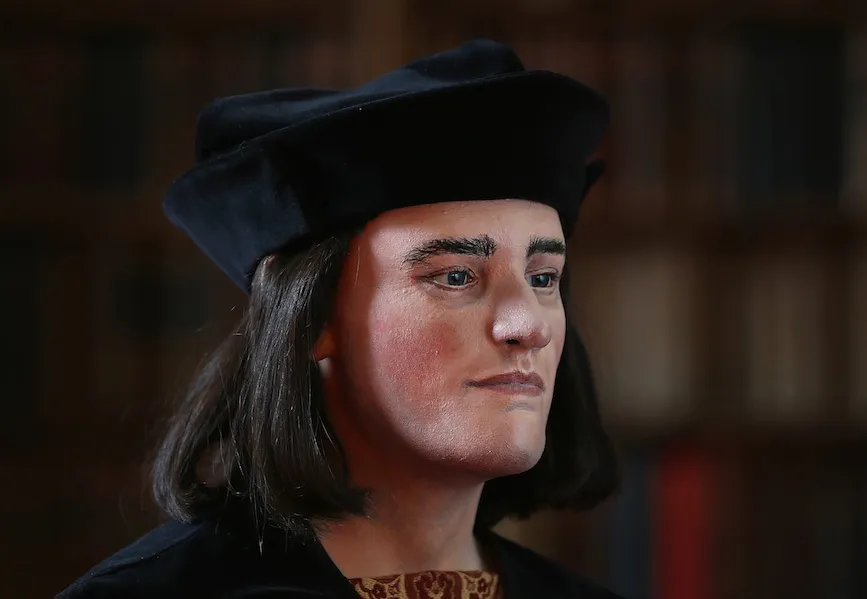
Can you psychoanalyze a man who's been dead for 528 years? University of Leicester psychologists have given it a shot.
They've concluded that Richard III, whose remains were recently identified in Leicester, was no psychopath, but he may have been a control freak.
The basis of this analysis was the historical record, according to psychologists Mark Lansdale and Julian Boon.
"Overall, we recognize the difficulty of drawing conclusions about people who lived 500 years ago and about whom relatively little is reliably recorded, especially when psychology is a science that is so reliant upon observation," Lansdale said in a statement. "However, noting that this is the problem historians work with as a matter of routine, we argue that a psychological approach provides a distinct and novel perspective: one which offers a different way of thinking about the human being behind the bones."
Villain or victim?
Richard III reigned for only two years before his death in battle. His body, reportedly buried in a Leicester church, was subsequently lost.
A University of Leicester-led dig in a city council parking lot turned up the king's grave in September. Testing of the skeleton, which bore battle wounds consistent with tales of the king's death, strongly suggests that it is Richard III's. [Gallery: The Search for Richard III's Grave]
Get the world’s most fascinating discoveries delivered straight to your inbox.
The news triggered international interest in Richard III, who was made famous by Shakespeare as a conniving villain in the play "Richard III." Modern-day Richard enthusiasts contest that portrayal, arguing that the king was the victim of a smear campaign by the Tudor dynasty, which followed Richard III and had every reason to tear his reign down to build up its own legitimacy.
The psychology of Richard III
Richard III lovers will likely be pleased with the new psychological analysis, which ignored Shakespeare's century-later portrayal in favor of historical documents from the king's life. The researchers found no evidence that Richard III was narcissistic, devious, callous, reckless or lacking in empathy, the traits that define a psychopath.
However, Richard III's insecure childhood (which took place during the War of the Roses, the civil war that would eventually kill him) may have made him intolerant of uncertainty, Lansdale said. The "intolerant of uncertainty" syndrome is associated with piety, a strong sense of right and wrong and loyalty, he said. But people who are intolerant of uncertainty can also harbor control freak tendencies and overreact when they feel their loyalty has been betrayed.
Richard III isn't the only historical figure whose personal life has undergone scrutiny years after death. In 2011, an anthropologist sought permission to open William Shakespeare's grave to attempt to look for traces of marijuana in the corpse's hair, fingernails or toenails. (Previously, the anthropologist had found traces of pot on pipe fragments in Shakespeare's garden, though cannabis was a common raw material for textiles and rope in England at the time.)
The Mona Lisa has been subject to similar scrutiny, with an ongoing project searching for the bones of Lisa Gherardini Del Giocondo, the woman who may have modeled for da Vinci's painting.
Email Stephanie Pappas or follow her @sipappas. Follow LiveScience on Twitter @livescience, Facebook or Google+. Original article on LiveScience.com.

Stephanie Pappas is a contributing writer for Live Science, covering topics ranging from geoscience to archaeology to the human brain and behavior. She was previously a senior writer for Live Science but is now a freelancer based in Denver, Colorado, and regularly contributes to Scientific American and The Monitor, the monthly magazine of the American Psychological Association. Stephanie received a bachelor's degree in psychology from the University of South Carolina and a graduate certificate in science communication from the University of California, Santa Cruz.