













Image gallery: Ancient buried treasure eluded Romans

Black Sea Treasure
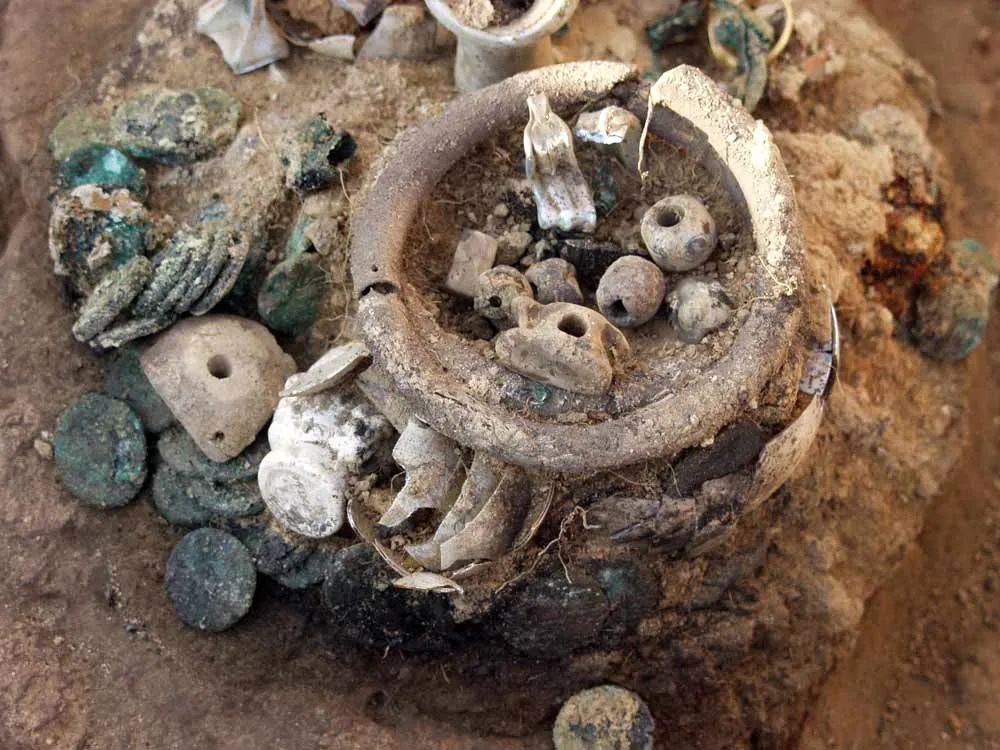
Researchers working at the site of Artezian in the Crimea (Ukraine) have discovered two hoards of buried treasure (one hoard shown here) dating to A.D. 45, a time when the people of the citadel were under siege by the Roman army. Here, two silver anklets, beads, numerous coins and a white, glass flask with a two-headed face, one side serious and the other happy.
Related: 2,000-Year-Old Treasure Discovered In Black Sea Fortress
Funerary Practices

The hoards were discovered beneath the torched citadel. In A.D. 45 the people of the town were trapped by the Roman army and knew they were likely going to die. Archaeologists believe the hoards may have been "funeral sacrifices" of sorts to prepare their owners for what was to come.
Gemstones

Among the discoveries from the hoards were gold rings with carved gemstones. They've been buried for nearly 2,000 years and a coin has apparently become stuck to this piece.
Goddess of Love

More treasures from the hoards: a silver brooch (left) depicting Aphrodite, goddess of love, alongside a pair of winged deities known as Erotes.
Hidden Treasure

One of the hoards shown from a distance. Originally the treasures would have been inside wooden caskets that have since decomposed.
People of Artezian

Work at Artezian has been ongoing since 1989 thanks in large part to the efforts of volunteers. There are other treasures the team has unearthed at the citadel that, while not part of the hoards, shed light on the people who lived there.
Get the world’s most fascinating discoveries delivered straight to your inbox.
Graffiti

The people at Artezian had a fondness for sketching what we might consider "graffiti," as seen here.
Terracotta Figurines

Researchers also found numerous terracotta figures at the citadel, including this depiction of Demeter, Greek goddess of the harvest.
Spindles

These ancient decorated spindles were also found on site.
Torched Citadel

The citadel was torched by the Roman army in A.D. 45, with many of its inhabitants likely killed. Some time afterward Artezian was rebuilt with stronger fortifications although it, along with the rest of the Bosporan Kingdom, was under the sway of Rome.
Citadel

Another image of the citadel.

Owen Jarus is a regular contributor to Live Science who writes about archaeology and humans' past. He has also written for The Independent (UK), The Canadian Press (CP) and The Associated Press (AP), among others. Owen has a bachelor of arts degree from the University of Toronto and a journalism degree from Ryerson University.