














Super Salmonella Bacteria Found

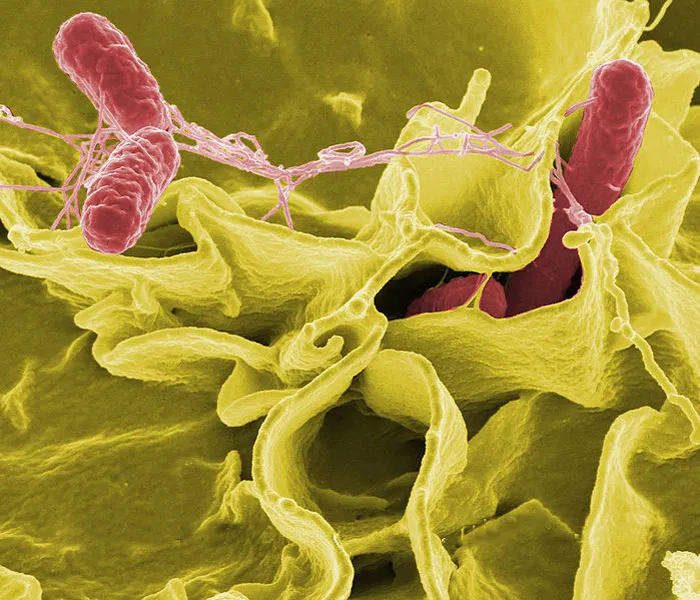
Certain Salmonella bacteria, the microbes that cause food poisoning, have the potential to become as much as 100 times more virulent than normal, recent research has found. In the study, these super-bugs overcame the protective effects of a Salmonella vaccine, killing vaccinated mice.
The scientists found that some of the bacteria have the potential to become much nastier than others, a result that has implications for averting outbreaks among humans and animals, they write in a study published April 12 in the journal PLoS Pathogens.
Led by Douglas Heithoff of the University of California, Santa Barbara, they used a technique called animal passage, in which a pathogen is weakened or strengthened by infecting an animal with it. In recent research that created a more transmissible version of the H5N1 flu virus, scientists passed it between ferrets. In this case, the scientists created more virulent forms of the bacteria by infecting mice.
They found that certain strains had the potential to become hyperinfectious and were among the most virulent Salmonella ever reported, they write. [10 Deadly Diseases That Hopped Across Species]
To measure the nastiness of the strain, the team looked at how much was required to kill half of the infected animals. The hypervirulent strains required a dose as little as 100-fold lower than normal to be that lethal.
Certain variables related to the host or the environment appeared to help create these microbial monsters, so the researchers warn that factors such as herd size, livestock diet, or livestock exposure to their own waste might inadvertently trigger the emergence of unusually virulent Salmonella in livestock.
Every year, 42,000 cases of salmonellosis are reported in the United States, but the actual number of cases is likely much higher, since many mild ones likely aren't reported, according to the U.S. Centers for Disease Control and Prevention (CDC).
Get the world’s most fascinating discoveries delivered straight to your inbox.
Infection causes diarrhea, fever, or abdominal cramps. The use of antibiotics in the livestock industry has led some strains to become resistant to antibiotics, according to the CDC.
Outbreaks are frequent; one at the moment has infected at least 141 people in 20 states, and officials have traced it back to a frozen raw yellowfin tuna product, known as Nakaochi Scrape.
Although research is ongoing, there is no Salmonella vaccine for humans available yet; infections are treated with antibiotics.
You can follow LiveScience senior writer Wynne Parry on Twitter @Wynne_Parry. Follow LiveScience for the latest in science news and discoveries on Twitter @livescience and on Facebook.
