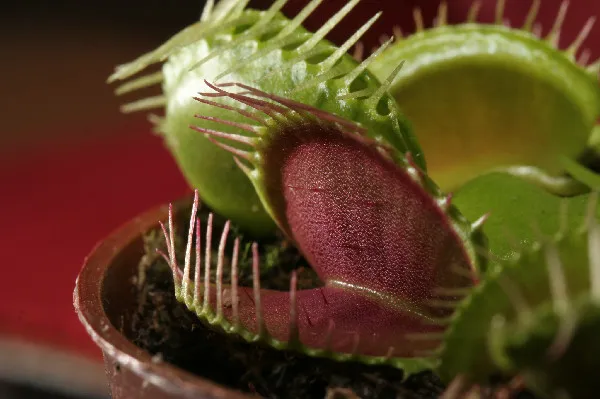
Venus flytraps are the speed demons of the plant world. In spite of belonging to a particularly sedate kingdom of organisms, these carnivorous plants snap shut their two-lobed traps in a tenth of a second to capture an insect meal, which they then digest.
Just how they do this is not fully understood, but new research is exploring the mechanisms that allow a plant to become a predator. [Giant Plant Eats Rodents]
The Venus flytrap turned to carnivory to survive in the nutrient-poor soil of its native habitat in North and South Carolina, in and around the Green Swamp. To get the nutrition it needs, the flytrap lures insects, including ants and flies, into the jaws of its trap. The trap's reddish interior and small nectar-secreting glands along its rim trick the insects into thinking they have found a flower, said Rainer Hedrich, a biophysicist at the University Wuerzburg in Germany. He and colleagues have revealed how hormones play a role in how the plant snaps up and digests its prey.
Latest Videos From
How the flytrap kills
Each side of the trap has three to four sensor hairs, each no longer than 0.2 inches (0.5 centimeters). An insect must trip a hair twice or two hairs within 20 seconds for the trap to respond; this allows it to avoid snapping shut on raindrops or other false alarms.
The first time a hair is triggered, it creates an electrical signal that travels along the surface of the trap, much like the electrical signal that travels through an animal's nerve cell. The energy of that first signal is stored. When the second touch occurs, it also generates an electrical signal. Together, the energy from these two signals passes the threshold required for the trap to respond.
The travelling electrical signals result from the movement of charged atoms, called ions, across the membranes of cells within the trap lobes. During the second signal, cells in the center of each lobe lose water along with the ions. This causes the cells to lose turgor, the water pressure that keeps a plant rigid. As a result, the lobes snap together, according to Hedrich.
After the trap has snapped shut, the plant turns it into an external stomach, sealing the trap so no air gets in or out. Glands produce enzymes that digest the insect, first the exoskeleton made of chitin, then the nitrogen-rich blood, which is called hemolyph.
The digestion takes several days depending on the size of the insect, and then the leaf re-opens. By that time, the insect is a "shadow skeleton" that is easily blown away by the wind, he said.
Venus' hormones
The new research looks at what happens when the insect has been caught and is squirming around as the trap seals itself up. Hedrich and colleagues took samples from traps during this phase and found that hormones play a role in the response.
One of these is a type of touch-hormone, called jasmonate, which allows plants to respond to contact. For instance, when a leaf is bitten by a caterpillar, it may release jasmonate, which elicits a defensive response, such as the production of a poison. But until now, it appeared that jasmonates were only involved in defensive responses.
The researchers were able to induce empty traps to secret digestive enzymes and slowly close by simply spraying the jasmonates on them. This bypassed the fast, first phase — in which an electrical signal snaps the trap shut — and closed the trap using the slower process, initiated by the jasmonates, that turn the trap into a stomach by hermetically sealing it to prevent the digestive juices from leaking out.
"Normally, plants have to defend against their predators. In carnivory, plants turned this around and simply eat their predators," Hedrich said.
They also found that the drought-stress hormone abscisic acid counteracts the jasmonates, and that spraying abscisic acid on the trap appeared to prevent it from closing when the hairs were stimulated. This hormone prevents the plant from undergoing the water-demanding process of digesting prey during times of drought stress, according to Hedrich.
Hedrich and his colleagues are in the process of sequencing the plant's genome, by comparing it with noncarnivorous relatives, they hope to explore the evolution of carnivory. They also want to know if and how the flytrap recognizes the insect it has caught to put together a cocktail of digestive enzymes tailored specifically for it.
You can follow LiveScience writer Wynne Parry on Twitter @Wynne_Parry. Follow LiveScience for the latest in science news and discoveries on Twitter @livescience and on Facebook.

 Live Science Plus