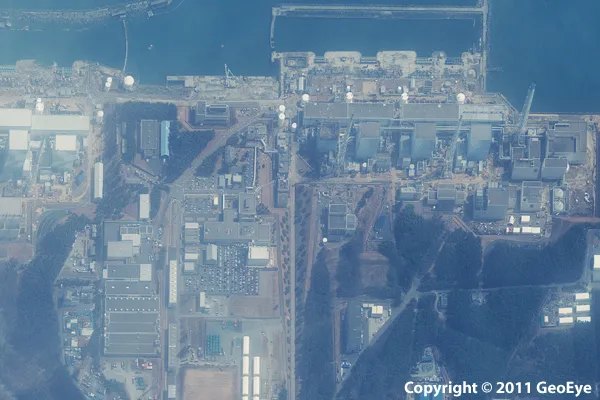
A containment vessel at the Fukushima Daiichi nuclear reactor cracked under the pressure of the rising heat and steam inside it yesterday (March 15), and another vessel has possibly ruptured today. Just a few days ago, experts believed the vessels to be fail-safe.
"The containment will contain all significant radioactivity inside it," one MIT nuclear engineer told LiveScience on Saturday. "It is designed to contain the products of an accident," said another.
The containments encapsulating the Fukushima reactors, according to the experts, were a distinguishing factor between the crisis there and the much worse one at Chernobyl. Chernobyl did not have containment vessels.
Latest Videos From
Even with a containment breach, scientists maintain that Fukushima will not yield a Chernobyl-scale disaster, because the nuclear fission of uranium dioxide inside the reactor has long since been turned off; radiation is not being actively produced, but is only coming from the decay of residual fission products. (There are hundreds of such products, some of which have already fully decayed, others of which decay more slowly.) By contrast, the Chernobyl explosion occurred while fission was running at full force, causing one-third of the radioactive material in the nuclear core to blast out into the environment.
Still, the Fukushima containment breach will produce a much larger radiation leak than was initially expected, and a massive cleanup at Fukushima will now be required. No one likes nuclear-related surprises: Does the unexpected rupture of containment vessels at Fukushima call to question the safety of nuclear facilities in the United States and elsewhere?
According to Kent Hansen, a nuclear systems engineer at MIT, there are 10 or 12 different designs for containment vessels in the world, and the Fukushima facility uses one of the earliest designs. The General Electric-designed vessels there are cooled via water boiling. Most facilities in the United States are passively cooled with a system that utilizes natural convection, but approximately 40 U.S. facilities also use water boiling reactors. The Nuclear Regulatory Commission reports that 23 of those are of the same design as the Fukushima facilities. [Infographic: Inside Japan's Nuclear Reactors]
That doesn't mean the U.S. facilities are dangerous, however.
"Nuclear power plants have shown themselves to be much safer than most other forms of energy production," Hansen told Life's Little Mysteries, a sister site to LiveScience. As far as energy-related accidents go, "the largest loss of life was a [hydroelectric] dam failure in India that killed 20,000 people. It would take a lot of nuclear accidents to catch up to that."
Radiation sickness killed 140 people at Chernobyl, with a few thousand more coming down with cancer in the aftermath (though that figure is controversial). No one died as a direct result of the nuclear crisis at Three Mile Island (though cancer rates may have increased downwind from the facility for a few years).
If an earthquake struck an old, water boiling nuclear reactor in Idaho, for example, and a blizzard rolled in at the same time, and on top of that, a plane crashed into the building, maybe that chain of events would lead to a cooling failure and a burst containment vessel. But you can't plan for that kind of thing, Hansen said.
"One cannot prove that an airplane would not crash into a ballpark during a ballgame, which would kill thousands of people," he said. "But should we shut down the airport during ballgames? Where do you draw the line and say this is a reasonable level of protection?"
"These large-scale disasters are extremely rare," Hansen said. "You can design for a certain level of accident probability, and if you're below that level of probability at a plant, it must be deemed safe."
This article was provided by Life's Little Mysteries, a sister site to LiveScience. Follow Natalie Wolchover on Twitter @nattyover

 Live Science Plus