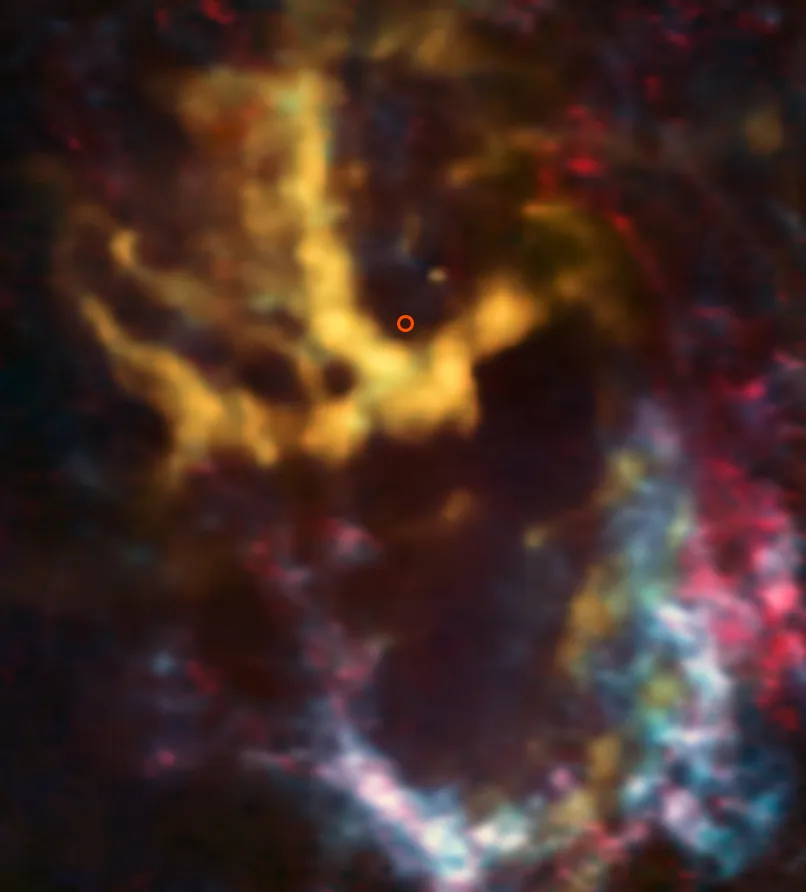
An image from the Atacama Large Millimeter/submillimeter Array (ALMA) shows molecular gas clouds around the region where the Milky Way's central, supermassive black hole is known to exist. That region, highlighted in red, looks dark and silent.
(Image credit: ALMA (ESO/NAOJ/NRAO)/ J. R. Goicoechea (Instituto de Física Fundamental, CSIC, Spain))
There's a beast hiding at the center of the Milky Way, and it's barely moving.
This supermassive black hole, Sagittarius A* (SgrA*), has a mass 4.15 million times that of our sun. It first revealed itself to scientists as a mysterious source of radio waves from the galaxy's center back in 1931; but it wasn't until 2002 that researchers confirmed the radio waves were coming from something massive and compact like a black hole — a feat that earned them the 2020 Nobel Prize in physics. Just days before the team learned about their Nobel on Oct. 6, another group learned something new about the black hole: It's spinning more slowly than a supermassive black hole should, moving less than (possibly far less than) 10% of the speed of light.
Black holes, despite their awesome power, are extraordinarily simple objects. All the distinguishing features of the matter that forms and feeds them gets lost in their infinitesimal singularities. So every black hole in the galaxy can be described with just three numbers: mass, spin and charge.
Once researchers locate a black hole in space, measuring the mass is pretty straightforward — just check how strongly its mass is tugging on nearby objects. To get the mass of SgrA*, scientists just observed its influence on the "S-stars," a collection of the Milky Way's innermost stars that get accelerated to incredible speeds as they whip around the black hole in tight orbits. And researchers assume that, like most large objects in space, black holes don't have strong electromagnetic charges.
(Planet Earth, for example, has some positively charged particles and some negatively charged particles, but they cancel each other out across the whole planet. The other planets and known stars work the same way. Researchers assume black holes are similarly neutral in charge.)
That leaves spin as the remaining measurable feature of SgrA*, and now researchers think they have evidence that the supermassive is an unusually slow spinner.
Sign up for the Live Science daily newsletter now
Get the world’s most fascinating discoveries delivered straight to your inbox.
Spin matters for two main reasons.
First, as Live Science previously reported, a black hole's event horizon — the shadowy region within which not even light can escape the monster's gravity — grows as it gains more mass, reaching further and further from the singularity of the black hole. But as the black hole spins faster and faster, the event horizon shrinks. Very fast-spinning black holes should have smaller event horizons than slower-moving black holes of the same mass.
Second, spin is thought to play a role in the two white-hot jets of matter that sometimes launch into space at incredible speeds from a black hole's axis of rotation. Most Milky Way-sized galaxies have supermassive black holes at their center, and often these galaxies have enormous jets visible bursting from their cores.
But the Milky Way has no visible jets. That on its own implies that SgrA* probably isn't spinning very fast. Researchers think that a fast-spinning black hole stirs up the disk of accreting matter whirling just outside its event horizon, accelerating some of that matter to burst out as a jet. What scientists know about the quiet SgrA* already suggests it either has a small accretion disk, is barely spinning, or both.
In a new paper, a team of researchers attempted to measure SgrA*'s spin. Once again, they relied on the visible S-stars to learn what their big dark companion is doing.
Right now, the researchers found, the S-stars circle SgrA* on two orbital planes. If you were to draw their orbits around the black hole and view the system from the side, they'd form an X. SgrA* must be spinning at a rate less than 10% of the speed of light, they found, because any faster movement would have knocked the S-stars out of their X-shaped orbital planes by now.
That's because those orbits, the researchers wrote, are likely as old as the S-stars themselves. The stars still follow the orbits they were born with. If SgrA* were spinning very fast, that wouldn't be the case.
When heavy objects spin very fast in space, that spin influences anything in orbit around them. Over time, that massive object tugs on the orbits of those smaller objects, making them line up more and more with the rotating object's own direction of spin. The slower the spin is, the weaker the effect, and the longer it takes for those objects to line up in orbit around their hefty chief.
The stars are old enough that the spin should have noticeably tugged on them if it were very strong. With their orbits as pristine as the day they were born, the S-stars strongly suggest an upper speed limit for SgrA* at just one-tenth the speed of light. And it may be spinning much slower.
This result also would explain why SgrA* doesn't seem to have any visible jets, they wrote. A first close-up image of SgrA*'s shadow, expected to come in the near future from another research team, should help confirm this, they wrote.
Rafi joined Live Science in 2017. He has a bachelor's degree in journalism from Northwestern University’s Medill School of journalism. You can find his past science reporting at Inverse, Business Insider and Popular Science, and his past photojournalism on the Flash90 wire service and in the pages of The Courier Post of southern New Jersey.