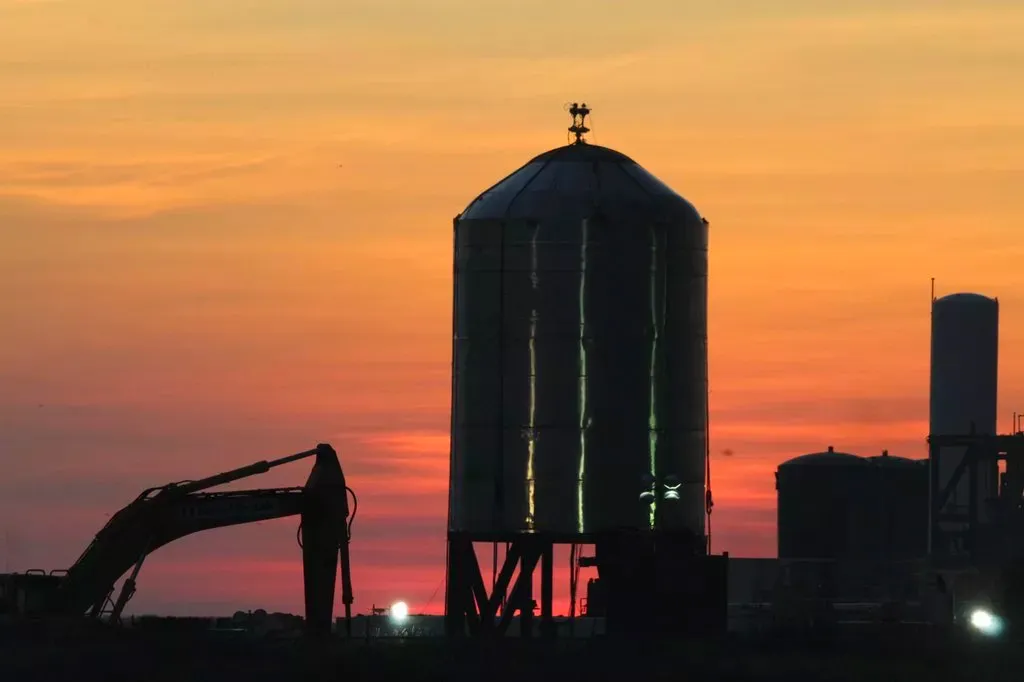
SpaceX just popped another Starship test tank.
The Starship SN7.1 tank was destroyed on purpose Tuesday night (Sept. 22) at SpaceX's South Texas facilities, during a pressure test designed to take the stainless-steel hardware to its bursting point.
SpaceX has performed several other such tests, including one this past June that blew the top off the SN7 tank. Such trials inform future iterations of Starship, the 100-passenger spacecraft Elon Musk's company is developing to get people to Mars, the moon and other cosmic destinations.
Related: SpaceX's Starship and Super Heavy rocket in pictures
SN7.1's death clears the way for testing of the SN8 prototype, which could begin as soon as this weekend. If SN8 aces a series of checkouts and engine trials, it will attempt a 12-mile-high (20 kilometers) flight into the South Texas skies, Musk has said.
Two full-size Starship prototypes have already gotten off the ground — SN5 and SN6, each of which got about 500 feet (150 meters) high during recent test flights. ("SN" stands for "serial number," in case you were wondering.)
The flights of both SN5 and SN6 were powered by just a single Raptor engine. SN8 will have three Raptors, as well as a nose cone and control-improving body flaps, further accoutrements that its predecessors lacked.
The final Starship will have six Raptors, which will make the 165-foot-tall (50 m) vehicle powerful enough to launch itself off the moon and Mars, Musk has said. But Starship will need help getting off our bulkier Earth, so it will launch from here atop a giant rocket called Super Heavy, which will be powered by about 30 Raptors of its own.
Starship and Super Heavy are both designed to be fully and rapidly reusable. Musk envisions the duo cutting the cost of spaceflight dramatically — so dramatically, in fact, that ambitious feats such as Mars colonization become economically feasible.
Mike Wall is the author of "Out There" (Grand Central Publishing, 2018; illustrated by Karl Tate), a book about the search for alien life. Follow him on Twitter @michaeldwall. Follow us on Twitter @Spacedotcom or Facebook.