













Red 'star' rising with the moon on Sunday is really Mars — and you may be able to see it 'disappear'
Mars will appear to make an ultraclose approach to the moon on Sunday, after Jupiter had a turn earlier this week. Here's how to get the best view of the rare conjunction.

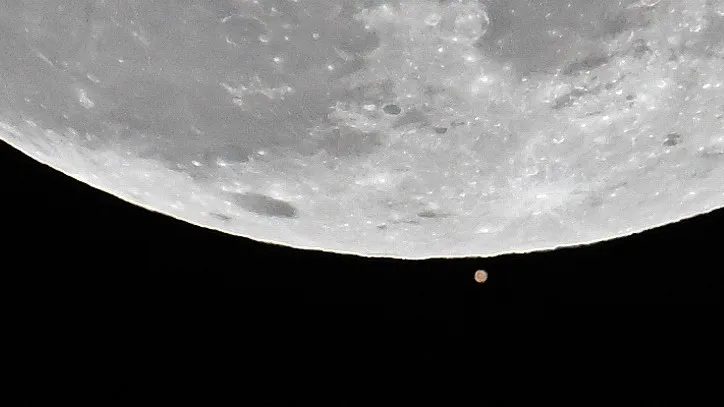
The bright moon is hosting some special guests in the night sky this week: Following a close conjunction of Jupiter and the moon on Thursday (Feb. 6), the Red Planet Mars is ready to rise alongside Earth's natural satellite this Sunday (Feb. 9).
In a rare celestial event, the moon and Mars will be just 1 to 2 degrees apart, providing great viewing opportunities all night.
To get the best views of the close approach, find a spot under clear skies and away from artificial light (although both planets are still visible amid city light pollution). Allow some time for your eyes to adjust to the darkness, and if you have to use a flashlight, opt for red light instead of white light to preserve your night vision. You can easily see Mars and Jupiter with your naked eyes, but these planets are best viewed through a pair of skywatching binoculars or a good backyard telescope.
Planets hugging the moon
On Feb. 6-7, Jupiter and the moon rose about 5 degrees apart, in what's known as a conjunction. The conjunction of Jupiter and the moon occured at 10:36 p.m. EST, and the two celestial bodies remained very close together all night, according to Stellarium.
Related: The 10 best stargazing events of 2025
A few nights later, on Feb. 9, Mars and the moon will be in conjunction around 2:36 p.m. EST, according to Starwalk. When they reach conjunction, they will be about half a degree apart, although that will vary slightly depending on your exact location. Mars and the moon will rise and set together, rising shortly after 2 p.m. on Feb. 8 and setting shortly before 6 a.m. on Feb. 9.
Although Mars will be closest to the moon during daylight hours for viewers in the United States and Canada, Mars will remain very close to the moon all night. Shortly after sunset, the moon and Mars will be about 2 degrees apart, although this could vary slightly depending on your location. Look for them in the eastern sky, in the constellation Gemini. Mars will appear above and slightly to the west of the waxing gibbous moon, which will be about 90% illuminated.
Get the world’s most fascinating discoveries delivered straight to your inbox.
RELATED STORIES
Skywatchers in northern latitudes might even be able to catch a lunar occultation, when the moon appears to swallow a planet from the sky. Mars will vanish behind the moon around 1:09 p.m. EST and emerge from behind the moon around 4:30 p.m. EST, according to Starwalk. The lunar occultation of Mars will be visible from parts of Canada, most of Scandinavia and Russia, and parts of Asia. The occultation will barely graze the northernmost part of the U.K.
This map from In-the-Sky shows the locations where the lunar occultation will be visible; you can type your location into the sidebar on In-the-Sky to check if the lunar occultation will be visible from your location.
Editor's note: This article was updated on Friday (Feb. 7) after the conjunction of Jupiter and the moon ended.
Mars quiz: Is your knowledge of the Red Planet out of this world?

Gretchen Rundorff is an astronomy enthusiast who is passionate about science communication and empowering people to learn about the night sky. She has seen multiple meteor showers, has seen a partial solar eclipse in 2016, has photographed the 2024 total solar eclipse, and has used telescopes to view planets and star clusters. Gretchen holds a bachelor’s degree in philosophy and French from the University of Pittsburgh, and a graduate-level certificate in copyediting from the University of California San Diego.
You must confirm your public display name before commenting
Please logout and then login again, you will then be prompted to enter your display name.