















1st known 'Trojan' planets discovered locked in the exact same orbit around a star
A distant Jupiter-size planet could have the shattered remains of a smaller sibling in its tow.

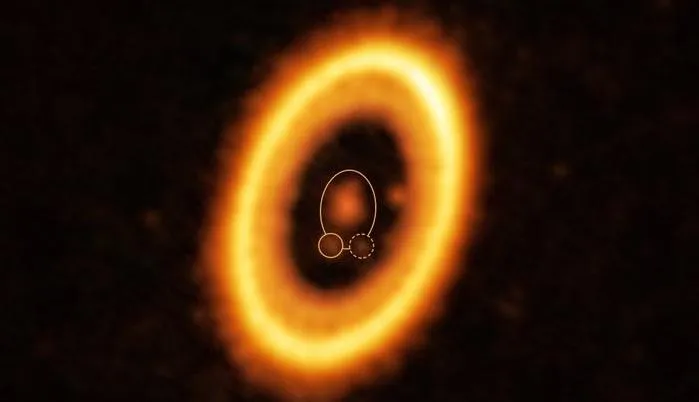
Astronomers have discovered the first evidence of ultra-rare 'Trojan' planets: two sibling planets bound on the same orbit around the same star.
The potential co-orbiting planets, dancing around the young star PDS 70 roughly 370 light-years away, consist of a Jupiter-size planet and a cloud of debris — possibly the shattered remains of a dead planet, or the gathering building blocks of one yet to be born.
If scientists confirm that the debris cloud is moving along the same orbital path as the giant planet, the discovery will be the first-ever detection of Trojan planets. The researchers published their findings Wednesday (July 19) in the journal Astronomy and Astrophysics.
Related: What's the maximum number of planets that could orbit the sun?
"Two decades ago it was predicted in theory that pairs of planets of similar mass may share the same orbit around their star, the so-called Trojan or co-orbital planets. For the first time, we have found evidence in favor of that idea," lead-author Olga Balsalobre-Ruza, a graduate student at the Center for Astrobiology (CAB) in Madrid, Spain, said in a statement.
Trojan planets get their unusual name from the two asteroid clusters seen around Jupiter, which, upon their discovery, were split into Greeks and Trojans (the opposing sides of the mythical Trojan War in Homer's Iliad) based on their proximity to the gas giant's gravitationally stable Lagrange points.
Lagrange points are places in a solar system where the gravitational pulls of a star and an orbiting planet balance out the motion of an object's orbit, trapping the object so that it moves in lock-step with the planet.
Get the world’s most fascinating discoveries delivered straight to your inbox.
It's not just asteroids that can get trapped inside Lagrange points; planets that form at the same time can also find themselves locked on the same orbital path. Yet, despite calculations by astronomers suggesting that as many as 42 Earth-size planets can be theoretically crammed into a single orbit, the long-term instability of Trojan orbits and the inability of current telescopes to view them means they had yet to be spotted.
To look for signs of Trojans hiding out in space, the astronomers used the Atacama Large Millimeter/submillimeter Array (ALMA) — a set of 66 sub-radio range telescopes in Chile's Atacama Desert. Millimeter and submillimeter light is typically given off by very cold pockets of gas and dust, which means it is a perfect spectrum in which to search for the first or final stirrings of planets.
RELATED STORIES
Two Jupiter-scale monster planets occupy the PDS 70 system. By zooming in on one of the Lagrange points belonging to the planet called PDS 70b, the researchers found a faint signal. The signal belonged to a debris cloud, indicating that a mass roughly twice the size of Earth's moon was moving alongside PDS 70b.
"Who could imagine two worlds that share the duration of the year and the habitability conditions? Our work is the first evidence that this kind of world could exist," Balsalobre-Ruza said. "We can imagine that a planet can share its orbit with thousands of asteroids as in the case of Jupiter, but it is mind blowing to me that planets could share the same orbit."
The researchers will have to wait until 2026 to confirm the finding. This is when the next window opens up to check if PDS 70b and its accompanying Trojan have moved together. If the planets are found to have done so, the researchers will have made a breakthrough.
"Our research is a first step to look for co-orbital planets very early in their formation," co-author Itziar De Gregorio-Monsalvo, head of the Office for Science at the European Southern Observatory in Chile, said in the statement. "The future of this topic is very exciting and we look forward to the extended ALMA capabilities, planned for 2030, which will dramatically improve the array's ability to characterize Trojans in many other stars."

Ben Turner is a U.K. based writer and editor at Live Science. He covers physics and astronomy, tech and climate change. He graduated from University College London with a degree in particle physics before training as a journalist. When he's not writing, Ben enjoys reading literature, playing the guitar and embarrassing himself with chess.