Get the world’s most fascinating discoveries delivered straight to your inbox.
You are now subscribed
Your newsletter sign-up was successful
Want to add more newsletters?
Join the club
Get full access to premium articles, exclusive features and a growing list of member rewards.
An account already exists for this email address, please log in.
An encounter with 'something outside of the solar system' may have triggered an ice age on Earth
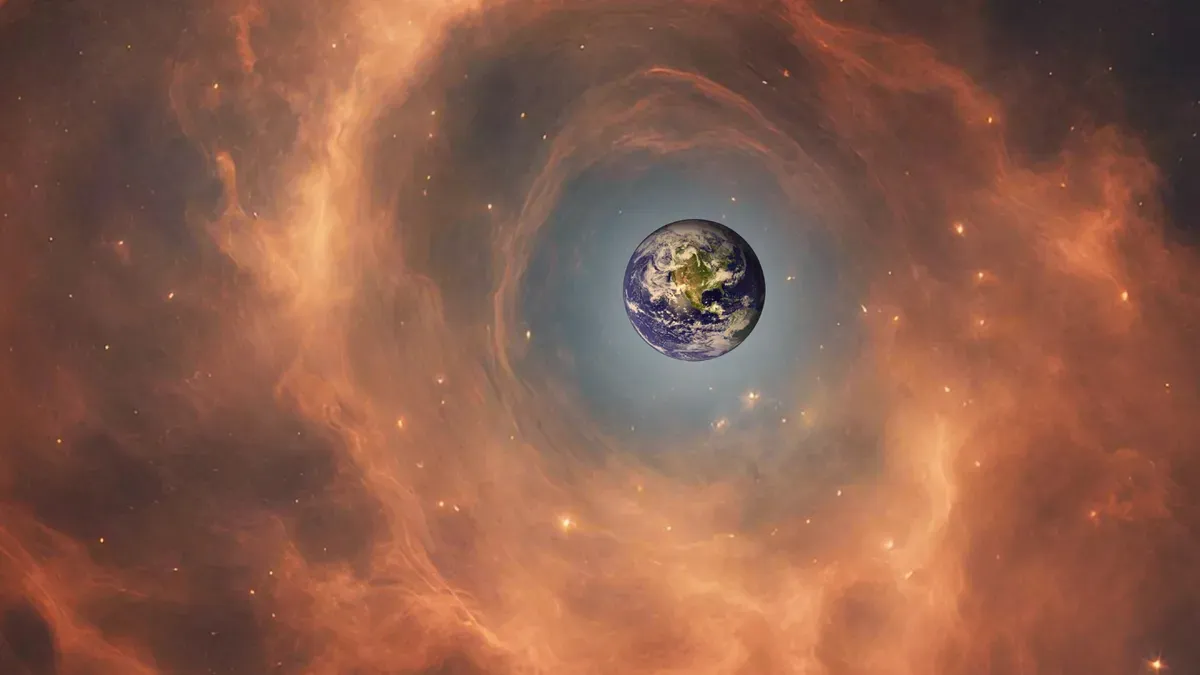
Two million years ago, an encounter with a cold cloud of gas and dust could have caused our planet's "protective giant bubble" to draw back, potentially cooling our planet, new research claims.
Scientists believe Earth may have briefly lost protection from the sun around two million years ago, left to endure the extreme environment of interstellar space as the solar system passed through a dense cloud of gas and dust between stars.
At that time, early human ancestors shared our planet with prehistoric animals like mastodons and sabretooth tigers. It's also when Earth was in the midst of the ice age that ended only around 12,000 years ago. Ice ages are brought about by a range of factors, including our planet's tilt and rotation, carbon dioxide levels in its atmosphere, and shifting plate tectonics and volcanic eruptions at its surface. However, given the timing of when scientists think Earth plunged through interstellar space, this research suggests radical changes in our planet's climate, like the onset and ending of ice ages, could also be influenced by the position of our solar system in our home galaxy.
More specifically, the team behind the new findings suggests the solar system could have encountered a dense patch of interstellar gas and dust as it traversed the Milky Way two million years ago. And that patch may have been thick enough to interfere with a stream of charged particles called the "solar wind" flowing from the sun and impacting Earth, potentially causing plunging temperatures.
"This paper is the first to quantitatively show there was an encounter between the sun and something outside of the solar system that would have affected Earth's climate," research lead author Merav Opher, a space physicist and expert on the heliosphere at Boston University, said in a statement.
The solar system, back in time
Our entire solar system is enveloped in a "giant bubble" of protective plasma that comes from the sun, which is known as the "heliosphere." This protective shield is created when solar winds press on the interstellar medium, which refers to stuff that drifts through the spaces between stars in the Milky Way. The heliosphere is perpetually refreshed by a constant flow of charged particles from the sun, which stream out past Pluto.
The heliosphere shields Earth's surface from radiation and galactic rays that could potentially impact the DNA of living things. This shielding is so crucial that many scientists believe it was integral to the emergence and evolution of life on Earth.
Sign up for the Live Science daily newsletter now
Get the world’s most fascinating discoveries delivered straight to your inbox.
This team thinks that it is possible a cold cloud of interstellar material could have once stymied the solar wind in such a way that the heliosphere was compressed. This might have, for a short period (in cosmic terms), removed Earth and other solar system planets from the protection offered by the heliosphere.
"Stars move, and now this paper is showing not only that they move, but they encounter drastic changes," Opher added.
A diagram showing the heliosphere sheilding the solar system from the dense and cold conditions of the interstellar medium.
(Image credit: Southwest Research Institute)
To determine the effect such a bombardment of dense interstellar dust on the heliosphere would have had on Earth, Opher wound back the clock with sophisticated computer models. This allowed her and the team to visualize where the sun was positioned two million years ago and also determine where the heliosphere and the rest of the solar system were at this time.
They also tracked the progress of a string of dense cold gas called the "Local Ribbon of Cold Clouds system" back through time as it swept through the Milky Way. This revealed that one dense cloud at the tail-end of the Local Ribbon of Cold Clouds system, called the "Local Lynx of Cold Cloud," could have clashed with the heliosphere.
This would have left Earth exposed to the interstellar medium, including the heavy and radioactive elements that populate it, which are the remains of massive stars that die in supernova explosions. The heliosphere usually blocks these particles — without that shielding, these radioactive elements could have rained down on Earth. This could explain an increase in the isotopes iron 60 and plutonium 244 found in Antarctic snow and ice cores and on the moon that correspond to a period two million years ago. The timing of the heliosphere's clash with the Local Lynx of Cold Cloud also corresponds to a cooling period on Earth two million years ago.
Opher theorizes the pressure from the Local Lynx of Cold Cloud could have restricted the heliosphere for a period as short as a few hundred years, or as long as a million years. This would all depend on how large the cloud actually was, Opher said. She added that the heliosphere would have grown to surround the planets again after the influence of this dense cloud had gone.
For now, however, it is hard to precisely determine the impact this cold interstellar cloud would have had on Earth, including if it could have truly sparked an ice age. The team will now investigate even further back in time to find other times the solar system crossed paths with dense interstellar clouds and to determine if these also line up with ice ages.
She and her team are also now exploring the effect of so much hydrogen and radioactive material crossing paths with Earth's atmosphere.
"This cloud was indeed in our past, and if we crossed something that massive, we were exposed to the interstellar medium," Opher said. "This is only the beginning."
The team's research was published on Monday (June 10) in Nature Astronomy.
Robert Lea is a science journalist in the U.K. who specializes in science, space, physics, astronomy, astrophysics, cosmology, quantum mechanics and technology. Rob's articles have been published in Physics World, New Scientist, Astronomy Magazine, All About Space and ZME Science. He also writes about science communication for Elsevier and the European Journal of Physics. Rob holds a bachelor of science degree in physics and astronomy from the U.K.’s Open University