













This gooey, brainless blob can store memories

A neon-yellow slime mold can store memories, even though it lacks a nervous system. Now, scientists have found a new clue as to how the brainless blob manages this impressive feat.
The single-cell organism, known as Physarum polycephalum, belongs to the taxonomic group Amoebozoa, the same group as amoebas, Live Science previously reported. The blobs can exist as one tiny cell with one nucleus, the cell's control center, or multiple cells can fuse together to form one gargantuan cell with many nuclei. These fused cells can grow to cover dozens of square inches (hundreds of square centimeters) in area.
When fused, the huge cells form a complex network of internal tubing; these tubes contract, similar to blood vessels, to push fluid and nutrients through the brainless blob.
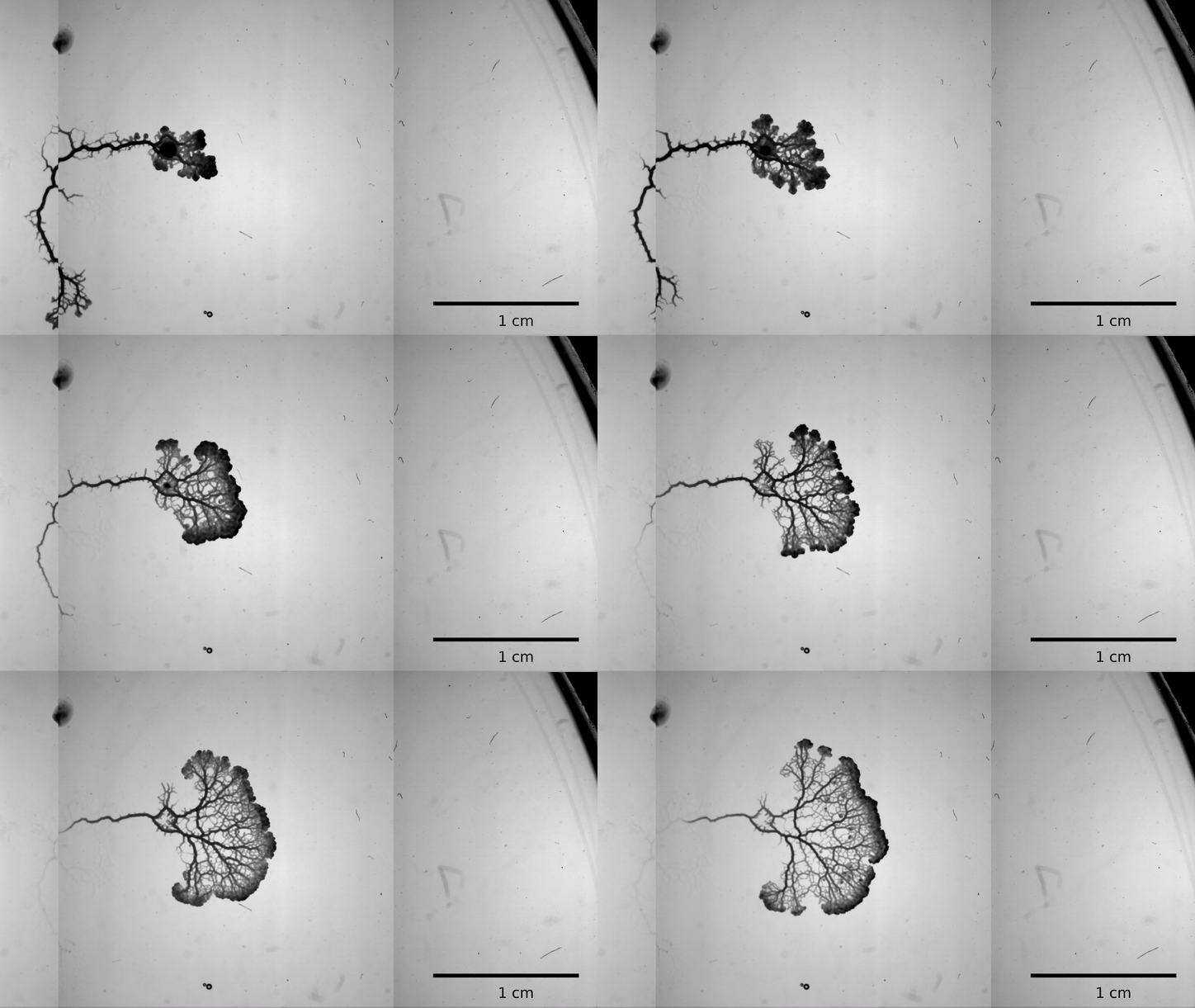
The new study, published Feb. 22 in the journal Proceedings of the National Academy of Sciences, shows that the diameters of these branching tubes can encode information, such as where the slime mold has recently found food. When the blob finds food, it rapidly reorganizes its tubular network, widening some tubes and shrinking others, and this architecture remains in place even after the blobs have eaten the food.
Related: Extreme life on Earth: 8 bizarre creatures

This photo shows the yellow slime mold Physarum polycephalum growing over a fallen log in the Belding Wildlife Management Area of Vernon, Connecticut.
This basic form of memory may help slime molds solve complex puzzles, such as finding the fastest route to food or the shortest path through a maze, senior author Karen Alim, an associate professor of biological physics at the Technical University of Munich, told Live Science in an email.
When P. polycephalum senses a snack nearby, by detecting chemicals that its food lets off, the tubes nearest to the food begin to dilate. Meanwhile, tubes farther from the food shrink and sometimes disappear altogether, becoming reabsorbed by the slime. The slime mold then creeps in the direction of the wide, dilated tubes, migrating until it engulfs its snack.
Get the world’s most fascinating discoveries delivered straight to your inbox.
But even after gobbling down every morsel of food, the slime mold hangs on to the cluster of thick tubes, leaving a long-lasting "imprint" of where the food was once located, the authors wrote. This dictates how fluid flows through the whole network and influences which direction the slime mold travels next. For instance, if more food crops up near the thick, imprinted tubes, the slime mold is already prepped to spread in that direction, and that imprinted "memory" becomes reinforced.
"In the brain, we store information by strengthening or weakening connections between individual neurons," a kind of nerve cell that sends electrical and chemical signals, Alim said. "Each additional impulse may strengthen an existing strong connection."
A similar — but simplified — process shapes memory formation inside slime molds, she said.
And just like connections in the brain, slime mold "memories'' can grow weaker if they're not reinforced, Alim added. While tubes near food grow thicker, tubes far from food grow thinner and may disappear. "Memories vanish when tubes retract and vanish" into the larger slime mold, Alim said. In this way, old memories of food can be overwritten as the blob migrates and hunts for new nutrients.
Related Content
Past studies of slime molds also hinted that the "slime mold network adapts to external cues and that the network could be used as a read-out of what the slime mold experienced," said Audrey Dussutour, a researcher who studies cognitive processing in ants and slime molds at the University of Toulouse in France. The new study provides more evidence as to how and why the tubular network reorganizes, Dussutour, who was not involved in the research, told Live Science in an email.
"The results remind me of trail networks in ants," where foraging ants lay down a trail of chemicals for other ants to follow, Dussutour added. As more ants follow the same trail and deposit more chemicals, more ants become likely to follow the well-worn trail over another, less-traveled one, according to a 2005 report Dussutour co-authored in the journal Proceedings of the Royal Society B.
However, while scientists know what pheromones ants secrete to lay their trails, it's uncertain what signal tells tubes to widen and others to shrink, Alim said.
Based on lab experiments and computer models of P. polycephalum, the authors suspect that the slime mold produces some soluble substance upon sensing food and that this substance causes the tubes closest to the food to soften and stretch. As the gel-like walls of the tubes stretch, some of the substance leaks into the larger network of tubes and becomes more diluted the farther it travels. Therefore, tubes far away from the food source receive very little of the substance, if any, the study authors explained.
While there's evidence that this mystery chemical drives the tube dilation, we sadly have no idea on its chemical composition," Alim said. That will be the focus of future research.
In addition, "the next step is to ask how many memories can be stored in a network and if we can transfer the mechanism to synthetic systems to build smart materials," Alim said. These smart materials would mimic the living flow networks found in slime molds and could be used to build soft-bodied robots, for example, according to a statement.
Originally published on Live Science.

Nicoletta Lanese is the health channel editor at Live Science and was previously a news editor and staff writer at the site. She is a recipient of the 2026 AHCJ International Health Study Fellowship, with a project focused on antibiotic stewardship practices in Japan and the U.S. They hold a graduate certificate in science communication from UC Santa Cruz and degrees in neuroscience and dance from the University of Florida. Beyond Live Science, Lanese's work has appeared in The Scientist, Science News, the Mercury News, Mongabay and Stanford Medicine Magazine, among other outlets. Based in NYC, she also remains involved in dance and performs in local choreographers' work.