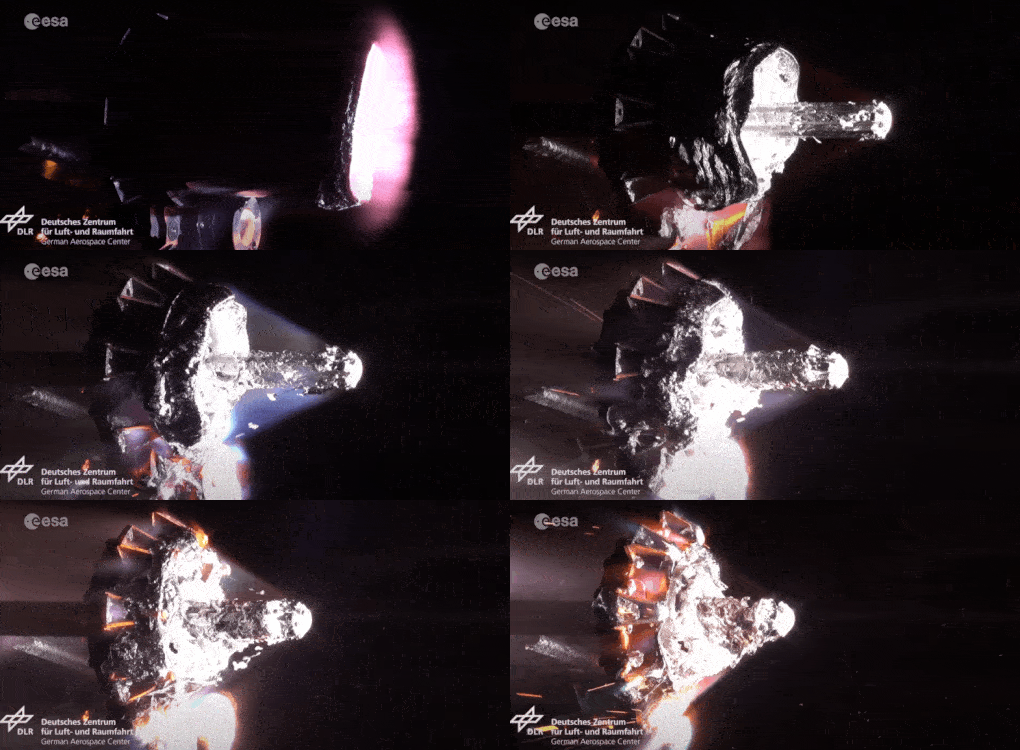
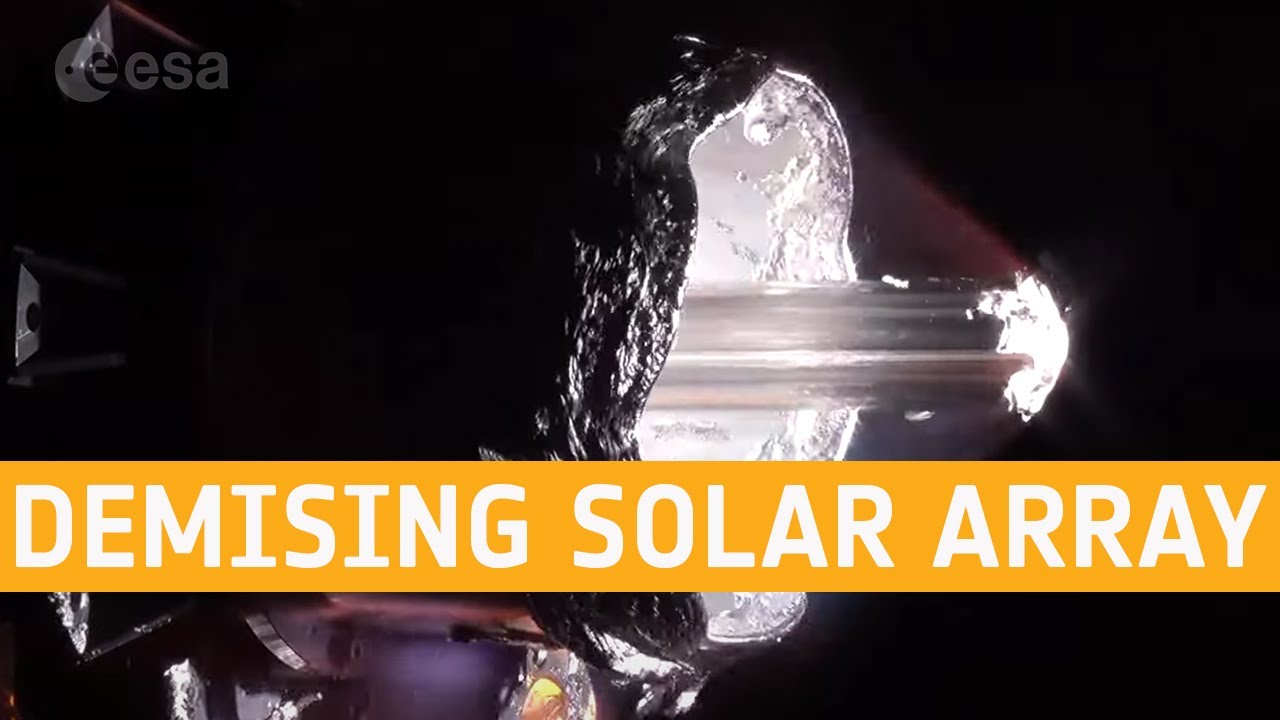
A plasma wind tunnel completely vaporizes a model of a satellite in a video from the European Space Agency (ESA), demonstrating how the speed and heat of atmospheric reentry can obliterate even the bulkiest parts of space satellites.
That utter destruction is a good thing.
Here's why: Fast-moving space debris entering Earth's atmosphere could pose a serious hazard if that space junk survives the stresses of reentry. By testing satellites' heat thresholds, engineers can design spacecraft that are robust enough to do their job but that will also safely burn up in the atmosphere during their fall to Earth, ESA representatives said in a statement.
Latest Videos FromLive Science
Related: Interstellar space travel: 7 futuristic spacecraft to explore the cosmos
After a satellite's mission is complete, its operators can remove the object from orbit by using its control system to lower the satellite's perigee, or the orbital point closest to Earth, in what is known as a controlled reentry. When the perigee is low enough, gravity then takes over and pulls the spacecraft down, according to ESA. This method causes the satellite to reenter the atmosphere at a steep angle, thereby ensuring that the debris will then strike an area that's relatively small. Satellite operators typically target the open ocean, to minimize the risk to people, according to ESA.
By comparison, uncontrolled reentries do not send the satellite to a designated landing area. But in order for an operator to send a satellite plummeting into Earth's atmosphere in an uncontrolled descent, federal satellite-regulating agencies require proof that the casualty risk from impacts is lower than 1 in 10,000, according to ESA.
To achieve that degree of certainty, engineers must show that all the parts of the falling satellite will burn up before they get close to the ground — as seen in the meltiness of the satellite in footage filmed inside a test chamber belonging to the German Aerospace Center (DLR), in Cologne, Germany. Scientists there simulated atmospheric reentry conditions using gas heated by an electric arc to temperatures of more than 12,000 degrees Fahrenheit (6,700 degrees Celsius), according to the DLR's Institute of Aerodynamics and Flow Technology.
In the ESA video, a solar array drive mechanism (SADM) — the part of a satellite that directs the position of its solar panels, and one of the bulkiest portions of a typical satellite — enters the plasma wind chamber. Experiments to make the SADM more vulnerable to atmospheric destruction began a year earlier. In the first stage, researchers built software models of the SADM that tested the melting point of a new type of aluminum screw.
Scientists then built a physical 3D model of the SADM using the new aluminum screws, putting it to the test inside the plasma chamber. The model encountered wind speeds of thousands of miles per hour, reproducing conditions comparable to atmospheric reentry, and the result was a vaporized SADM — just as the software models predicted, ESA representatives said.
Satellite-melting experiments such as this are also part of an ESA program called CleanSat, in which the agency is investigating and testing new technologies so that future designs of low-orbiting satellites will follow a grim-sounding concept: "D4D," or "Design for Demise," according to ESA.
Originally published on Live Science.