Get the world’s most fascinating discoveries delivered straight to your inbox.
You are now subscribed
Your newsletter sign-up was successful
Want to add more newsletters?
Join the club
Get full access to premium articles, exclusive features and a growing list of member rewards.
An account already exists for this email address, please log in.
Norway's Dragon's Eye: The fantastical 'pothole' that emerged from ice 16,000 years ago
Norway's photogenic "Dragon's Eye" likely formed around 20,000 years ago, when all of Scandinavia sat beneath an enormous mass of ice called the Fennoscandian Ice Sheet.
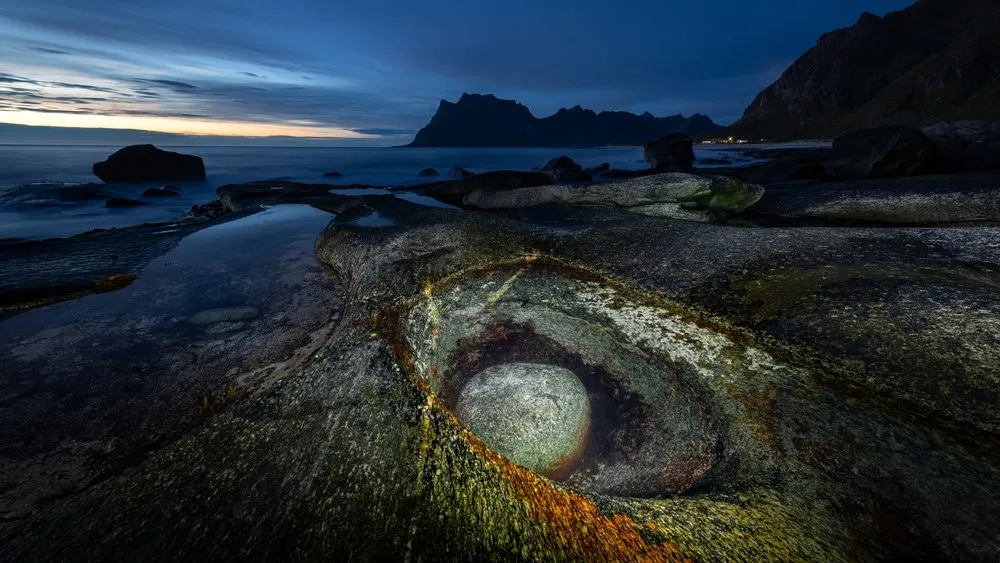
Why it's incredible: White sand, algae and a big boulder give this natural landform its distinctive eyelike appearance.
"Dragon's Eye" is a natural hollow in the rocks along Norway's northwestern coastline that looks just like a reptilian oculus. A boulder that sits at the bottom of the hollow stands out against a bed of white sand and algae, forming the eye's pupil.
"The Dragon Eye is a natural feature that very likely formed beneath the large Fennoscandian Ice Sheet, possibly during the last ice age," Francis Chantel Nixon, an associate professor of physical geography and quaternary geology at the Norwegian University of Science and Technology, told Live Science in an email. "This specific type of glacial landform is called a pothole."
The Fennoscandian Ice Sheet was an enormous glacier that blanketed Scandinavia, as well as parts of Northern Europe and northwestern Russia, during the last glacial maximum, around 20,000 years ago. Glaciation can lead to all kinds of geological formations, including features called plastic forms, or p-forms, which result from erosion of the bedrock beneath the ice sheet, Nixon said.
"P-forms are created by meltwater full of abrasive sediments," Nixon said. These sediments include rocks of all shapes and sizes, ranging from fine sand to giant boulders. High-pressure meltwater currents moving beneath the ice may "sculpt the bedrock into smooth-walled depressions, which can be straight, curving or circular, and on the order of centimeters to several meters in width and depth," Nixon said.
Geological features like Norway's Dragon's Eye are called potholes. Dragon's Eye measures roughly 5 feet (1.5 meters) across.
(Image credit: Ruslan Kalnitsky/Alamy Stock Photo)
Potholes like Dragon's Eye are a type of p-form thought to be shaped by particularly turbulent meltwater currents that concentrate abrasion and erosion in circular patterns. "When the meltwater eventually slows down or disappears, the coarse sediments will settle out of suspension and become trapped inside the pothole," Nixon said, adding that this might be how a boulder came to sit at the bottom of Dragon's Eye.
Dragon's Eye probably emerged from beneath the ice around 16,000 years ago, when deglaciation occurred in the surrounding region, Nixon said. The retreat of the Fennoscandian Ice Sheet exposed the bedrock and its potholes, which are made of gneiss, a type of metamorphic rock with colorful mineral bands that add to the fantastical appearance of the eye.
Sign up for the Live Science daily newsletter now
Get the world’s most fascinating discoveries delivered straight to your inbox.
The eye, which measures roughly 5 feet (1.5 meters) across, looks different depending on the time of day and the tides. At high tide, waves wash over the rocks, episodically depositing and removing sand from the hollow, so that the boulder sometimes sits on bare bedrock. The algae inside the eye also looks different depending on the time of year and the light.
Discover more incredible places, where we highlight the fantastic history and science behind some of the most dramatic landscapes on Earth.
Sascha is a U.K.-based staff writer at Live Science. She holds a bachelor’s degree in biology from the University of Southampton in England and a master’s degree in science communication from Imperial College London. Her work has appeared in The Guardian and the health website Zoe. Besides writing, she enjoys playing tennis, bread-making and browsing second-hand shops for hidden gems.