













Gulf Stream's fate to be decided by climate 'tug-of-war'
New research suggests that runoff from the Greenland Ice Sheet could prevent icebergs from disrupting key ocean currents. But some scientists have cautioned that other factors may be at play.


The fate of the Gulf Stream will be decided by a "tug-of-war" between two types of melting from the Greenland Ice Sheet, a new study suggests.
Throughout the last ice age, between 16,800 to 60,000 years ago, fleets of icebergs launched from the coast of North America, causing vital ocean currents to weaken dramatically.
Now, researchers have found that, despite the present-day calving rates of icebergs from the Greenland Ice Sheet being as high as they were during some of these past events, runoff from Greenland's coasts may halt this disruption. The researchers published their findings May 30 in the journal Science.
"There's a tug-of-war between the more effective but decelerating ice discharge and less effective accelerating runoff," lead author Yuxin Zhou, a postdoctoral researcher at the University of California, Santa Barbara, told Live Science. "Those are the two influences that we're primarily worried about."
The Atlantic Meridional Overturning Circulation (AMOC), which includes the Gulf Stream, governs the climate by bringing nutrients, oxygen and heat in tropical waters north and cold water south. The current can exist in two stable states: a stronger, faster one that we rely on today, and another that is much slower and weaker.
Climate change is slowing this flow by sending fresh water from Greenland's melting ice sheet to make the water less dense and less salty. This has led to a growing number of studies suggesting that the current is slowing and could even be veering toward collapse.
The discharge of icebergs from the Laurentide Ice Sheet — which covered most of North America during the last Ice Age — are known as Heinrich events. The present-day cause of this melt is climate change, but during the last glacial maximum it likely resulted from a mixture of ocean heating and the weight of ice accumulating on the sheet.
Get the world’s most fascinating discoveries delivered straight to your inbox.
This led icebergs to slide into the sea and fresh water to cascade from the shelf, both of which caused the AMOC to weaken dramatically over a few hundred years.
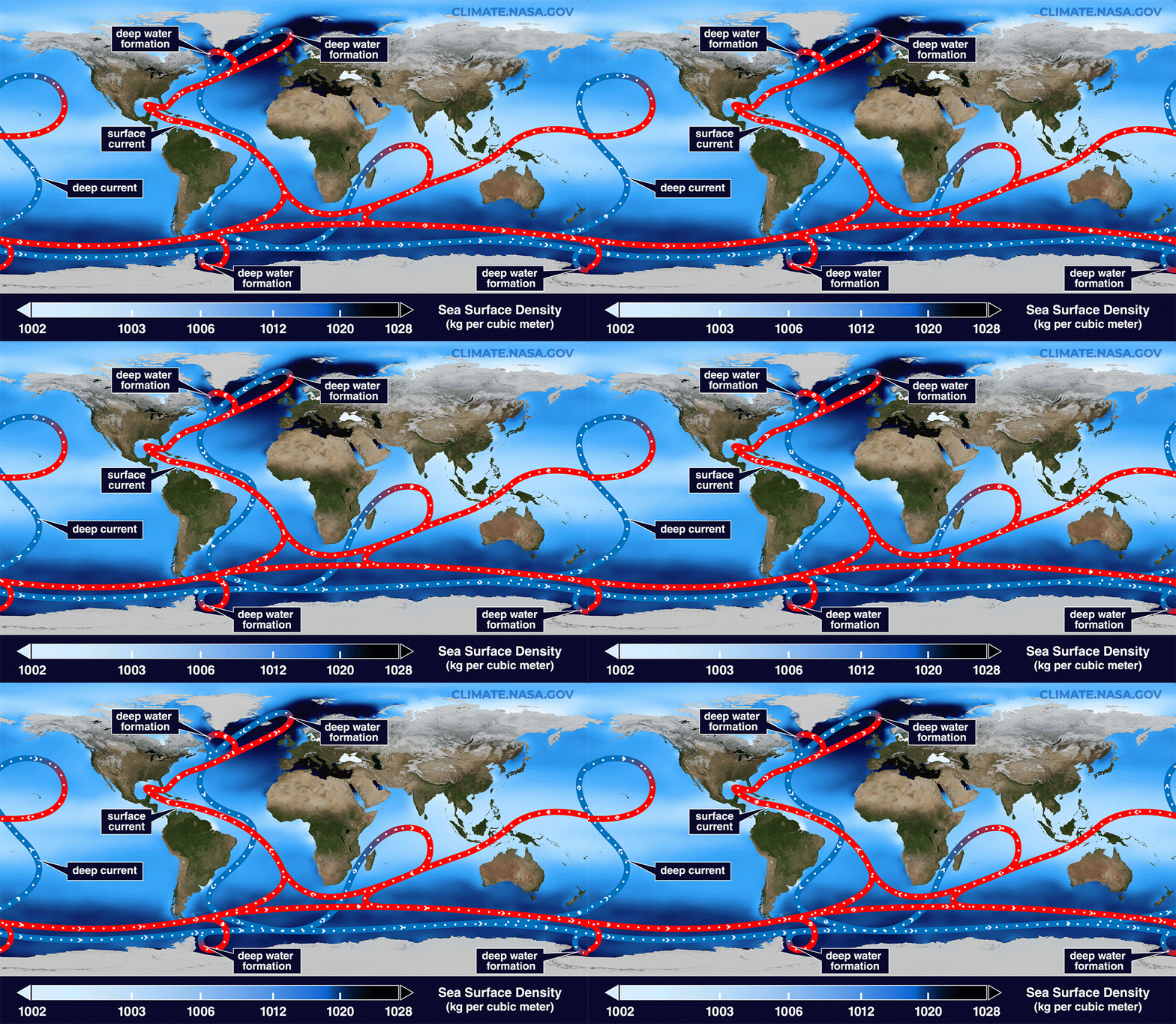
A simplified animation of the global AMOC "conveyor belt", with surface currents shown in red and deep sea ones in blue.
To assess whether icebergs calving from Greenland could trigger a collapse of the AMOC in the present day, Zhou and his colleagues studied sediment layers deposited by past Heinrich events. The researchers focused on thorium-230, a form of the radioactive element produced in seawater at a steady rate. This means its concentrations are detectably diluted by fresh meltwater from icebergs.
By comparing their results with predicted ice outflow from Greenland, the researchers found that modern-day climate change (taken since the Industrial Revolution) was comparable to a "midrange" Heinrich event.
But there are key differences between then and now. During the last ice age, the slowdown of the AMOC had started before icebergs started calving. And, despite having more variability than previously thought, the AMOC is currently in a "pretty healthy state" without significant slowdown, Zhou said.
Zhou said that the changes we're seeing today are governed by the relationship between iceberg calving and freshwater melt straight from the shelf. Icebergs are the most significant factor in this slowdown, while runoff plays a secondary role. But while melt does cause some slowdown, it also slows iceberg production, creating the tug-of-war whose interplay will decide the AMOC's future.
But if the AMOC is taken to be starting today from a stronger position than it did in ancient times, that could be a reason for cautious optimism, Zhou said.
"It's going to become more and more clear in the future as more studies come out," Zhou said. "But I do think, in the near term before 2100, our study says that the AMOC is probably not going to be severely weakened."
RELATED STORIES
However, the researchers noted that their study does not factor in other effects from the warming of the ocean and the Arctic. This means other climate scientists have cautioned against uncritically applying the research's assumptions to the present day.
"A big issue is that how the AMOC behaved (and responded to meltwater) during the last Ice Age is likely to be very different to today," David Thornalley, a professor of ocean and climate science at University College London, told Live Science. "The ocean-atmosphere climate system behaves differently if you have massive ice sheets in North America and meltwater is entering the ocean in different places."
These differences, when paired with recent studies that suggest AMOC has already weakened and may even be approaching a tipping point, could prove crucial, Thornalley said.
"There is loads we still need to work out to be confident about future AMOC behavior: how good our models are; how easily the modern AMOC can be destabilized; [and] there might be unexpected surprises, good or bad," Thornalley said. "But there are enough reasons to be concerned about the AMOC, and we should apply the precautionary principle — we really don't want to see firsthand the climate impacts of an AMOC collapse. It is just one of many climate impacts we should do all we can to avoid."

Ben Turner is a U.K. based writer and editor at Live Science. He covers physics and astronomy, tech and climate change. He graduated from University College London with a degree in particle physics before training as a journalist. When he's not writing, Ben enjoys reading literature, playing the guitar and embarrassing himself with chess.