













Scientists just made the largest quasicrystal ever — because one of them bet it couldn't be done
The quasicrystal, a type of non-repeating crystal once deemed impossible, was made by jiggling thousands of metal balls in a tray for over a week.

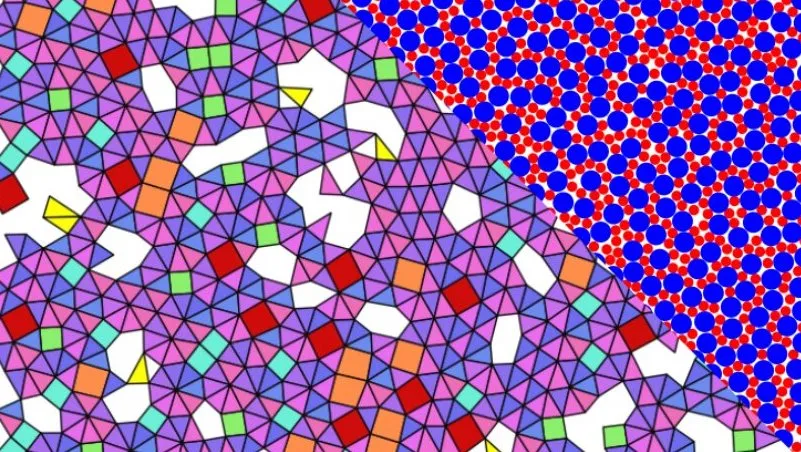
By jiggling thousands of metal beads in a tray for a week, researchers have created the largest-ever quasicrystal — a structure that scientists previously considered impossible.
First represented in the irregular, non-repeating tile patterns of early Islamic art, quasicrystals are crystals whose atoms fit into an ordered arrangement and yet, fascinatingly, never repeat. They are crystals, yet they stubbornly break the rules of symmetry once used to divide traditional crystals from more chaotically structured solids.
First theorized in 1981 and discovered in 1982, the once-controversial structures got the scientist who found them booted from his lab for defending his discovery — before later earning him the 2011 Nobel Prize in chemistry.
Now, scientists have created the biggest-ever quasicrystal from similarly contentious circumstances — as a consequence of a bet made between the lead researcher and a colleague about whether the experiment would work. The researchers published their findings July 4 on the preprint server arXiv; the paper has not been peer-reviewed yet.
Since their discovery, hundreds of quasicrystals have been made in labs, and some have even been discovered in nature. Yet they are all fairly small and made from particles between micrometer and nanometer scales — or between 0.001% and 1% of a hair's width. The scientists wanted to see if they could make quasicrystals that were thousands of times bigger.
RELATED STORIES
To investigate how big the particles inside a quasicrystal could feasibly get, the researchers ran computer simulations to find the best types of particles to form a large quasicrystal. Their results indicated that two particles should be used: one 2.4 millimeters (0.09 inch) in diameter and one with a diameter of 1.2 mm (0.047 inch).
Get the world’s most fascinating discoveries delivered straight to your inbox.
After placing roughly 4,000 steel spheres of both sizes into a shallow container, the researchers set the spheres to jiggle and jostle at a rate of 120 times per second for a week and filmed the process as it occurred. After reviewing their experiment, the researchers wrote in their paper, "an interesting picture seems to emerge."
The spheres had arranged themselves into the tiled, non-repeating structure of a quasicrystal composed of three basic parts: large spheres in a square with either one or four smaller spheres plopped in the middle, and large spheres forming triangles with smaller spheres in their centers.
Most of the practical applications for quasicrystals are still a long way off, but their unique properties could allow them to shield objects from heat, reinforce steel and repair broken bones. Further research into this new crystal and its similarities to other quasicrystals could bring these possibilities closer to reality.

Ben Turner is a U.K. based writer and editor at Live Science. He covers physics and astronomy, tech and climate change. He graduated from University College London with a degree in particle physics before training as a journalist. When he's not writing, Ben enjoys reading literature, playing the guitar and embarrassing himself with chess.