















'Can you predict the future? Yes, of course you can.': Inside the 1 equation that can predict the weather, sporting events, and more
"Life isn’t chess, a game of perfect information, one that can in theory be 'solved.' It's poker, a game where you're trying to make the best decisions using the limited information you have. "

Whether the sight of an equation makes you jump for joy or run to the hills, there is no doubting that so much of science is guided by the principles laid out in these beautiful collections of symbols and numbers. But from medical testing to artificial intelligence, one mathematical rule guides much of the modern world — Bayes' theorem.
To this day, the seemingly simple equation, developed by an 18th-century Presbyterian minister and amateur mathematician, is used in modeling and forecasting to help us predict everything from future weather events, fluctuations in the stock market to the winners of sporting events.
The book "Everything is Predictable," by award-winning science writer Tom Chivers is a captivating tour of this curious theorem and how it impacts modern life, and has been shortlisted for the prestigious 2024 Royal Society Trivedi Science Book Prize. Below is a short excerpt from the book's introduction, which explores to what extent we can predict the future.
Related: 32 sci-fi technology predictions that came true
Can you predict the future? Yes, of course you can.
You can predict with near-certain accuracy that in the next few seconds, you'll take a breath, and let it out again. Your heart will beat, somewhere between one and three times a second. Tomorrow morning, the sun will come up, at a particular time which depends upon your latitude and the time of year but which nonetheless you can find out with great accuracy. All of these events you can predict with confidence.
You can also predict that the train will arrive at a certain time, or that your friend will arrive on time at the restaurant at which you've arranged to meet her. Though, depending on the rail company, or your friend, you might be less confident in that.
Get the world’s most fascinating discoveries delivered straight to your inbox.
And you can predict that the world's population will continue to grow until around the middle of the century, and then start to fall again. You can predict that global average surface temperatures in the year 2030 will be higher than they were in the year 1930.
The future isn't opaque. You can see into it. Some parts are more predictable than others – the Newtonian dance of the planets we can predict out for thousands of years; the Lorenzian chaos of the weather, really only a few days. But you can peer through the murk, after a fashion.
That's not what people normally mean when they say, "I can predict the future." They are referring to something mystical, some psychic or magical vision. We probably can't do that. (You'll read about a scientist in this book who thinks we can, and you’ll also read about why he's almost certainly wrong.) But we don’t need to. All that we do, all the time, is predict the future. We couldn’t function if we couldn’t. We make very basic predictions, like "the air will continue to be breathable," implicitly, with every breath we take. We make more complex predictions, like "The corner shop will have Alpen [a breakfast cereal] when I get there," each time we make a decision. We're not basing them on mystical visions, but on information we have gathered in the past.
The thing with all these predictions is that they are uncertain. The universe may or may not be deterministic; perhaps if we had perfect, God-like knowledge of the position, movement and qualities of every particle in the universe, we could perfectly predict everything, the fall of every sparrow. But we don't. Instead, we have partial information. We can see bits of the universe, imperfectly, through our imperfect senses. We have best guesses for the way those bits move — we know the human-shaped bits tend to seek food and company; we know the rock-shaped bits tend to sit still. We can make messy, imperfect predictions with that information.
Life isn’t chess, a game of perfect information, one that can in theory be "solved." It's poker, a game where you're trying to make the best decisions using the limited information you have. This book is about the equation that lets you do that.
Excerpted from "Everything is predictable: How Bayesian Statistics Explain our World." Copyright © 2024 by Tim Chivers.
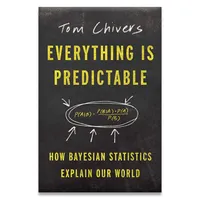
"Everything Is Predictable" by award-winning science writer Tom Chivers gives a captivating tour of Bayes' theorem and its impact on modern life, from medical testing to artificial intelligence. While Bayes was an 18th-century Presbyterian minister and amateur mathematician who lived an obscure life, today Bayesian principles are widely used in modeling and forecasting.
Tom Chivers is a science writer and author. He was given Royal Statistical Society 'Statistical Excellence in Journalism' awards in 2018 and 2020 and was declared the Science Writer of the Year by the Association of British Science Writers in 2021.
- Alexander McNamara Editor-in-Chief, Live Science