













Shimmering 'night spiral' captured above Hawaii is actually a dying SpaceX rocket
The descent looked like a 'flying whirlpool' over Hawaii.


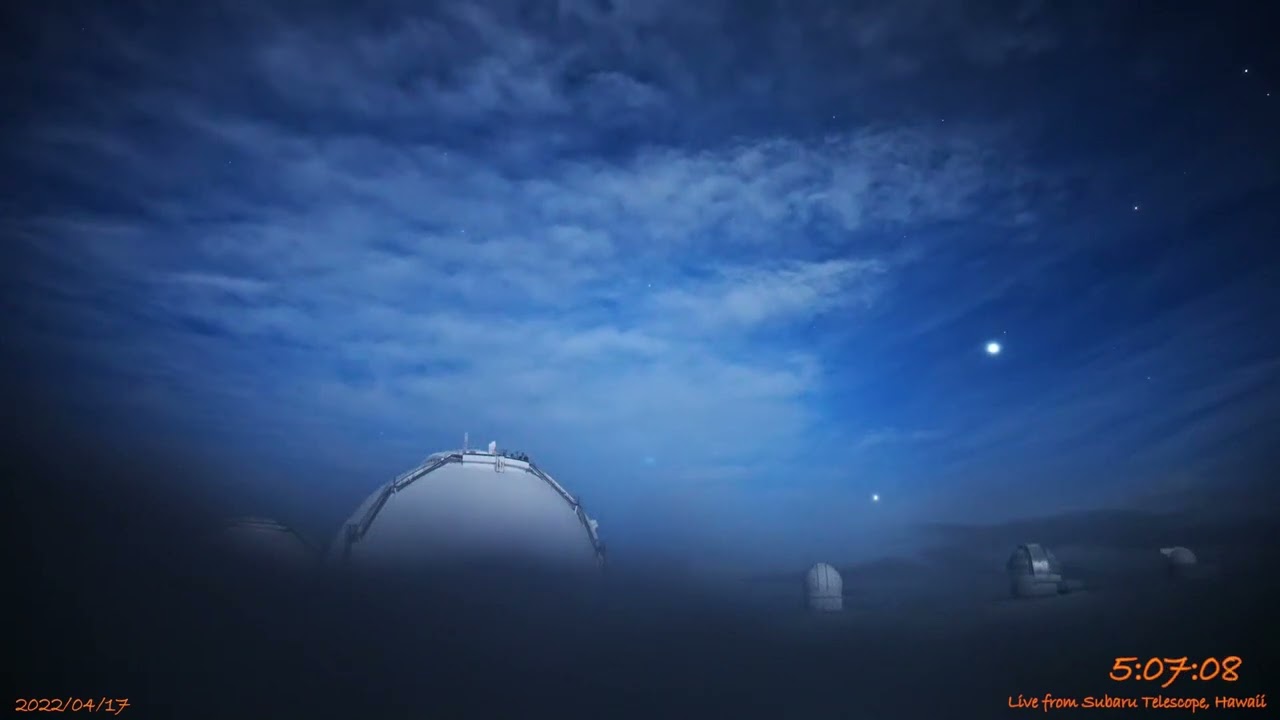
The Subaru Telescope captured video of a mysterious, glowing swirl above Hawaii on April 17, 2022.
A dying SpaceX rocket stage generated a strange and stunning "night spiral" over Hawaii.
The Subaru Telescope captured a video of the "flying whirlpool," as SpaceWeather.com termed it, on Sunday (April 17) near Mauna Kea, hours after a California-based Falcon 9 rocket successfully launched a spy satellite into orbit.
SpaceX launched the spy satellite for the U.S. National Reconnaissance Office (NRO). The Falcon 9 rocket was capped by a NROL-85 spacecraft, which lifted off at 9:13 a.m. EDT (13:13 GMT) from Vandenberg Space Force Base in California; the activity and payload of the spacecraft were classified.
The video "shows the characteristic spiral caused by the post-deorbit-burn fuel vent of the Falcon 9 upper stage, which was deorbited over the Pacific [Ocean] just after the end of the 1st revolution," Netherlands-based satellite tracker Marco Langbroek told SpaceWeather.com.
Langbroek closely watches SpaceX launches and has created stunning footage of his own that shows deploying Starlink satellites, which are used for broadband services in remote areas.
The first stage of the Falcon 9 booster is reusable, and it landed successfully atop a drone ship in the Pacific Ocean, according to SpaceX footage. The upper stage of Falcon 9 is not reusable, and after sending the spacecraft out to its assigned orbit, that stage fell back naturally in the atmosphere to burn up.
RELATED STORIES
The Subaru Telescope is an 8.2-meter optical-infrared telescope located in Hawaii and operated by the National Astronomical Observatory of Japan. The facility operates at 13,579 feet (4,139 meters) in altitude.
Get the world’s most fascinating discoveries delivered straight to your inbox.
Due to the difficulties of working in such thin atmosphere, most of Subaru's staff works remotely and only a handful of folks stay on site to operate the telescope, according to the facility website.
The Subaru-Asahi Sky Camera, which captured the footage, is an outreach camera project in collaboration with the Asahi-Shimbun, a large Japanese newspaper. The project started in 2021 to livestream the night sky, Subaru stated in a press release about the project.
Article originally published on LiveScience.

Elizabeth Howell was staff reporter at Space.com between 2022 and 2024 and a regular contributor to Live Science and Space.com between 2012 and 2022. Elizabeth's reporting includes multiple exclusives with the White House, speaking several times with the International Space Station, witnessing five human spaceflight launches on two continents, flying parabolic, working inside a spacesuit, and participating in a simulated Mars mission. Her latest book, "Why Am I Taller?" (ECW Press, 2022) is co-written with astronaut Dave Williams.