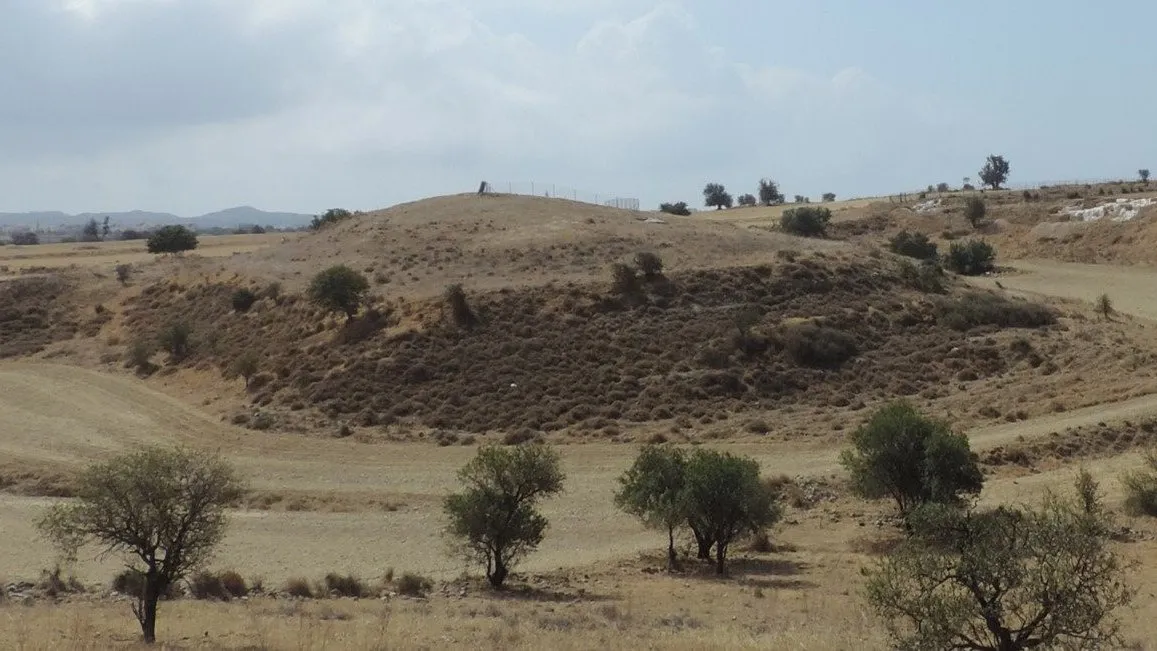
Archaeologists excavating an enormous ancient burial mound in Cyprus have uncovered an even older structure hidden beneath it: a rampart, or part of a defensive wall, according to a statement from the Department of Antiquities Cyprus.
The large mound, known as the tumulus of Laona, is longer than a football field, or 328 feet long by 196 feet wide (100 by 60 meters) and was likely built around the third century B.C., when the successors of Alexander the Great were fighting for control of Cyprus and large swaths of the empire. Researchers have been gradually excavating and digitally documenting the tumulus over the past decade. But in a new finding, archaeologists learned that the tumulus was erected on top of a broken rampart that is even older than the mound, dating to the early fifth century B.C.
Ancient people on Cyprus buried the fortress wall under about 484,000 cubic feet (13,700 cubic meters) of loose soil with sand, silt or clay, known as marl, and red soil, which had been transported from elsewhere on Cyprus for the construction of the tumulus. The Laona fortress was, therefore, well preserved under the tumulus; its northeast corner survives to a height of 20 feet (6 m), making it one of the most significant monuments of the "Age of the Cypriot Kingdoms", according to the University of Cypres Department of Antiquities.
With the "unexpected discovery" of the broken rampart under the "lasting mega-monument," it's apparent that "Laona combines two monuments that are so far unique in the archaeology of Cyprus," the Department of Antiquities Cyprus wrote in a statement posted Aug. 13 on Facebook.
An aerial view of the Laona burial mound and surrounding sites on Cyprus.
(Image credit: Department of Antiquities Cyprus)
The tumulus is located 0.6 miles (1 kilometer) northeast of the Sanctuary of Aphrodite, an ancient site dating to the 12th century B.C. "The mound/tumulus was always visible, but the locals considered it a natural hillock," Giorgos Papantoniou, an assistant professor of ancient visual and material culture at Trinity College Dublin, who was not involved in the excavation. "Its geological identification as an artificial mound was confirmed in 2011."
In 2021, the team published a study in the journal Geoarchaeology, describing the tumulus as "an accomplished architectural structure" that was built over time in several stages. "As the height of the structure gradually increased, the tumulus became an imposing physical mark that gave the landscape a new meaning," the researchers wrote in the study.
Sign up for the Live Science daily newsletter now
Get the world’s most fascinating discoveries delivered straight to your inbox.
The newly discovered rampart is Cypro-Classical, and is credited to the royal dynasty that ruled Paphos through the end of the fourth century B.C. The archaeologists report that the wall is functionally similar to and fits the same timeline as the palace and workshop complexes on the citadel of Hadjiabdoulla, which are only 230 feet (70 meters) away from Laona.
Archaeologists were surprised to find a broken rampart hidden under an ancient burial ground on Cyprus.
(Image credit: Department of Antiquities Cyprus)
The finding is part of a larger project whose "main goal is the identification of the urban structure of the capital centre of the ancient polity of Paphos," Papantoniou told Live Science in an email.
During a recent excavation, the antiquities team exposed the rampart's east side and two ancient staircases. Further analysis revealed that the rampart turned north under the highest point of the mound. "Its wall follows a descending NW course, and it is in an excellent state of preservation," the team said in the Facebook statement.
The rare defensive monument is 16 feet (5 m) wide and made of mold-made mud bricks between two parallel walls of unworked stone. Currently, the wall is 525 feet (160 m) long; its internal area is at least 18,729 square feet (1,740 square m), the University of Cyprus reported in the statement.
Investigations at the base of the wall suggest that ancient people leveled the ground to start the project. On top of this leveled ground is a thick layer of river pebbles, followed by a layer of red soil containing sherds, or broken pieces of pottery, according to the statement.
"The tumulus was constructed with local soils and sediments, but since there are no tumulus builders recorded from ancient Cyprus, the engineers with the required expertise must have been non-Cypriots, maybe Macedonians," Papantoniou said.
Further excavation of parts of the rampart — such as the northern staircase — has been halted for now due to safety concerns. Moving forward, the Laona project will focus on the tumulus. The enormous burial mound's construction would have required a huge and experienced workforce led by expert engineers, the researchers said. Further research at Laona will try to prove that it is a burial mound and attempt to identify who was behind its construction.
Donavyn Coffey is a Kentucky-based health and environment journalist reporting on healthcare, food systems and anything you can CRISPR. Her work has appeared in Scientific American, Wired UK, Popular Science and Youth Today, among others. Donavyn was a Fulbright Fellow to Denmark where she studied molecular nutrition and food policy. She holds a bachelor's degree in biotechnology from the University of Kentucky and master's degrees in food technology from Aarhus University and journalism from New York University.