













Large Hadron Collider breaks new record only days after it reopens
After a 3-year shutdown, LHC is once again smashing atoms together.

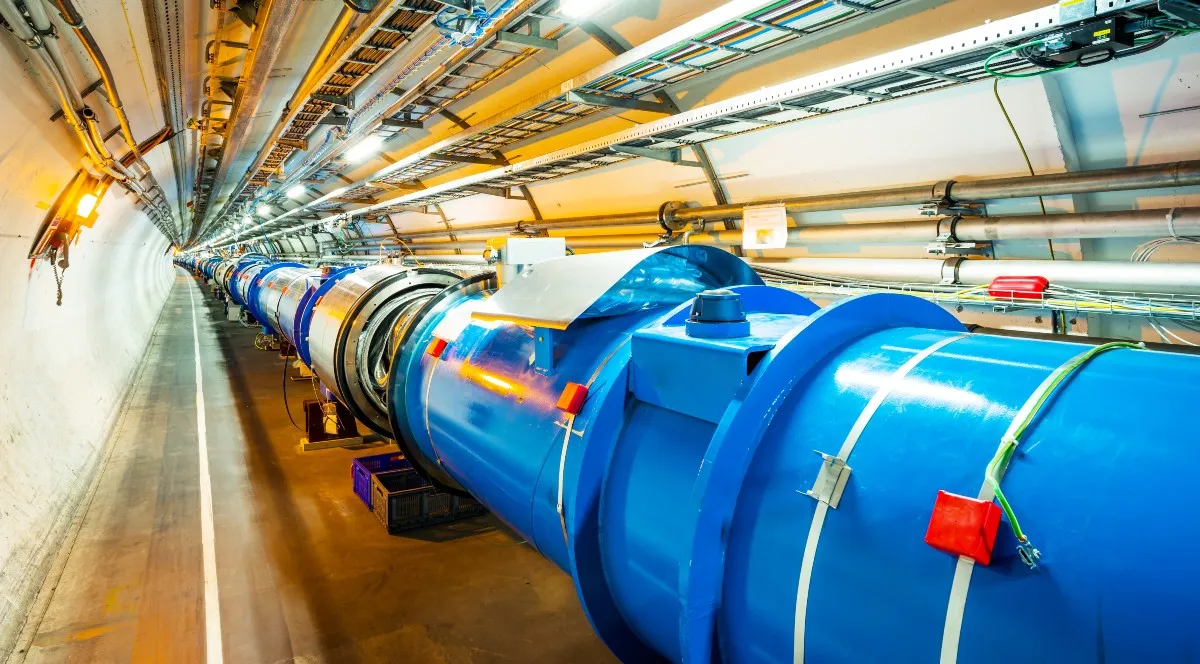
After a three-year hiatus, the world's most powerful particle accelerator is back in business and already breaking records.
The Large Hadron Collider (LHC) — which is operated by the European Council for Nuclear Research (CERN) — is the world's largest particle accelerator and consists of a 17-mile (27 kilometers) ring of superconducting magnets buried between the border of France and Switzerland. LHC uses these magnets to accelerate and smash together protons and ions to almost the speed of light, to help scientists understand particle physics, including the origin of mass, dark matter and antimatter, according to CERN.
However, over the past three years, the LHC has been closed for maintenance and repairs.
"The machines and facilities underwent major upgrades during the second long shutdown of CERN's accelerator complex," CERN's Director for Accelerators and Technology, Mike Lamont said in a statement. "The LHC itself has undergone an extensive consolidation program and will now operate at an even higher energy and, thanks to major improvements in the injector complex, it will deliver significantly more data to the upgraded LHC experiments."
Now, beams of protons are once again circulating LHC after it reopened on April 22 and the LHC upgrades are already paying off.
Related: 'X particle' from the dawn of time detected inside the Large Hadron Collider
After only three days of reopening, two beams of protons were accelerated to record energy of 6.8 trillion electronvolts per beam, according to a video announcing the milestone. The previous record occurred during the LHC's second run in 2015 when it reached energy levels of 6.5 TeV.
Get the world’s most fascinating discoveries delivered straight to your inbox.
Related stories
This pilot run is the precursor to the third major run of the LHC, which is planned for this summer — called LHC Run 3. LHC scientists are gearing up to once again smash the new record by topping an energy output of 13.6 TeV, according to CERN. Along with colliding particles with greater energy, LHC scientists will collect data from more collisions than ever before. One of the experiments designed to study heavy-ion collisions — called A Large Ion Collider Experiment (ALICE) — can expect a "50 times increase" in the number of ion collisions it can record thanks to the latest upgrade, according to CERN.
LHC Run 3 is expected to last for three years until 2025, when it will once again have a prolonged shutdown between 2026 and 2030, according to the LHC schedule.
Originally published on Live Science.

Scott is a staff writer for How It Works magazine and has previously written for other science and knowledge outlets, including BBC Wildlife magazine, World of Animals magazine, Space.com and All About History magazine. Scott has a masters in science and environmental journalism and a bachelor's degree in conservation biology degree from the University of Lincoln in the U.K. During his academic and professional career, Scott has participated in several animal conservation projects, including English bird surveys, wolf monitoring in Germany and leopard tracking in South Africa.