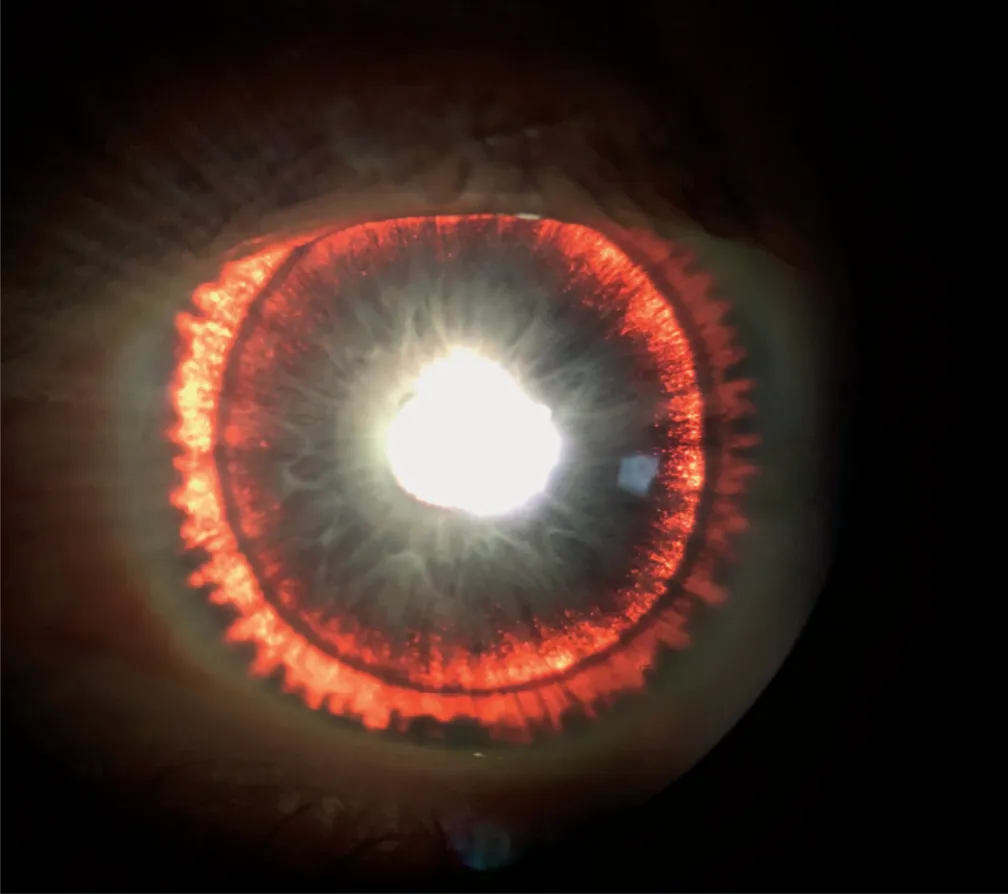
A man's eye exam showed something unusual: His iris appeared to be "glowing."
This eerie appearance turned out to be a sign of a rare disorder that caused his eye pigment to flake off, according to a new report of the case.
The 44-year-old man went to an eye clinic after he moved to a new area and wanted to get set up with an eye doctor there, according to the report, published today (Nov. 13) in The New England Journal of Medicine.
He said that he had a family history of glaucoma, an eye disease that can damage the optic nerve, the bundle of nerve fibers that connects the back of the eye to the brain. This damage is typically caused by increased pressure in the eye, and indeed, the man had already been diagnosed with high eye pressure and was taking medication to reduce it, according to the report authors, from the University of Texas Medical Branch at Galveston.
Still, tests found that the pressure in his eye was very slightly above the normal range.
What's more, when the doctor performed an eye exam, using a microscope and a bright light to view the eye, the evaluation revealed "iris transillumination" in both of the patient's eyes, the report said. In other words, light was shining through the iris, or the colored part of the eye. This happens when sections of pigment are missing from the iris, which allows light to pass through, according to the National Institutes of Health.
Sign up for the Live Science daily newsletter now
Get the world’s most fascinating discoveries delivered straight to your inbox.
The man was diagnosed with pigment dispersion syndrome. In this eye condition, pigment rubs off the back of the iris, according to the American Academy of Ophthalmology (AAO). These flakes of pigment can clog the eye's drainage system, resulting in increased eye pressure, which in turn can lead to glaucoma.
Pigment dispersion syndrome is rare, although it is more commonly diagnosed in men in their 20s and 30s and may be inherited, the AAO says.
In this case, the man underwent laser therapy to open the eyes's clogged drainage channels. This therapy helps fluid flow out of the eye and reduces eye pressure, the AAO says. However, patients often need to continue taking pressure-reducing eye medications after the surgery, as was the case for this patient, the case report said.
Rachael is a Live Science contributor, and was a former channel editor and senior writer for Live Science between 2010 and 2022. She has a master's degree in journalism from New York University's Science, Health and Environmental Reporting Program. She also holds a B.S. in molecular biology and an M.S. in biology from the University of California, San Diego. Her work has appeared in Scienceline, The Washington Post and Scientific American.