













'Cold sore' virus may have gained prominence thanks to Bronze Age smooching
Kissing may have become more common at that time.

The herpes virus behind cold sores may have first spread widely about 5,000 years ago, possibly due to the rising popularity of kissing at the time, researchers say.
"Every primate species has a form of herpes, so we assume it has been with us since our own species left Africa," co-senior author Christiana Scheib, a research fellow at the University of Cambridge's St. John's College and head of the Ancient DNA lab at the University of Tartu in Estonia, said in a statement. "However, something happened around five thousand years ago that allowed one strain of herpes to overtake all others, possibly an increase in transmissions, which could have been linked to kissing."
That's the theory, anyway. Charlotte Houldcroft, co-senior author and leader of the Virus Genomics group in Cambridge University's Department of Genetics, told The Guardian that more evidence is needed to solidify the link between Bronze Age make-out sessions and modern herpes. "Kissing is one of those behaviours that doesn't fossilise well," she said.
Herpes simplex virus 1 (HSV-1) is a type of herpes that most commonly causes cold sores, although it can also cause gential herpes, according to the World Health Organization (WHO). The lifelong infection often produces no symptoms but can sometimes cause painful blisters or open sores to appear at the site of infection. The latest estimates suggest that about 3.7 billion people under the age of 50, or about 67% of that age group, have an HSV-1 infection, and most of those affected acquire the infection in childhood or early adulthood through contact with virus-laden saliva, according to the Centers for Disease Control and Prevention (CDC).
Related: The oral and genital herpes viruses are having 'sex.' The result is worrisome.
In a new study, published July 27 in the journal Science Advances, researchers suggest that the modern HSV-1 virus outcompeted other herpes variants during the Bronze Age, after people from the steppe grasslands of Eurasia traveled to Europe in mass migrations.
For the study, the researchers analyzed traces of herpes virus DNA found in the remains of four individuals excavated in the U.K., the Netherlands and Russia. The oldest remains, excavated from Russia's Ural Mountains region, were about 1,500 years old, and the youngest, found in the Netherlands, were about 350 years old.
Get the world’s most fascinating discoveries delivered straight to your inbox.
Prior to the study, the oldest herpes genomes ever recovered only dated to 1925, Houldcroft said in the statement.
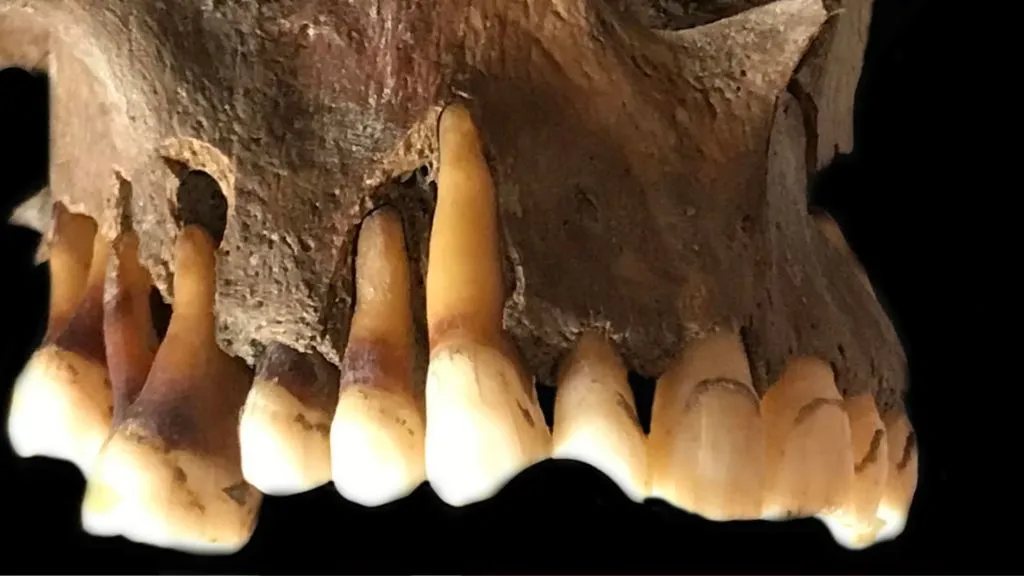
The researchers looked to the roots of these individuals' teeth to "dust" for genetic "fingerprints" of herpes viruses. Unlike bones in the body, teeth don't regenerate, meaning they don't ever replace their old cells with new ones. Because of this, and because viruses can infiltrate teeth via the bloodstream, teeth can provide a cumulative record of pathogens a person has encountered, Live Science previously reported.
RELATED STORIES
By comparing the newfound herpes DNA to that of 20th century herpes viruses, the researchers could estimate the virus's mutation rate and thus trace the evolutionary history of the pathogen. Based on this analysis, they determined that HSV-1 likely emerged roughly 5,200 years ago, give or take a few hundred years. This may have coincided with Bronze Age migrations to Europe, during which the custom of romantic and sexual kissing likely became more widespread, the authors posit.
Although some Stone Age figurines could be interpreted as couples embracing, "the earliest known written record of kissing is a Bronze Age manuscript from South Asia," the study authors wrote. The armies of Alexander the Great may have brought the custom to the Mediterranean around 300 B.C., and then in the first century A.D., "the [Roman] Emperor Tiberius is said to have tried to ban kissing at official functions in an effort to stop the spread of disease (unclear whether the disease was herpes)," the authors wrote.
This increase in kissing likely helped HSV-1 spread and gain prominence over other circulating herpes viruses, the authors argue. "If you suddenly have a group of people who are kissing, which was not a universal human behaviour, that is an extra way to spread the virus," Houldcroft told The Guardian. (Romantic kissing isn't universally practiced in modern cultures, either, according to a 2015 study published in the journal American Anthropologist.)
But again, this is just a theory. Even if romantic kissing did become more common during Bronze Age migrations, it's unclear how much influence these snogging sessions would have had on the evolution of herpes viruses. The authors note that, earlier in history, most people likely caught herpes from their family members in childhood, similar to how, in modern times, most people catch HSV-1 in childhood and not through romantic kissing.
Originally published on Live Science.

Nicoletta Lanese is the health channel editor at Live Science and was previously a news editor and staff writer at the site. She is a recipient of the 2026 AHCJ International Health Study Fellowship, with a project focused on antibiotic stewardship practices in Japan and the U.S. They hold a graduate certificate in science communication from UC Santa Cruz and degrees in neuroscience and dance from the University of Florida. Beyond Live Science, Lanese's work has appeared in The Scientist, Science News, the Mercury News, Mongabay and Stanford Medicine Magazine, among other outlets. Based in NYC, she also remains involved in dance and performs in local choreographers' work.