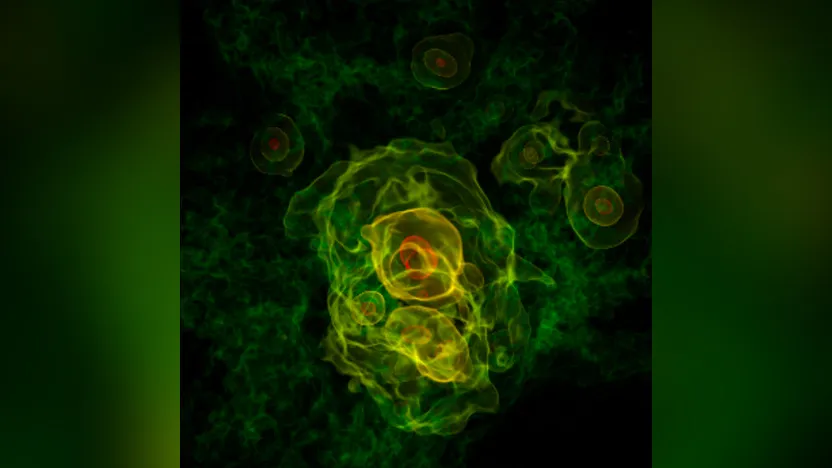
An ultra-high-resolution simulation of a tiny slice of the universe — a million times smaller than a proton — has revealed the very first structures to ever exist. And these dense structures are weird.
The first trillionths of a second after the Big Bang, the universe was a hot, soupy place, place, heated to over a trillion degrees. Though scientists can't directly observe this moment in time, they can reconstruct it using high-powered computer simulations.
The new simulations, more detailed than ever before, showed how in these first instances gravity caused quantum particles known as inflatons to lump together. The results showed for the first time how these lumps then formed complex and dense structures that weighed between a few grams to 20 kilograms — roughly heavier than a postage stamp but lighter than a bulldog — packed into a space smaller than an elementary particle.
The simulations are the first that show enough detail that scientists can decipher the range of sizes and shapes of these infant structures. Additionally, the results elegantly matched a simple theoretical model that is nearly 40 years old, said study co-author Richard Easther, a physics professor at the University of Auckland.
"We are uncovering this incredibly complex phase in the very early universe, which is only just starting to be properly understood."
The simulations modeled a time at the end of inflation, a period when the universe massively ballooned in size. At that time, the universe contained only energy and inflatons — a type of quantum matter that formed out of the energy field that filled all of space after the Big Bang.
Sign up for the Live Science daily newsletter now
Get the world’s most fascinating discoveries delivered straight to your inbox.
Physicists think the inflaton structures seen in the simulations resulted from fluctuations in that energy field immediately after the Big Bang. This same field likely created the large-scale galactic structures seen in the universe today that are billions of light-years across.
The dense inflaton-filled structures seen in the simulations likely didn't last long, as they probably turned into elementary particles within fractions of a second. But with their high densities — reaching as much as 100,000 times denser the surrounding space — their movements and interactions may have generated ripples in the fabric of space-time called gravitational waves. The new simulations will help scientists calculate exactly how big those gravitational waves may have been, which will help future experiments look for similar ripples in the universe.
The little lumps might also have collapsed under their own weight, creating the universe's first black holes, called primordial black holes. Some scientists think such black holes could be a candidate for dark matter — the mysterious substance that no one has directly seen but makes up 85% of matter in the universe today. The physicists didn't see any black holes in their simulations, but they plan to run longer, more detailed simulations in the future that could show such objects.
"The primordial black holes are an intriguing possibility at this point — they may lead to new behavior but would also provide new handles for testing the model," Easther wrote in an email to Live Science. Since some primordial black holes should persist to the present-day universe, finding one could help verify scientists' models of these early moments in the universe's infancy.
Easther and his colleagues published a paper describing the simulations March 22 in the journal Physical Review D.
Mara Johnson-Groh is a contributing writer for Live Science. She writes about everything under the sun, and even things beyond it, for a variety of publications including Discover, Science News, Scientific American, Eos and more, and is also a science writer for NASA. Mara has a bachelor's degree in physics and Scandinavian studies from Gustavus Adolphus College in Minnesota and a master's degree in astronomy from the University of Victoria in Canada.