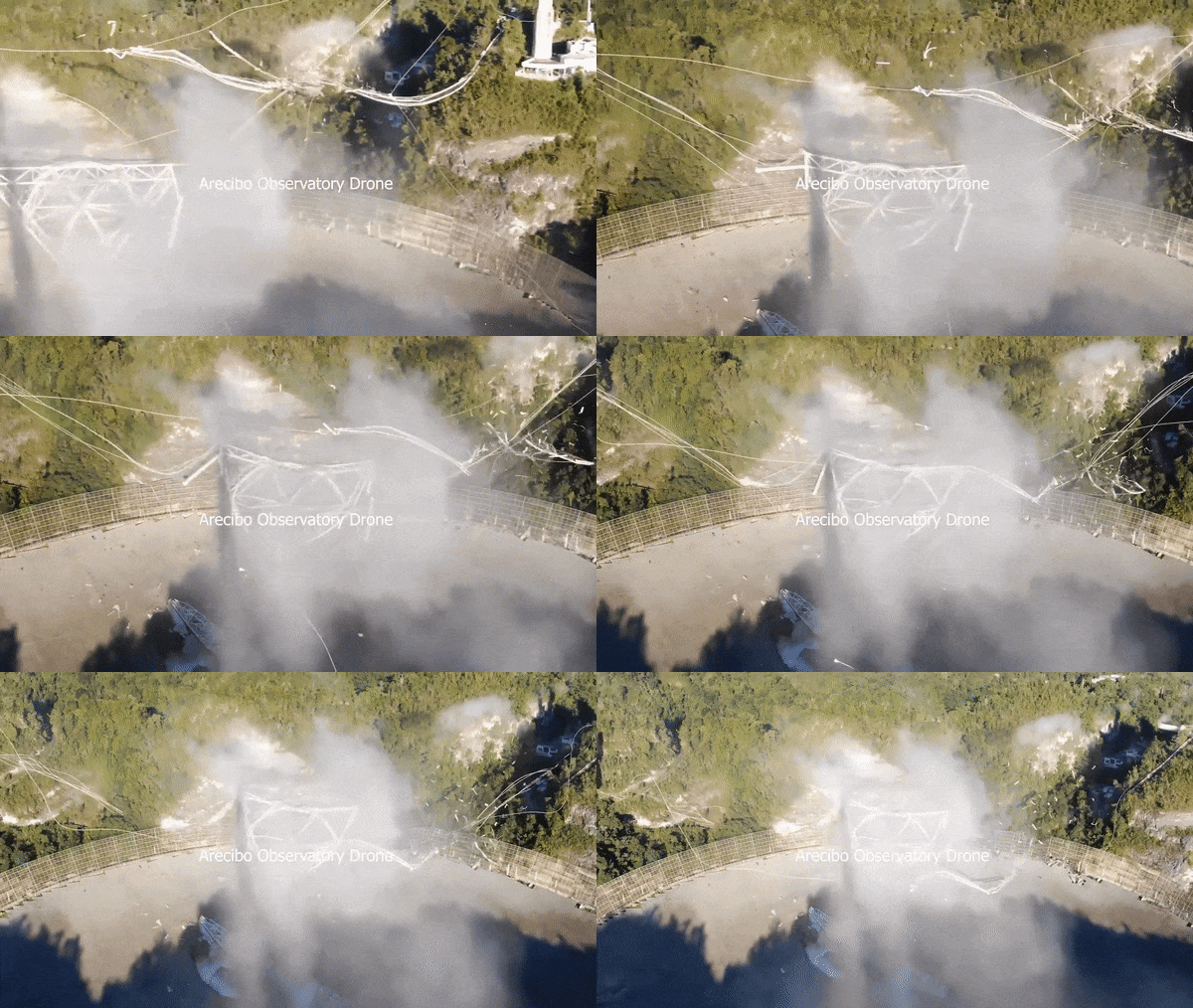
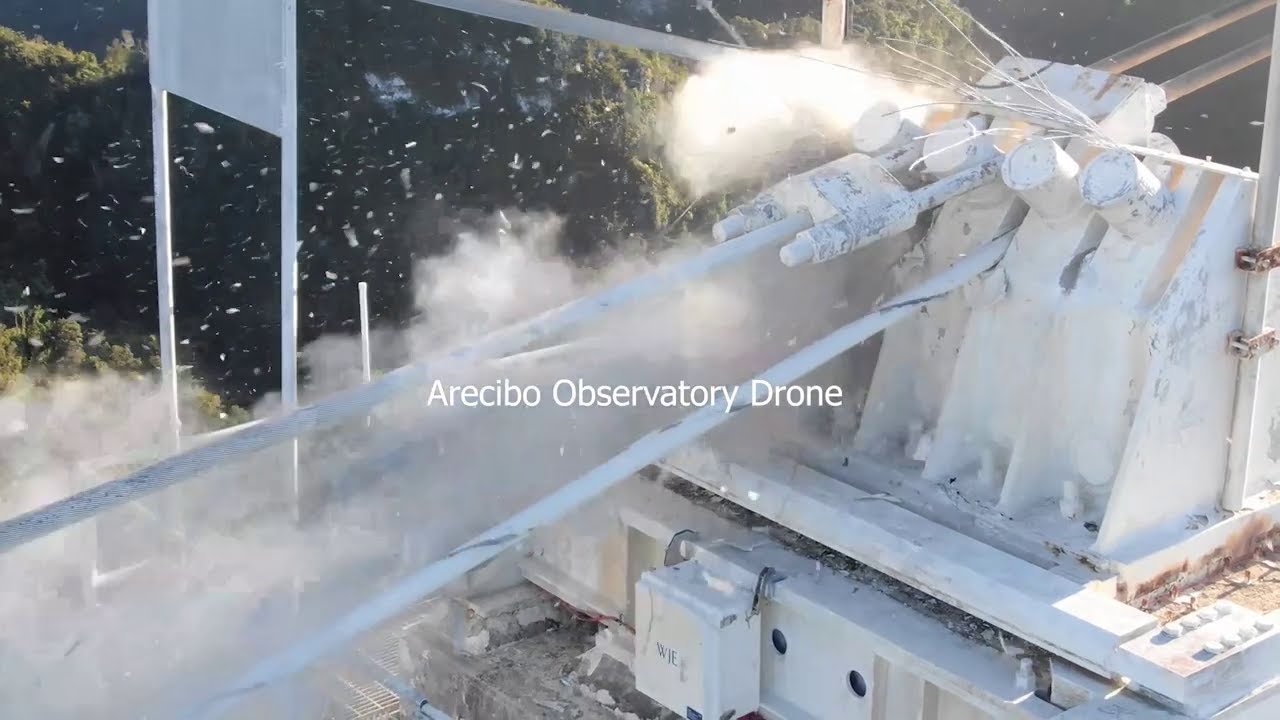
The exact moment of Arecibo Observatory's final collapse — when the cables supporting its instrument platform broke — was caught on video by a drone doing a routine inspection flyby, according to a new video released by the observatory Thursday (Dec. 3).
The footage, taken just before 8 a.m. local time in Puerto Rico on Dec. 1, shows what at first appears to be a peaceful, blue-sky morning. Then, one of the main cables holding up the suspended platform over the radio dish gives way, and the entire platform swings downward, breaking apart as it twists toward the ground.
The footage may help scientists understand what went wrong at the famous alien-searching observatory, known not just to astronomers and science enthusiasts but also to moviegoers who watched the 1995 James Bond hit "GoldenEye" and the 1997 film "Contact," based on Carl Sagan's novel.
Latest Videos FromLive Science
Related: From Big Bang to present: Snapshots of our universe through time
Scott Manley, who describes himself as an astronogamer, astrophysicist and YouTube star, posted a a 2-minute clip of the video in a tweet Thursday, saying "There was a drone inspecting the Tower 4 Cables when the collapse started so we get a close up on the cables breaking, check the second video segment."
A longer version can be seen here.
In a second tweet, Manley added, "It looks to me as if the cable is pulled from its socket rather than simply snapping."
As Live Science previously reported, the National Science Foundation (NSF) decided to decommission Arecibo Observatory even before its 900-ton (816 metric ton) instrument platform fell this week. The observatory, built in 1963, suffered substantial damage this year after earthquakes shook it in January. In August, one of its heavy cables unexpectedly snapped, tearing a 100-foot-long (30 meters) gash in the 1,000-foot-wide (305 m) radio dish. With that cable gone, the remaining cables still had to bear the heavy instrument platform that was suspended over the dish.
When another cable failed on Nov. 6, engineers realized that the other cables were likely weaker than expected, and advised that the structure could not be safely repaired, NSF reported. On Nov. 19, the NSF reported that the radio telescope would be shut down.
No one was hurt during the observatories multiple failures.
To get another view of the collapse, check out Manley's synced edited video, with "Both telescope collapse cameras synced up as best as I can tell," he tweeted.
Originally published on Live Science.