













2,000-year-old chariot unearthed at Pompeii
It was the 'Lamborghini' of its day.
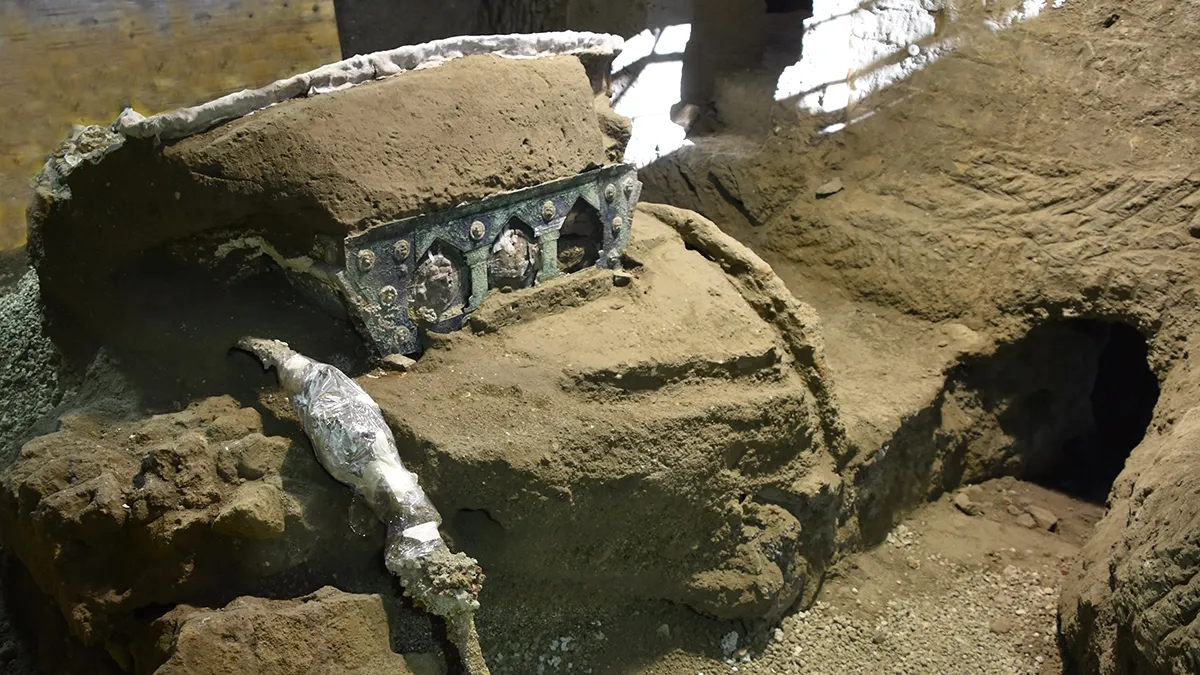
An ornate four-wheeled chariot of iron, bronze and wood that archaeologists think was drawn by a team of horses in processions through Pompeii almost 2,000 years ago has been unearthed during excavations of a wealthy Roman villa just north of the ancient city’s walls.
Archaeologists discovered the elaborate chariot, which still has imprints of organic materials such as its ropes and floral decorations, almost intact in a portico of the villa in the suburb of Civita Giuliana, facing the stables where the remains of three horses were found in 2018.
The collapsing walls and roof of the villa helped preserve the chariot from 21st-century antiquities thieves, who had dug tunnels at the site that nearly reached the chariot, according to officials at the Archaeological Park of Pompeii, which is managed by Italy's cultural heritage ministry.
Related: See photos of an early Bronze Age chariot burial
It's thought the richly-adorned chariot may have been a pilentum referred to by some sources, which was not for everyday use or for agricultural transport, but featured in community festivities, parades, and processions. It's the first time that this type of ceremonial chariot has been found in Italy, the statement said.
The exceptional preservation and the fact that the chariot would have been such a show-stopper in its day has archaeologists amazed. "I was astounded," Eric Poehler, an associate professor at the University of Massachusetts Amherst who has written about ancient Pompeii, told NPR. "Many of the vehicles I'd written about before ... are your standard station wagon or vehicle for taking the kids to soccer. This is a Lamborghini. This is an outright fancy, fancy car."
Park director Massimo Osanna said in the statement that the chariot "is an extraordinary discovery for the advancement of knowledge of the ancient world." She added, "At Pompeii, vehicles used for transport have been found [in] the past… but nothing like the Civita Giuliana chariot."
Get the world’s most fascinating discoveries delivered straight to your inbox.


View Original
View Original
View Original

View Original

View Original

View Original
View Original
View Original

Destructive eruption
The ancient city of Pompeii near Naples was destroyed when the nearby volcano Vesuviu erupted in A.D. 79, when pyroclastic flows of superheated gas spread throughout the surrounding settlements, killing more than 30,000 and burying the city under up to 10 feet (3 meters) of ash.
Parts of the buried city were discovered in the late 1500s, and scientific excavations started there in the 18th century. In the 19th century, archaeologists developed a method of injecting plaster into the voids left by the remains of the dead in the ash layer — mostly of humans, but famously also a chained-up dog.
The shapes of the three Roman horses found at Civita Giuliana a few years ago were the first time the technique had been used successfully on large mammals. Two of them had been harnessed with bits and bridles, possibly as their owner attempted to escape the destruction.
Related: Pompeii photos: Skeletal remains of victims of Vesuvius eruption
Archaeologists say most of the newly unearthed chariot has survived intact, although its materials are extremely fragile.
The shapes of the shaft and platform of the chariot, which were made of wood that has long since rotted away, and the imprint of its ropes have been preserved by injecting plaster into the voids that remain in the ash.
Among the decorations of the ceremonial chariot are medallions of satyrs and nymphs associated with Eros, the Greek god of desire and sex.
The ceremonial style of the chariot may have Greek origins; among its decorations are medallions that show figures of satyrs and nymphs associated with Eros, the Greek god of desire and sex, whose Roman counterpart was Cupid.
"One cannot exclude the possibility that this could have been a chariot used for rituals relating to marriage, for leading the bride to her new household," the statement said.
Antiquities thieves
The archaeological park at Pompeii is now a UNESCO World Heritage site that covers 170 acres (69 hectares) of the buried ancient city, but roughly 50 acres (20 ha) are still unexcavated.
The latest excavations at Civita Giuliana began after looters dug tunnels to a closed-off area in search of antiquities they could sell illegally; a police investigation that started in 2014 eventually led to the arrest of more than 140 suspects and the recovery of about 2,000 ancient artifacts.
Archaeological excavations since 2017 have revealed the looters dug an extensive network of tunnels into the ash, stealing or damaging many culturally important artifacts, the statement said.
Related content
Both the looters and the archaeologists who excavated the area initially overlooked the chariot.
They eventually found it beneath the collapsed wooden ceiling of a two-level portico that opened onto an uncovered courtyard; an upper part of the chariot was revealed only when archaeologists preserved and removed carbonized wooden beams from the ceiling that lay above it.
Scientists also used photogrammetry and laser scanning to record the elements of the chariot and the rooms that surround it; they transferred the remains of the chariot to the park's laboratory, where restorers are working to remove more volcanic material from its metal parts.
Originally published on Live Science.
Tom Metcalfe is a freelance journalist and regular Live Science contributor who is based in London in the United Kingdom. Tom writes mainly about science, space, archaeology, the Earth and the oceans. He has also written for the BBC, NBC News, National Geographic, Scientific American, Air & Space, and many others.