

-
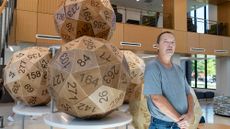 Mathematicians say these 60-sided dice are the fairest in the world
A team of mathematicians discovered that five 60-sided dice, arranged with exactly the right numbers, can determine a perfectly fair turn order for any group of players, with zero chance of a tie.
mathematics -
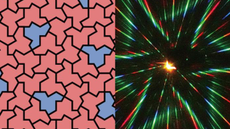 Crystal made from 13-sided 'einstein' shape bends light in ways physicists never imagined
Scientists carved a 13-sided shape called an "einstein" into a chip and discovered that it steers light in ways no other crystal does.
physics-mathematics -
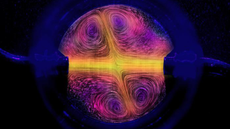 Richard Feynman's divisive 'reverse sprinkler' problem finally solved by modern lab experiments
Scientists have pinned down why a sprinkler spins when it sucks in water instead of spraying it out — a problem that stumped Richard Feynman and has divided physicists for nearly a century.
3 Commentsphysics-mathematics -
 Physicists develop the first working model of quantum mechanics using only 'real' numbers
Physicists have built a real-number version of quantum mechanics that makes all the same predictions as the standard theory, resolving a question that's simmered since the field began.
15 Commentsphysics-mathematics -
 Physicist demonstrates a key theory of time by building a 'mini-universe' in his lab
By ignoring part of his own experiment, a physicist coaxed time to emerge from within a closed quantum system.
physics-mathematics -
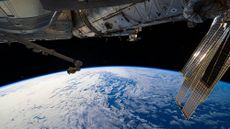 Why does metal stick together in space?
Life's Little Mysteries If you push two metal plates together on Earth, nothing happens. In space, they can fuse into one. Here's why.
2 CommentsLife's Little Mysteries -
 Water might secretly be a mix of 2 different liquids, scientists say
For decades, scientists suspected water secretly behaves like two different liquids. A new AI-powered study has finally caught it happening at the molecular level.
9 Commentsphysics-mathematics -
 Richard Feynman's forgotten notes on 'the restaurant problem' finally deciphered
Researchers cracked a 50-year-old math problem scribbled by Richard Feynman over lunch. The equations show that humans are better decision-makers than scientists once thought.
8 Commentsphysics-mathematics -
 Physicists confirm 'negative time' is real in mind-bending quantum experiment
A new experiment confirms that photons passing through a cloud of atoms can spend a negative amount of time there, and the atoms themselves are the ones saying so.
12 Commentsquantum-physics -
 Physicists entangle two moving atoms for the first time, validating 'spooky' quantum theory
For the first time, scientists have observed quantum entanglement in the momentum of massive particles. The result, decades in the making, could help physicists probe the relationship between quantum mechanics and gravity.
6 Commentsquantum-physics -
 Do you weigh more when an elevator goes up or when it comes down?
Your weight doesn't change because of gravity but because the floor pushes back. Physicists explain why elevators briefly make you feel heavier or lighter.
4 Commentsphysics-mathematics -
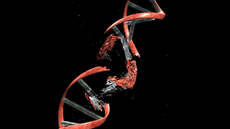 CTE may stem from rampant inflammation and DNA damage
New research shows that CTE may stem from DNA damage and inflammation set in motion by blows to the head.
neuroscience -
 For the first time, physicists peer inside the nucleus of a molecule using electrons as a probe
A novel experiment has revealed a phenomenon called the Bohr–Weisskopf effect in a pear-shaped nucleus in a molecule for the first time.
particle-physics -
 Weird symmetry between Earth's Northern and Southern Hemispheres appears to be breaking
The Northern Hemisphere is absorbing more sunlight than the Southern Hemisphere, and clouds can no longer keep the balance.
7 Commentsplanet-earth -
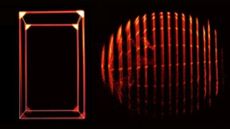 Physicists capture rare illusion of an object moving at 99.9% the speed of light
For the first time, physicists have simulated what objects moving near the speed of light would look like — an optical illusion called the Terrell-Penrose effect.
20 Commentsphysics-mathematics -
 Unique gene variants in the Turkana people of Kenya may help them survive harsh desert heat
Scientists discovered genetic variants in the Turkana that help conserve water in deserts, but these variants may now raise disease risks in urban settings, early data suggest.
genetics -
 Physicists find a loophole in Heisenberg’s uncertainty principle without breaking it
By using something called a quantum grid, scientists have found a clever way to simultaneously measure momentum and position without violating Heisenberg's uncertainty principle.
4 Commentsphysics-mathematics -
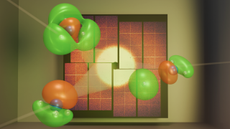 Scientists watch a single electron move during a chemical reaction for first time ever
For the first time, scientists visualized how electrons behave during a chemical reaction, which could help reduce unwanted byproducts in future chemistry.
particle-physics -
 Scientists uncover 'coils' in DNA that form under pressure
A new study shows that DNA forms coils under stress, not the tangled knots that scientists expected.
genetics -
 Why can't we walk through walls if atoms are mostly empty space?
Most of an atom is empty space, so why does some matter feel solid? Two physics principles explain why.
6 Commentsphysics-mathematics -
 Meet the 'neglectons': Previously overlooked particles that could revolutionize quantum computing
When mathematicians revived ignored mathematical structures, they found that overlooked particles, called "neglectons," could complete the quantum computing puzzle.
4 Commentsquantum


