













Legacy of shattered alien-seeking Arecibo telescope will live on for millions of years
"Lost, not forgotten."

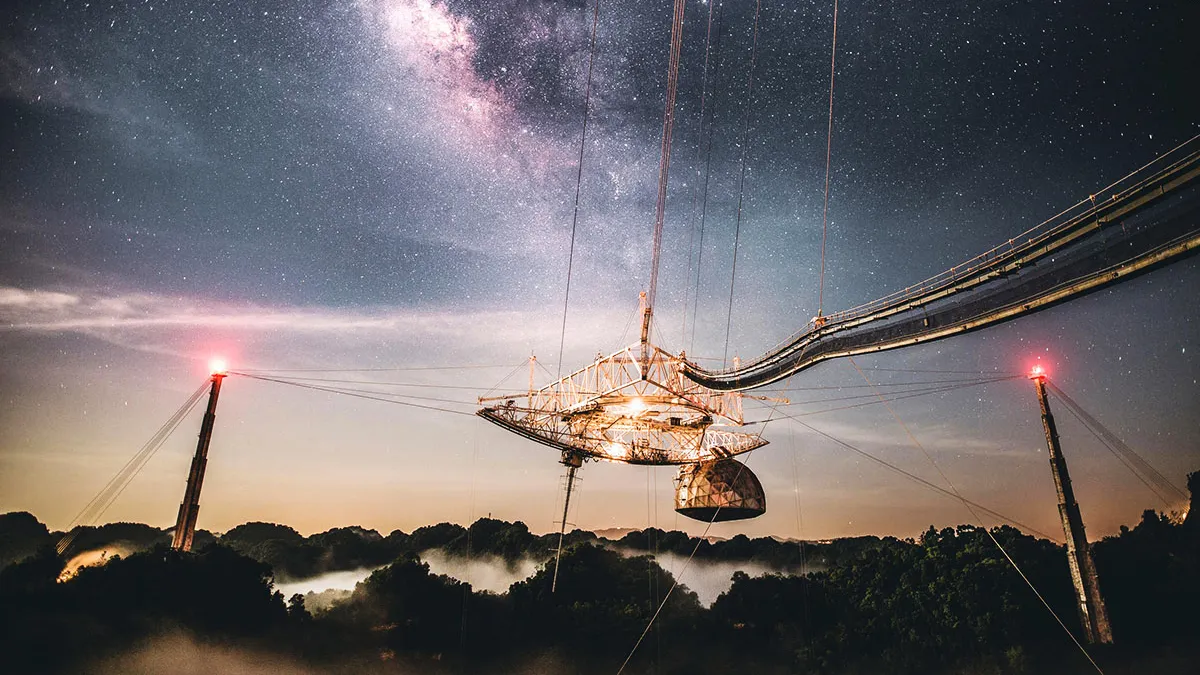
Arecibo Observatory radio telescope in Puerto Rico, which made Earth's first attempt to contact aliens, shaped pioneering cosmic research for nearly six decades. Its collapse in December last year, preceded by two cable failures and the National Science Foundation's (NSF) decision to decommission and dismantle the telescope, marked the end of an era.
Nevertheless, Arecibo leaves behind a rich legacy of scientific discovery spanning 57 years, and data collected prior to the telescope's demise will continue to inform the study of asteroids, planets and distant galaxies, researchers recently reported.
Scientists outlined Arecibo's enduring contributions to radio astronomy in a presentation on March 19 at the 52nd Lunar and Planetary Science Conference (LPSC), held virtually this year due to the COVID-19 pandemic. The presenters wrote that Arecibo left an "indelible mark on planetary science, radio astronomy, and space and atmospheric sciences," and they expressed the sorrow surrounding its collapse in a wistful haiku: "Six decades' service / Arecibo's telescope / Lost, not forgotten."
Related: Drone catches Arecibo Observatory's last moments
Constructed in 1963, the 1,000-food-wide (305 meters) Arecibo telescope dish was the biggest and most powerful radio telescope in the world. It broadcast Earth's first attempt to contact extraterrestrials — the "Arecibo Message" — in 1974, beaming a pictorial missive into space that included simple images of a human; the Arecibo telescope; the formula for DNA; a diagram of our solar system; and some of the chemicals for life, according to the Search for Extraterrestrial Intelligence (SETI) Institute.
Arecibo helped astronomers measure the rotations of Mercury and Venus for the first time. It detected the first known exoplanet orbiting a pulsar, in 1990. The observatory scrutinized Saturn's rings and mapped the surface of the moon. It even verified Albert Einstein's theory of general relativity and inferred the presence of gravitational waves, the researchers reported at LPSC.
The telescope also revolutionized the use of radar for study and tracking of asteroids that orbit close to our planet. Arecibo collected critical data on their physical properties, satellites and orbits, enabling NASA to calculate the risk an asteroid might pose to Earth, said LPSC presenter Patrick Taylor, a senior scientist with the Universities Space Research Association at the Lunar and Planetary Institute in Houston, Texas.
Get the world’s most fascinating discoveries delivered straight to your inbox.
"In the last 10 years, we greatly expanded how much observing we did of near-Earth asteroids, with Arecibo and with radar in general," Taylor told Live Science. "Arecibo is not the only facility for this, but it was by far the most powerful and the most sensitive instrument to use. We've observed hundreds of near-Earth asteroids with Arecibo," Taylor said.

Arecibo spotted the first confirmed exoplanets around the pulsar PSR 1257+12, during a sky survey in 1992.
I watched my entire professional career fall into a sinkhole.
Patrick Taylor, USPRA senior scientist
But Arecibo's work came to a crashing halt in 2020. One of the telescope's cables failed in August that year, and then another broke in November. After examining the damage and assessing the condition of the remaining support cables, NSF announced that the telescope could not be safely repaired and would be decommissioned. But on Dec. 1, another snapped cable sent Arecibo's instrument platform plummeting into the telescope dish below — a devastating sight that stunned astronomers and planetary scientists worldwide.
"I watched my entire professional career fall into a sinkhole," Taylor said. "Ever since grad school, what I did was Arecibo science. That's obviously a heavy blow to take."
By then, Arecibo had not only amassed a decades-long record of groundbreaking scientific accomplishments, it had also recorded a treasure trove of observations that will inform scientists' work for years to come, according to the LPSC presentation.
"In terms of asteroid radar, we have a tremendous archive of data that we have to keep sifting through — there's a lot of detailed modeling, especially determining the actual three-dimensional shapes of these bodies, that can be really time-consuming," Taylor said. "Even though we won't have any new data from Arecibo, we certainly have plenty of archival data that can keep us busy for a while."

Damage to the 305-meter telescope at Arecibo Observatory, after its collapse on Dec. 1, 2020. The remains of the instrument platform are visible on the telescope's dish. Photo date: Dec. 8, 2020.
RELATED CONTENT
Arecibo's legacy is also preserved in its long-standing impact on science and education for communities in Puerto Rico, the scientists said at LPSC.
"Many Boricua scientists, even those outside of astronomy and planetary science, began their paths in the fields of science, technology, engineering and mathematics with inspiration taken from the Arecibo Observatory," they wrote in the presentation.
But the most long-lived part of Arecibo's legacy may be the Arecibo Message, which will keep moving long after generations of scientists have combed through all of the telescope's data. The message is traveling at the speed of light toward its target — a cluster of 300,000 stars about 25,000 light-years (about 150 quadrillion miles, or nearly 240 quadrillion kilometers) from Earth; even after it reaches its destination, the message will continue its journey into outer space, perhaps for millions of years, the Cornell Chronicle reported in 1999, on the 25th anniversary of Arecibo's landmark broadcast.
Originally published on Live Science.

Mindy Weisberger is a science journalist and author of "Rise of the Zombie Bugs: The Surprising Science of Parasitic Mind-Control" (Hopkins Press). She formerly edited for Scholastic and was a channel editor and senior writer for Live Science. She has reported on general science, covering climate change, paleontology, biology and space. Mindy studied film at Columbia University; prior to LS, she produced, wrote and directed media for the American Museum of Natural History in NYC. Her videos about dinosaurs, astrophysics, biodiversity and evolution appear in museums and science centers worldwide, earning awards such as the CINE Golden Eagle and the Communicator Award of Excellence. Her writing has also appeared in Scientific American, The Washington Post, How It Works Magazine and CNN.