













1st-century coins from Jewish revolt against the Romans discovered near the Black Sea
Roman soldiers took coins minted by Jewish rebels in the Holy Land with them to a military camp in Georgia.

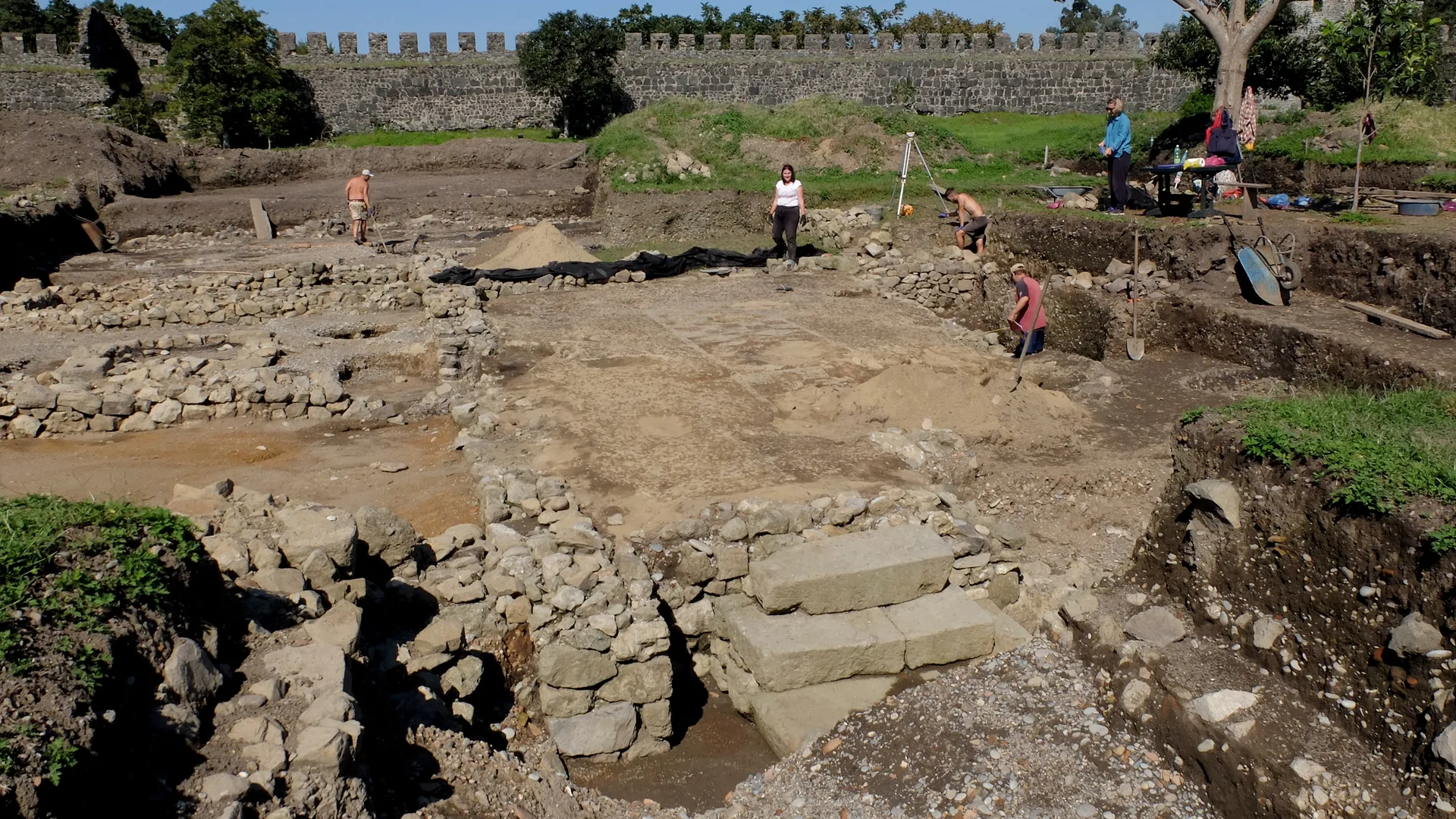
Decades after fighting Jewish rebels in the Holy Land, a Roman military unit traveled to what is now the country of Georgia, leaving coins minted in what is now Israel at one of their camps there, new research reveals.
Archaeologists discovered the Roman-era coins at Colchis, in western Georgia near the Black Sea. An analysis revealed that some of the coins were brought to the site by Legio X Fretensis, a military unit that took part in fighting Jewish rebels during the first Jewish revolt. However, it's unlikely that the Roman soldiers who fought the Jews were the same ones who left the coins at Colchis. Instead, the coins likely stayed in the unit as new soldiers joined it.
The first Jewish revolt against the Romans started around A.D. 66 and saw the Roman sack of Jerusalem and the destruction of the Second Temple in A.D. 70. The revolt continued until the Roman siege of Masada, which ended with many of the nearly 1,000 remaining Jewish defenders taking their own lives around A.D. 73 or 74, to avoid enslavement or death at the hands of the Romans.

Remains of coins brought to the site by the Legio X Fretensis.
Most of the coins used in the analysis were discovered between 2014 and 2022 by a Polish-Georgian team at the fort of Apsaros at Colchis, Piotr Jaworski, an archaeologist at the University of Warsaw who is a coin expert on the team, told Live Science in an email. The researchers found that a few of the coins were actually minted by Jewish rebels and that the Romans continued to use the currency. During the revolt, the Jewish rebels minted coins of their own that were inscribed with a variety of images, including pomegranates and chalices.
Related: When the Romans turned Jerusalem into a pagan city, Jews revolted and minted this coin
The legion would have brought the coins to the site around A.D. 115, when the Roman emperor Trajan (who reigned from 98 to 117) launched an initially successful invasion of the Parthian Empire — an action that pushed the Roman Empire's borders deep into the Middle East. Historical records and archaeological remains indicate that Legio X Fretensis was used in this invasion and spent time in Colchis. The site was "a good logistical base for military operations in the region," Jaworski said.
Related stories
While research into the site is ongoing, Jaworksi published a paper discussing some of the coin finds in 2021 in the journal Notae Numismaticae. The team found that, in addition to the Roman coins brought by Legio X Fretensis, large numbers of Roman coins were brought to the site in the first and third centuries A.D, likely by Roman soldiers.
Get the world’s most fascinating discoveries delivered straight to your inbox.
"The finds are very interesting" and provide additional information into Trajan's invasion of Parthia, Edward Dabrowa, a professor emeritus of history at Jagiellonian University in Poland who was not involved with the research, told Live Science in an email.

Owen Jarus is a regular contributor to Live Science who writes about archaeology and humans' past. He has also written for The Independent (UK), The Canadian Press (CP) and The Associated Press (AP), among others. Owen has a bachelor of arts degree from the University of Toronto and a journalism degree from Ryerson University.