Get the world’s most fascinating discoveries delivered straight to your inbox.
You are now subscribed
Your newsletter sign-up was successful
Want to add more newsletters?
Join the club
Get full access to premium articles, exclusive features and a growing list of member rewards.
An account already exists for this email address, please log in.
1,900-year-old Roman sanctuary and coin found in flooded Spanish cave
Archaeologists discovered ancient Roman inscriptions and a 1,900-year-old coin wedged between rock formations while exploring a cave called the Cova de les Dones in eastern Spain.
Archaeologists have discovered evidence of Roman occupation and ritual activity hidden inside a partially flooded cave in Spain. The remains date to about 1,900 years ago, researchers say.
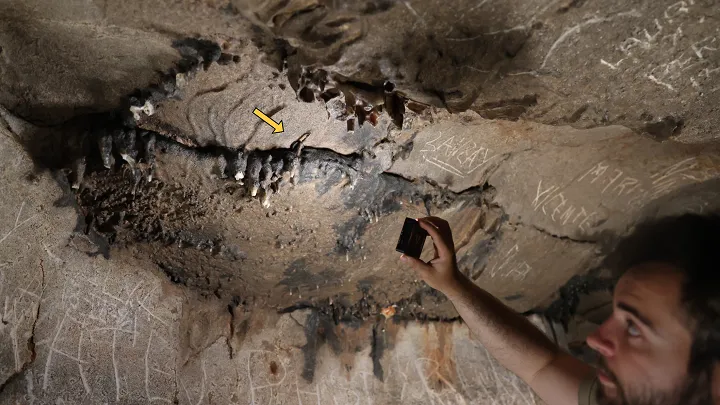
The researchers were exploring the depths of the cave, which is located in eastern Spain, by flashlight when they noticed a rusty coin wedged between a crack in the ceiling and a stalactite, according to a translated statement. Subsequent analyses revealed that the coin dates from the time of Emperor Claudius, who ruled the Roman Empire from A.D. 41 to 54. The coin was likely put there as an offering, the researchers noted.
The team also discovered 15 inscriptions that were likely carved into the rock by people living on the Iberian Peninsula during Roman occupation of the region — although the meaning behind them remains unclear. Together, the markings and the coin indicate that these people considered the cave to be a sanctuary, according to the statement.
Discoveries going back to the 1960s suggest humans have occupied the Cova de les Dones, which in Catalan Spanish means "women's cave," for thousands of years.
"The inscriptions and the coin provide irrefutable evidence that the sanctuary continued to be used or was repurposed by the Romans," Aitor Ruiz-Redondo, a professor of prehistory at the University of Zaragoza in Spain who co-led the cave exploration, told the Spanish regional newspaper Levante.
Analyses revealed that the coin dates from the time of Emperor Claudius.
(Image credit: Museu de Prehistòria de València)
The Cova de les Dones is known to hold Iron Age ceramics and prehistoric rock art, including a representation of an auroch's head and a stag. A 2023 study published in the journal Antiquity catalogued more than 110 paintings deep inside the cave. Cave bear (Ursus spelaeus) claw marks that overlap with some of the paintings suggest the art is more than 24,000 years old, because cave bears went extinct in Europe around this time, according to the study.
Sign up for the Live Science daily newsletter now
Get the world’s most fascinating discoveries delivered straight to your inbox.
A section of the Cova de les Dones holds 15 Roman inscriptions, but the meaning behind them is unclear.
(Image credit: A. Ruiz-Redondo, V. Barciela & X. Martorell)
Romans may have performed rituals in the cave during the first century A.D., the new findings indicate. "This discovery confirms the continuity of the site's ritual use throughout different historical periods," Ruiz-Redondo said.
The Roman inscriptions are located roughly 660 feet (200 meters) from the cave entrance. The Cova de les Dones consists of a single, 1,640 foot-deep (500 m) chamber and opens onto a steep canyon, according to the 2023 study.
Large sections of the cave remain unexplored, so archaeologists will likely find more evidence of ancient human activity in the coming years, according to the statement. Even the known sections of prehistoric art could yield surprises, as researchers have only studied one-fifth of the paintings in detail so far.
Roman emperor quiz: Test your knowledge on the rulers of the ancient empire
Sascha is a U.K.-based staff writer at Live Science. She holds a bachelor’s degree in biology from the University of Southampton in England and a master’s degree in science communication from Imperial College London. Her work has appeared in The Guardian and the health website Zoe. Besides writing, she enjoys playing tennis, bread-making and browsing second-hand shops for hidden gems.
You must confirm your public display name before commenting
Please logout and then login again, you will then be prompted to enter your display name.