An asteroid the size of the Eiffel Tower will zip past Earth Friday (March 5) and be out of our planetary neighborhood until 2029.
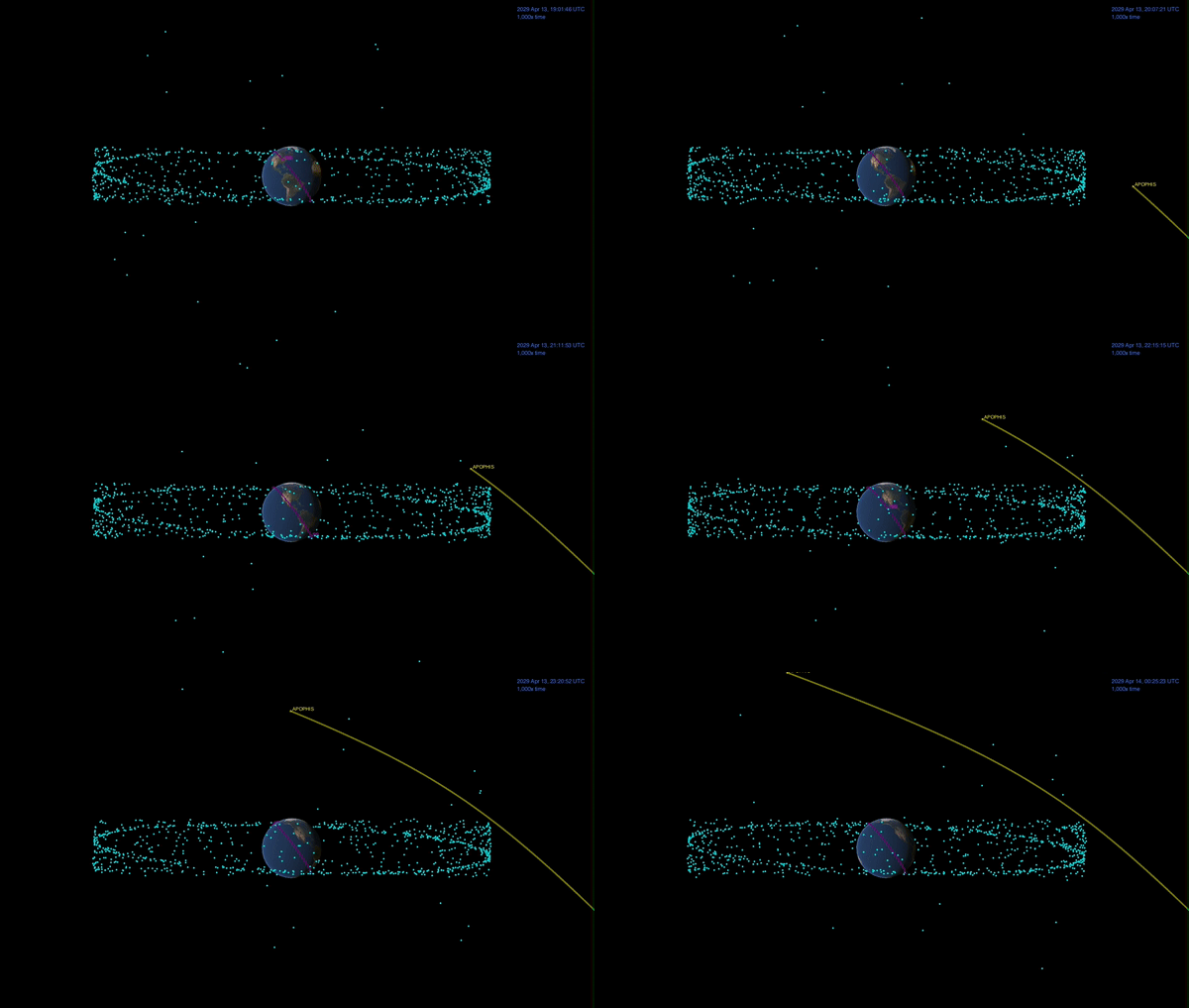
The space rock, dubbed Apophis (an ancient Egyptian demon), was first spotted in 2004 and won't pose any danger to Earth during this week's flyby; it will travel past the planet at a little more than 40 times the distance from Earth to the moon. But scientists are using this week as a dress rehearsal for the asteroid's next pass, on April 13, 2029, when Apophis will get as close to Earth as some of the highest-orbit satellites.
"Apophis in 2029 is going to be a really incredible observing opportunity for us," Marina Brozović, a radar scientist at NASA's Jet Propulsion Laboratory in California, told Live Science's sister site Space.com. "But before we get to 2029, we are preparing."
A brief flyby
Apophis is 1,120 feet (340-meter-wide) wide and made of rock, iron and nickel. It is probably shaped roughly like a peanut, though astronomers will have a better idea of its form when it passes by Earth this week, according to NASA.
The asteroid takes a full orbit around the sun about every 11 months. On March 5, it will come within 10,471,577 miles (16,852,369 km) of Earth at 8:15 p.m. EST (0115 GMT on March 6). That's too far to be seen with the naked eye, but scientists will use planetary radar to image Apophis as it flies by using NASA's Goldstone Deep Space Communications Complex in California and the Green Bank Telescope in West Virginia. They hope to determine the asteroid's shape and learn more about the way it rotates.
"We know Apophis is in a very complicated spin state, it's sort of spinning and tumbling at the same time," Richard Binzel, a planetary scientist at the Massachusetts Institute of Technology, told Space.com.
Sign up for the Live Science daily newsletter now
Get the world’s most fascinating discoveries delivered straight to your inbox.
This planetary radar study will provide researchers a baseline for the much closer fly-by in 2029, when Apophis will get as close as 19,800 miles (31,900 kilometers) to Earth. That's close enough that Earth's gravity might change the shape of the asteroid or scatter the boulders on its surface. How and if the asteroid changes as it flies by will help reveal details about the asteroid's inner structure, Binzel said.
At its closest approach in 2029, Apophis will be briefly visible to the naked eye over western Australia, growing as bright as the stars in the Big Dipper. It will be closest to Earth at 6 p.m. EDT on April 13, 2029, when it will be over the Atlantic -- an ocean it will cross in only an hour. The asteroid will cross over the United States by 7 p.m. EDT.
Apophis is named after an ancient Egyptian demon who personified chaos and evil, largely because astronomers initially calculated that there was a 3% chance the asteroid could impact Earth on its 2029 flyby. They've now shown that the asteroid won't collide with Earth in 2029, nor on its next pass in 2036. There's still a slight chance that the asteroid could hit Earth in 2068, but the 2021 and 2029 flybys should give astronomers more information with which to calculate Apophis' future.
Originally published on Live Science.
Editor's note: This article was updated to correct how close Apophis will get to Earth during its flyby.
Stephanie Pappas is a contributing writer for Live Science, covering topics ranging from geoscience to archaeology to the human brain and behavior. She was previously a senior writer for Live Science but is now a freelancer based in Denver, Colorado, and regularly contributes to Scientific American and The Monitor, the monthly magazine of the American Psychological Association. Stephanie received a bachelor's degree in psychology from the University of South Carolina and a graduate certificate in science communication from the University of California, Santa Cruz.